



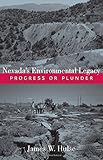
James W. Hulse. Nevada's Environmental Legacy: Progress or Plunder. Reno: University of Nevada Press, 2009. xvi + 138 pp. $24.95 (paper), ISBN 978-0-87417-769-5.
Reviewed by William Wyckoff (Montana State University)
Published on H-HistGeog (July, 2009)
Commissioned by Arn M. Keeling (Memorial University of Newfoundland)
Politics and Environment in the Silver State
Well-known Nevada historian James Hulse has focused his latest project on that state’s evolving environmental legacy. Hulse describes the history of Nevada’s resource economy, its close relationship to the land-hungry federal government, and its insatiable demands for water. The result is a highly readable, well-illustrated essay that offers state residents and a wider audience of westerners a penetrating look at the Silver State’s complex, highly politicized story of environmental change.
While Hulse notes the perspectives of many other western environmental historians such as Donald Worster, Marc Reisner, and Douglas Strong, this book is not a theory-rich foray into the drivers or the results of environmental change, but rather a more personal and historical essay that reflects the author’s familiarity with the particular people, stories, and political contexts of the Nevada setting. Because Hulse has been a long-time Nevada resident (and a professor of history at the University of Nevada-Reno), he has personally witnessed many of the events narrated in the book and he never hesitates to offer his own thoughtful interpretations about controversial issues and how they have played out within the state. Overall, the author often expresses an informed, if cynical view that private economic interests, a narrow-minded state government, and an uncaring federal bureaucracy have not traditionally placed a high value on the state’s environmental health. Why not? The author’s assessment of the contemporary scene offers this perspective: “We are in the midst of a population explosion and profit-motive mode, assuming that the bottom line is money.... The struggle to protect the natural habitat from builders, promoters, and casual polluters is never finished. Commercial imperatives will continue, and so will the resistance to uncontrolled exploitation and the efforts to reclaim some of the wild places” (p. 120).
Hulse begins his narrative with a brief overview of key land policies that have shaped Nevada’s history. Hulse assesses variables such as federal land disposal laws, railroad land grants, and shifting rangeland legislation. Next, he assesses the cumulative environmental impact of Nevada’s rich but destructive mining legacy. One strength of such a topical approach is that Hulse can in a single chapter suggest some of the common political and economic processes that drove both the early saga of Virginia City’s Comstock bonanza as well as the modern-day era of heap-leach gold mining.
Hulse devotes two chapters to Nevada’s tenuous relationship with water. He offers a fascinating tour of the state’s various watersheds, highlighting in each both historical geographies of water use and surveys of recent water-related problems. For example, we learn about the mining-related accumulations of mercury in the Carson River, the over-appropriation of Colorado River water among the western states, and the complex management issues found along the Truckee, the “aorta” of Reno’s water supply. Hulse also explores the water needs of Las Vegas and the larger environmental impacts of that exotic metropolis that increasingly dominates the state’s economic and political geography.
Hulse then turns his attention to the peculiarly pivotal role played by the federal government in the state’s environmental history, particularly when it comes to how the larger national military-industrial complex has impacted so much of the state’s most fragile and remote landscapes. These impacts accelerated in the twentieth century with the lead-up to the Second World War. Beginning with the creation of southern Nevada’s Nellis Air Force Base, huge tracts of land were withdrawn from the state’s public domain for military training and use. Massive construction projects, bombing runs, and toxic waste dumps were the environmental legacies of these initiatives. On top of that, Nevada bore an especially heavy burden as the nuclear age unfolded after the war. Hulse describes the “Faustian bargain” for the state: new jobs and employment opportunities also brought nuclear fallout and enduring ecological damage. Included in this historical narrative is a discussion of the proposal to store nuclear waste deep within Nevada’s Yucca Mountain, an idea that is still being debated today.
Hulse’s environmental portrait of the state also reminds us that much of the American West has been subjected to similar influences. Nevada’s challenges are hardly unique, but Hulse argues that for too long they have been largely invisible to much of the nation or even the state’s own residents. Hulse hopes that his book helps address that void. His conclusion is worth pondering in many settings: “This text is meant to encourage a Socratic dialogue about the environmental evolution of Nevada. Those of us who live here are entrusted with a very small plot on the planet. We have been here for a very short time, even in human terms.... One final Socratic question might be, ‘What is our ethical responsibility in this enterprise?’” (p. 123). This slender volume offers a highly readable, accessible response to that question, a response that emphasizes both the author’s understanding and empathy for a part of the West that he has come to call home.
If there is additional discussion of this review, you may access it through the network, at: https://networks.h-net.org/h-histgeog.
Citation:
William Wyckoff. Review of Hulse, James W., Nevada's Environmental Legacy: Progress or Plunder.
H-HistGeog, H-Net Reviews.
July, 2009.
URL: http://www.h-net.org/reviews/showrev.php?id=24280
 | This work is licensed under a Creative Commons Attribution-Noncommercial-No Derivative Works 3.0 United States License. |

