



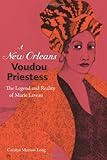
Carolyn Morrow Long. A New Orleans Voudou Priestess: The Legend and Reality of Marie Laveau. Gainesville: University Press of Florida, 2007. xxxvii + 294 pp. $26.00 (paper), ISBN 978-0-8130-3214-6.
Reviewed by Marise Bachand (University of Western Ontario)
Published on H-SAWH (March, 2009)
Commissioned by Antoinette G. van Zelm (TN Civil War Nat. Heritage Area Center for Historic Preservation)
Desperately Seeking Marie
Who was Marie Laveau? According to an obituary published in a New Orleans newspaper a few days after her death in June 1881, she was “up to an advanced age, the prime mover and soul of the indecent orgies of the ignoble Voudous; and to her influence may be attributed the fall of many a virtuous woman.” Yet, as the article acknowledged, the apparent she-devil Laveau had some “redeeming traits,” since it “is a peculiar quality of the old race of Creole Negroes that they are invariably kind-hearted and charitable.”[1] She is said to have been an herbal healer, a hairdresser, a procuress, the daughter of a white planter, the mother of fifteen children, and a slave liberator; her cottage on St. Ann Street was reputed to be a terminus of the Underground Railroad.
Already a legend in her lifetime, Laveau remains today a key figure of Louisiana folklore. In her book A New Orleans Voudou Priestess, Carolyn Morrow Long demythologizes Laveau as she unravels “verifiable facts” from what she calls “semifiction and complete fabrication” (p. 207). Going back and forth between legend and reality, Long compares the most extreme representations of Laveau told by newspaper articles, popular histories, and fiction with the evidence she gathered from the archives and a series of forty-seven interviews from the Louisiana Writers’ Project. One by one, each aspect and permutation of the Laveau legend is examined and each winds up either revised or discarded. In the end, the retired curator of the Smithsonian comes to the conclusion that Laveau was a “considerably less flamboyant woman” than the mysterious Voudou Queen that has fascinated generations of writers and scholars (p. 207).
Organized in three parts, the book covers a long span of New Orleans history. In part 1, Long pieces together the personal life of the Voudou priestess, mainly from religious and notarial documents. When Laveau was born in 1801, free people of color enjoyed privilege and prosperity. Marie’s mother, an emancipated slave, chose to become the plaçée (similar to a common-law wife) of a government official instead of marrying a man of color. Herself the daughter of a prosperous free man of color engaged in dealing land and slaves, Marie followed in her mother’s footsteps. After a brief marriage to Jacques Paris, one of her own caste, she engaged in an extramarital partnership with the white Christophe Glapion, who fathered at least seven of her children.
Although illiterate, Laveau knew nonetheless how to get the most out of the Louisiana legal system, which disapproved of interracial unions. Laveau and Glapion managed to circumvent the laws and ensured the financial security of their offspring, notably through inter vivos donations (gifts similar to bequests made while all parties are still alive). And like most affluent New Orleanians, the couple owned, purchased, and sold slaves. In the mid-1850s, Glapion faced financial hardships and died, leaving his partner of thirty years in relative poverty. Stripped of its most extraordinary aspects by Long’s research, the domestic life of Laveau remains nonetheless fascinating, if only because her lineage “serves as a paradigm for race relations during the first two hundred years of Louisiana’s history” (p. 3).
The second part of the book turns to the public life of Laveau as a Voudou priestess. New Orleans Voudou is presented here as a unique and well-organized Afro-Catholic religion, whose pantheon of spirits and deities attracted a racially mixed congregation, mostly composed of women.[2] From the 1820s until the 1870s, Laveau presided over regular services and special ceremonies, gave private consultation, sold gris-gris (charms), and used her home as a temple. Because women like Laveau, who engaged in extramarital partnerships, found an ally in Père Antoine (the beloved pastor of St. Louis Cathedral), they probably felt no contradiction in being simultaneously Catholic and Voudou. Although Long was not able to document the first few decades of Laveau’s ministry, she also found no evidence that Jean Montanée (a.k.a. Doctor John), the famous conjuror and fortuneteller, was ever her mentor.
The priestess first appears in official records in the 1850s, when municipal authorities started harassing the Voudou community for their unlawful assembly of people of color. Already a source of concern for the Spanish during the colonial era, Voudou was even more feared as slavery became a contentious issue in the national political arena. During Reconstruction, Voudou was often depicted as a site of orgies and prostitution, and it “was exploited as proof that blacks were ignorant, superstitious, and unworthy of full citizenship” (p. 123). An occasion for scorning African Americans for some, the St. John’s Eve celebration on Lake Pontchartrain was an object of fascination for others. By that time, Laveau had retired from officiating these ceremonies but was already a legend. Facing the intolerance of the civil and religious establishments, Voudou eventually was driven underground in the late nineteenth century in a Louisiana that was more than ever divided along the color line.
The third and last part of the book is a story of decline: of the elderly Laveau, of Voudou in New Orleans, and of the status of free people of color in the Jim Crow South. Long portrays Laveau in her final years as a woman who was emotionally and financially devastated by the death of Glapion and the aftermath of the Civil War. She still dedicated herself to charitable work and to visiting prisoners, if “the 1871 Daily Picayune article is to be believed” (p. 164). Feeble and poor, she died in the cottage on St. Ann Street, surrounded by her daughter, a devout Catholic who had also chosen to live with a white man, and her grandchildren. Even in those times of segregation and racism, Laveau was something of an untouchable, and most of New Orleans attended her funeral. Soon enough, her tomb in St. Louis Cemetery No.1 turned into a place of devotion.
Laveau's descendants, however, would not experience the fortune of their famed ancestor. As people of color lost their middling status in Louisiana, some left New Orleans to start over as whites, while others merged into the black community. In the last chapter of her book, Long rejects the idea that Laveau was replaced as a Voudou priestess by her own daughter, a Marie II. If there is strong evidence that a second woman calling herself Marie Laveau lived in the same house as the Widow Paris, she was not Laveau’s biological offspring.
A New Orleans Voudou Priestess is not so much a narrative as an investigative report, in which the author reveals each research path--both conclusive and inconclusive--that she followed to uncover the “real Laveau.” Product of much ferreting in the archives, the book is well documented and empirically grounded. Nicely illustrated, it presents several pertinent tables that summarize the evolution of the Laveau legend or contrast deities in Africa, Haiti, and New Orleans. In comparison with the recent monographs by the anthropologist Martha Ward (Voodoo Queen: The Spirited Lives of Marie Laveau [2004]) and the religious scholar Ina Johanna Fandrich (The Mysterious Voodoo Queen, Marie Laveaux: A Study of Powerful Female Leadership in Nineteenth-Century New Orleans [2005]), Long’s book appears to the historian as the most rigorous study of the Voudou Queen.[3] Then again, Long’s interpretations are at times either laconic or conjectural, as she often fails to explore the social forces that led Laveau to make certain choices. Was plaçage a conjugal choice like any other? Why would Laveau have perhaps declined her father’s offer to provide her an education? Why did she feel compelled to provide the funds necessary to liberate free women of color who were arrested for minor crimes? What motivated Glapion and Laveau to purchase a female slave who was known to be a maroon? The current state of Louisiana historiography certainly provides elements of answers to most of these questions.
Laveau may not have been immensely wealthy or powerful, but she was no ordinary woman to her contemporaries. Unfortunately, Long is so preoccupied with deconstructing the multiple variations of the Laveau legend that she forgets to tell us why she became a legend in the first place. Separating legend from reality for a figure who belonged in her lifetime as much to the world of faith as to the world of facts necessarily leads to an interpretive dead end. Let us hope that Long’s significant contribution to our understanding of a fascinating female religious leader will trigger more research and interpretation.
Notes
[1]. Obituary of Marie Laveau, “A Sainted Woman,” Democrat (New Orleans), June 18, 1881.
[2]. The author had started exploring New Orleans Voudou in her previous book. See Carolyn Morrow Long, Spiritual Merchants: Religion, Magic, and Commerce (Knoxville: University of Tennessee Press, 2001).
[3]. See Janet L. Allured, "Evaluating a New Orleans Icon: Evidence and Reinterpretation," review of The Mysterious Voodoo Queen, Marie Laveaux: A Study of Powerful Female Leadership in Nineteenth-Century New Orleans, by Ina Johanna Fandrich, and Voodoo Queen: The Spirited Lives of Marie Laveau, by Martha Ward, H-SAWH, H-Net Reviews, March 2006, http://www.h-net.org/reviews/showrev.php?id=11484.
If there is additional discussion of this review, you may access it through the network, at: https://networks.h-net.org/h-sawh.
Citation:
Marise Bachand. Review of Long, Carolyn Morrow, A New Orleans Voudou Priestess: The Legend and Reality of Marie Laveau.
H-SAWH, H-Net Reviews.
March, 2009.
URL: http://www.h-net.org/reviews/showrev.php?id=24274
 | This work is licensed under a Creative Commons Attribution-Noncommercial-No Derivative Works 3.0 United States License. |

