



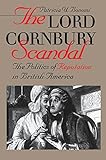
Patricia U. Bonomi. The Lord Cornbury Scandal: The Politics of Reputation in British America. Chapel Hill: University of North Carolina Press, 1998. xiv + 290 pp. $29.95 (cloth), ISBN 978-0-8078-2413-9.
Reviewed by Todd Estes (Oakland University)
Published on H-Review (October, 1998)
The case against Edward Hyde, Lord Cornbury, the royal governor of New York and New Jersey from 1702-1708, seemed airtight. Several incendiary letters and accounts portray him as a venal, irresponsible governor, a spendthrift who raided the public treasury and abused the powers of his office. Moreover, Cornbury was consistently depicted as a transvestite who paraded openly and without embarrassment in women's clothing. The clinching piece of evidence for the latter charge is the infamous alleged portrait of a gowned Cornbury which hangs in the New-York Historical Society, which has been the basis for much professional snickering among scholars. Believing the portrait to be incontrovertible evidence, they have uncritically accepted the portrayal of Cornbury as a transvestite and have made little effort to verify the portrait or examine the veracity of the other charges against the man.
In a fascinating book which begins with some simple questions--was the portrait of Lord Cornbury genuine? was he a cross-dresser?--and works out from those to other broader concerns, Patricia U. Bonomi weaves a complex story, adding to an understanding of how Cornbury has been misunderstood and wrongly accused and simultaneously revealing another dimension to the context of the political culture which spawned the reputation. Bonomi works first as a detective, unraveling the mystery surrounding the portrait, and goes on to produce a brilliant work of historical analysis which has a great deal to say to historians of colonial American politics, Anglo-American relations, and political culture. Her deeper subject--the politics of reputation--seems particularly relevant for some of today's political concerns, too. In short, The Lord Cornbury Scandal is a model for taking a single question or issue or controversy and using it to unravel and illuminate a braid of interwoven matters.
A work which attempts to accomplish so much could easily become diaphanous and unfocused, and it likely would in the hands of a lesser historian. But Bonomi is far too good at both narrative and analysis to let that happen and skillfully knits together an account that is at once both an intriguing tale of a man wrongly accused and a deft, nuanced work of historical scholarship which uses a particular case to make some larger points. Bonomi is particularly well-positioned to write such a work. A leading scholar of colonial New York, Bonomi in A Factious People: Politics and Society in Colonial New York (1971) examined the development and practice of politics in New York, a subject which plays a crucial role in this latest work as well. Her more recent Under the Cope of Heaven: Religion, Society, and Politics in Colonial America (1986) explores the broader workings of colonial society. Bonomi previously explored the question of Cornbury's portrait in her "Lord Cornbury Redressed: The Governor and the Problem Portrait" (William and Mary Quarterly 3d Ser., 51 [1994], 106-118). And the present work seeks not so much to restore Cornbury's reputation as to use his story "as a device for exploring the underside of an intensely partisan age" (p. 11) and to illuminate "an Anglophone political culture...pervaded by gossip, satire, slander, and sexual innuendo" (p. 10).
First, the matter of the portrait. The painting itself shows a man (purportedly Cornbury) in women's clothes and seems prima facie evidence of Cornbury's alleged proclivity for cross-dressing. But not so fast. Bonomi maps a series of unauthoritative and random attributions which linked Cornbury to the portrait, based mostly on a quotation from an 1847 work by a British historian which was cited and affixed as the label "more or less officially" in 1867 (p. 17). Yet all of these sources were, as it happens, based on hearsay, gossip, and unattributed sources which fail to stand up to scrutiny. A scientific investigation of the portrait, undertaken by the New-York Historical Society at Bonomi's request, determined that the picture had no signature or other evidence to help ascertain either the date or artist. In short, she finds that the portrait's provenance fails to establish a link to Cornbury, that the label information is specious, and that the portrait was likely painted in England. "[O]ne of the most influential pieces of evidence for the charge that Cornbury was a transvestite," she concludes, "must be declared fictitious" (p. 26).
Another charge that has bedeviled Cornbury over the years has been the dismissive, almost contemptuous assessment of historians who argue that he was the quintessentially incompetent royal governor, lacking intelligence, judgment, and probity. These historians also repeated the stories of the portrait and the cross-dressing as fact. But Bonomi shows that the governorship of New York and New Jersey to which Cornbury was appointed in 1701 was far too important a post to give to an incompetent or to someone who failed to command the respect of the court. Further, his actions as governor in dealing with the convoluted, heavily factionalized maze that was New York politics "actually managed to lower the temperature in politically feverish New York" (p. 59). Cornbury reached out to various interests, acted as a conciliator, and seems to have met with initial approval. Bonomi argues that while Cornbury expected deference and obeisance, "it also seems that he wished to govern well" (p. 61). She finds that while he had a relish for wielding power, he was not autocratic and made a solid record of achievement.
Part of the explanation for Cornbury's poor reputation was that he presided at a time when England sought greater centralization, inevitably leaving some in the colonies feeling ill-used and resentful. In turn, some of those Cornbury had to disappoint or who found fault with him mounted a campaign of intense opposition to the governor for lack of a better target. "Without an understood mechanism through which to express their domestic grievances, those who opposed royal government...had no alternative" but to blacken Cornbury's name and administration by condemning his actions and questioning his motives (p. 76). Bonomi shows, however, that Cornbury's tenure must be seen not only in the framework of New York politics but also in the broader context of all royal governors who found themselves in a "pernicious environment in which backbiting and slanderous gossip thrived" (p. 91). No matter how effectively or earnestly governors or high officials tried to carry out their duties, they were subject to accusations "by someone who believed himself the victim of the sly evasions and nefarious bargains of those in power" (p. 91). Indeed, Bonomi concludes, little that occurred in New York and New Jersey at the time happened outside a political context, and those in power could not escape the "climate of rumor, gossip, and suspicion that colored most political, and many personal, transactions in early modern life" (p. 98).
Thus, as Bonomi closely examines the record of Cornbury's governorship and conduct--as with her research into the alleged portrait--she finds little or no evidence to suggest that the accepted portrayal of Cornbury is correct. In fact, nearly all the evidence she uncovers points to a historical vindication of the much-maligned Cornbury, a find which will force some historians (this one included) to revise their colonial America lecture notes to delete some humorous and derogatory material on Cornbury, the veracity of which is here effectively demolished by Bonomi.
Having corrected the historical record, Bonomi continues her braid as the detective story and revisionist account of Cornbury's record transforms into a political analysis of far-reaching implications. If the hard evidence seems to absolve Cornbury on all charges, personal or professional, Bonomi asks, why did the charges emerge in the first place and why have they persisted? These questions set her and readers off on a fascinating account which locates the answers by examining the broader political culture of the time. It is this pursuit and the findings it turns up that make this such an insightful and interesting venture. Beginning with a question about the authenticity of a portrait and developing from there, this book offers a brilliant example of what historians can do by working out from a simple question, answering it, and then asking other questions as they occur.
Bonomi argues that the gossip and defamation aimed at destroying Cornbury must be seen not simply as a by-product of the always contentious New York politics but as part of the Anglo-American political world. Political invective reached its high points between 1695 and 1714, precisely the time of Cornbury's governorship, and developed from party rage and the Grub Street press. A recurrent theme of the book is that politicians of this period had no bipartisan tradition to provide context and the concept of a political out-group functioning as a loyal opposition did not exist. Since rival factions viewed each other contemptuously and believed that opposition threatened the nation's existence, politicians and the politically active took a special license to destroy the opposition with any and all weapons available.
One emerging tool in such campaigns was a newly liberated press. In 1695, the law requiring a license from Parliament to run a printing press was allowed to lapse. A freer press (and the financial opportunities that followed) along with the bitter politics of the time combined to produce a group of "hack writers" who became proficient at turning out pieces of verse, novels, newspapers and pamphlets "steaming with political gossip and prurient tattle" (p. 103). Soon, a climate emerged in which the various political factions who created the gossip and satire found the "smut and scandal of Grub Street...indispensable as each side strove to smear and discredit the other" (pp. 113-14). Although the colonial press was not as fully developed as Grub Street, such scandalmongers found an audience in the colonies. As in England, political factions deployed spoken and printed gossip and satire in order to go underground and attack or smear opponents.
Such factions had a variety of choice tactics. Charges of cross-dressing proved especially damaging as a political tool because English society increasingly linked transvestism with homosexuality, a threat which was underscored by the sharpening demarcation of gender lines at the turn of the eighteenth century. Emasculating a political opponent became a favored and sometimes effective way of tainting him along with the more common charges of corruption and malfeasance. In Bonomi's view, the opprobrium associated with cross-dressing and homosexuality in English society makes it highly unlikely that Cornbury would have behaved as his critics charged. In fact, no royal governor could have dressed as a woman without a scandal, especially so in the colonies where the Calvinist influence was strong. Had Cornbury cross-dressed, Bonomi suggests, it not only would have been remarkable and raised enormous controversy but would have produced a far greater body of written discussion than the four letters on which the charges are largely based.
Gossip is an invidious form of political assault: it can blacken reputations in an surreptitious fashion, making it difficult for those who are its targets to respond and defend themselves. Bonomi delineates two types of gossip: gossip as distilled malice or slander with deliberate intent to destroy, and gossip as idle talk which, although less calculating and more casual, could still harm. In examining the charges made against Cornbury, Bonomi detects both. But the ways in which the gossip worked--and more tellingly, did not work--is particularly revealing. The accusations against Cornbury were based on four letters written by three of Cornbury's bitterest political foes who circulated the gossip in hopes that it would be widely disseminated. They were disappointed. The rumors did not travel much beyond the circle of Cornbury's enemies and seem to have made little impact in London. Further, those who saw the governor regularly made no mention of his alleged cross-dressing; indeed, throughout his tenure, Cornbury received support from the council, the Anglican clergy, and people from the lower orders. Had Cornbury's behavior equaled the charges, continued support would have been highly unlikely. If such groups knew about the accusations, they obviously dismissed them or understood them in the context of the political rhetoric of the day, something Bonomi concludes that later historians--who took the rumors at face value--did not. She argues that over time, the scandal's political, cultural, even linguistic elements have been stripped of the context. As an understanding of the intemperance of early opposition rhetoric faded, only the texts remained. Full of slurs and vitriol, lacking a contextual grounding, such charges were "increasingly liable to be read as actual descriptions of past events and persons" (p. 9). Bonomi's study of the role of gossip in the political world is especially significant. That this facet of political life extended well past colonial days is demonstrated in Joanne B. Freeman's brilliant article "Slander, Poison, Whispers, and Fame: Jefferson's 'Anas' and Political Gossip in the Early Republic" (Journal of the Early Republic 15 [Spring 1995], 25-57) which examines the multiplicity of uses political gossip had in the new nation.
Why were such contretemps the order of the day in the Anglo-American political world of the early eighteenth century? Bonomi analyzes the entire scandal in the context of the larger changes going on in late Stuart England. Fierce contests for political power were exacerbated by the upheavals in English society. This unsteadiness fueled "a politics of slander and sexual innuendo" (p. 187) which led to the development of a rough Country attitude, all the more pronounced because of the absence of a logic or ideology of parties to give some perspective to oppositional politics. In this gap, a politics of personal character assassination--a "vulgarization of political rhetoric" (p. 8)--developed, fed by the Grub Street press which "recast political communication by enlarging the audience for gossip and scandal" and by presenting its revelations "in pungent prose that entertained as well as informed" (p. 187). Cornbury's accusers were familiar with Grub Street, caught up in the conspiratorial thinking of the period and quite adept at the politics of gossip and sexual defamation. Left with no political alternative other than a nasty, personalized politics, his enemies were "reduced to slander, libel, and the destruction of reputations" (p. 189). Cornbury had the unfortunate historical destiny to be, Bonomi concludes, the chief victim of a ruthless and virulent strain of political poison. It is precisely such an understanding that previous work on Cornbury has failed to see. Bonomi not only corrects the historical account, she points the way toward an understanding of the truly large, hugely significant context in which both Cornbury and his rivals operated.
This is an outstanding book. Richly illustrated and well-written, The Lord Cornbury Scandal makes a strong, persuasive argument and develops a fully-textured account out of what ostensibly is an open and shut case. Bonomi engages a wide body of scholarly work, drawing on such disparate areas as imperial government and finance, sexual culture, transatlantic communications, gender, gossip, and colonial politics. Equally proficient in her many roles as historian, detective, debunker, and researcher, Bonomi has produced an accessible and substantive work which brilliantly illuminates the insights to be gained from the study of political culture.
Copyright (c) 1998 by H-Net, all rights reserved. This work may be copied for non-profit educational use if proper credit is given to the author and the list. For other permission, please contact H-Net@H-Net.MSU.EDU.
If there is additional discussion of this review, you may access it through the network, at: /reviews.
Citation:
Todd Estes. Review of Bonomi, Patricia U., The Lord Cornbury Scandal: The Politics of Reputation in British America.
H-Review, H-Net Reviews.
October, 1998.
URL: http://www.h-net.org/reviews/showrev.php?id=2423
Copyright © 1998 by H-Net, all rights reserved. H-Net permits the redistribution and reprinting of this work for nonprofit, educational purposes, with full and accurate attribution to the author, web location, date of publication, originating list, and H-Net: Humanities & Social Sciences Online. For any other proposed use, contact the Reviews editorial staff at hbooks@mail.h-net.org.

