



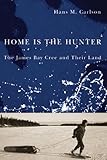
Hans M. Carlson. Home Is the Hunter: The James Bay Cree and Their Land. Nature/History/Society Series. Vancouver: University of British Columbia Press, 2008. xxiv + 317 pp. $98.00 (cloth), ISBN 978-0-7748-1494-2.
Reviewed by Jonathan Clapperton (University of Saskatchewan)
Published on H-Canada (March, 2009)
Commissioned by Stephanie Bangarth (King's University College, UWO)
Native-Newcomer Narratives: Rethinking Culture, Environment, and the Historical Center in Aboriginal and Canadian History
For Hans M. Carlson in Home Is the Hunter, the “bush” and the “hunt” represent consistent conceptual structures in a long history of cultural, social, technological, and environmental change for the Cree of James Bay. Carlson uses these two concepts as windows through which to imagine the multiplicity of Cree-newcomer interactions, ranging from the fur trade, to missionary activity, to conservation of the beaver, and to forest clear-cuts and hydroelectric projects. It is, of course, the latter--those damn dams--that dominate academic and popular discourse concerning James Bay in the last few decades. Indeed, Graham Wynn’s foreword to this latest addition to the burgeoning Nature/History/Society series from University of British Columbia Press opens with a discussion of hydroelectric megaprojects. But, as Carlson argues, and as Wynn is well aware, Aboriginal and environmentalist protest is only the latest and one of many competing narratives about James Bay and its original inhabitants. “This story,” Carlson writes, is “about Cree hunters and their relationship with the land of James Bay, but it is also the story of how James Bay has become integrated into the rational vision and economy of North America and how local energy and imagination have been challenged--not lost--in the process” (p. 5). For centuries, Carlson explains, “Cree land, hunting and its narrative remained dominant, interacting with the world outside but remaining internally defined.... Rapid and dramatic change came to James Bay not with the mere arrival of white fur traders, or even later with Anglicans and Roman Catholics and their application of certain aspects of Western narrative culture, but only with the combined power of modern technology and narratives about people’s place on the land” (pp. 7-8).
It is the question and power of narratives on which Carlson’s book turns. His study is thick with a multitude of them, and he seamlessly blends different narratives within each chapter, usually setting up his own interpretation against the dominant ones. He is particularly concerned with the interplay of culture and environment that often gets downplayed or ignored entirely in other studies. He begins his narrative with an ethnohistorical and natural description of James Bay in chapter 2. Chapters 3 and 4 then revise the traditional, often romantic, narratives of James Bay’s history, which obscure Cree culture and inaccurately empower fur traders and missionaries to dramatically change Cree culture. Instead, Carlson demonstrates that while Europeans entered a Cree world and worked to change them and the environment, for centuries these newcomers had neither the numbers nor the power to succeed. Echoing many postcolonial and subaltern studies that give considerably more agency to Aboriginal groups and individuals, Carlson describes how European newcomers relied heavily on Natives and not vice versa; they were bound by the hunter’s work and the hunter’s words and fur trading was incorporated into Cree culture at the same time that it often remained on the periphery. Many Cree went years without visiting a trading post. Turning to the narrative of Christianity, Carlson is apt to point out that while the tragedy of residential schools have correctly been brought to the forefront of public and academic concern, the residential school narrative has also cast a shadow over a longer history where the Cree made Christianity their own. Missionaries were never more than a token force in James Bay, and the story is not one of cultural hegemony. The process Carlson explains is syncretic: “if many Cree became Christians, it is likely because Christianity in its turn became very Cree” (p. 101).
After a few centuries of Cree domination, however, as Carlson describes in chapter 5, newcomers aside from fur traders and missionaries, who were not reliant on the Cree, slowly imposed their outsider understandings on the land and its people. At the same time, the Cree were less able to mitigate these impositions, partly because of their increasing reliance on traders for food due to overhunting as well as the debilitating effect of diseases that arrived in James Bay beginning in the 1860s. The Cree, however, did adapt, as always, to changing circumstances. While outsiders held more power than they did previously, Hudson Bay fur traders, government bureaucrats, and Cree hunters negotiated a system of beaver reserves, an interesting historical period explored in chapter 6. This system, beginning in the 1920s and 1930s, became a point of pride for all involved due to its success. While Carlson fails to mention the broader context of beaver conservation at the time--“Grey Owl,” for example, is completely absent--he does point out the burgeoning conservationist romanticism about the Cree. Nonetheless, this reserve system left the Cree in much control of their traditional territories as they regulated the hunt themselves, much as they had always done. This situation changed with the rise of Québécois nationalism and technocratic modernism and the dissolution of the reserves by Quebec’s government. In chapter 7, Carlson redirects his historical gaze, for the first time, from bush of James Bay to the courts of Quebec as the Cree were forced to engage in a legal discursive structure that operated far from Cree understandings of the hunt, the land, and its natural processes. Carlson also details how the federal government left the Cree to fend for themselves while it sought to placate a powerful Québécois separatist movement.
At many points, it appears that Carlson is critiquing Québécois society for trying to assert its uniqueness and to decolonize itself at the expense of the Cree who were hoping to do much the same. But he dispels these notions in his conclusion at the same time that he states the monograph’s underlying political message. It is too easy, Carlson writes, to condemn Quebec, or, for that matter, the dams, the development of the north, and clear-cutting; “in the end, if they are the problem, then it is because of us, the daily decisions we made as to where our resources originate from. This is why we need to connect ourselves to the lands of James Bay and to write the Cree into our narrative” (p. 252). In other words, we need to be more socially and environmentally aware of our actions, of our insatiable appetite for the so-called periphery’s natural resources. Further, I believe Carlson does more than write the Cree into our narrative; he pens a Cree-centered narrative that writes newcomers into it, and it is this aspect of Carlson’s book that is the most compelling. He recognizes that, despite traveling extensively throughout James Bay and speaking to many Cree, what he writes is, ultimately, his own interpretation of events. But like those traders and missionaries who visited the Cree and James Bay before him, the Cree, the “bush,” and the “hunt” have permanently influenced him and his narrative.
Though I do not want to take away from this book, for it is an excellent addition to the existing historiography of James Bay and the Cree, I do have a few well-intentioned comments on how one might take Carlson’s study further. First, Carlson tends to exaggerate the uniqueness of James Bay to justify his study of it; I think this is unnecessary. The Cree deserve this study in their own right, and the exaggeration veers dangerously close to romanticizing James Bay and the Cree, the very narrative process that Carlson, drawing on N. Scott Momaday, is particularly adamant about avoiding. Second, Carlson’s narrative still privileges Native-newcomer relationships, much as those before him have done, at the expense of revealing the interactions between the Cree and other Aboriginal groups or individuals. That is, just as Carlson argues that the fur trade or missionary activity were often peripheral to the day-to-day life of the Cree, a central focus on Native-newcomer interactions contradicts this assertion. Finally, I think Carlson does an excellent job at rereading trader and missionary texts and government documents to tease out the Native voices contained therein, but I found it odd that he does not include any oral histories of his own.
These reflections aside, Home Is the Hunter is an excellent study of human and environmental relationships. I would not recommend it as an introductory text into the history of James Bay or the Cree for the uninitiated. Anyone with a minimal understanding of this place and these people, however, should read this book, if only to see where their narratives fit in with others and to gain a greater appreciation for the history of the Cree and for the potential dangers to which we all contribute by pulling resources from the periphery while at the same time imposing our outsider understandings over local ones.
If there is additional discussion of this review, you may access it through the network, at: https://networks.h-net.org/h-canada.
Citation:
Jonathan Clapperton. Review of Carlson, Hans M., Home Is the Hunter: The James Bay Cree and Their Land.
H-Canada, H-Net Reviews.
March, 2009.
URL: http://www.h-net.org/reviews/showrev.php?id=24200
 | This work is licensed under a Creative Commons Attribution-Noncommercial-No Derivative Works 3.0 United States License. |

