



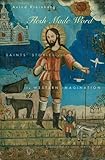
Aviad M. Kleinberg. Flesh Made Word: Saints' Stories and the Western Imagination. Translated by Jane Marie Todd. Cambridge: Belknap Press of Harvard University Press, 2008. xii + 340 pp. $29.95 (cloth), ISBN 978-0-674-02647-6.
Reviewed by Anna Lisa Taylor (Department of History, University of Massachusetts, Amherst)
Published on H-German (August, 2009)
Commissioned by Susan R. Boettcher
The Unquiet Dead
In this recent book, Kleinberg examines hagiographical narratives from late antiquity and the later Middle Ages to show how these strange and unruly texts can reflect the tensions between popular needs and official agendas, between narrative effect and didactic purpose, between the church's toleration of heterogeneity and the need for control, and between the saint's shocking charismatic power and the church's desire to domesticate it. Drawing on a theme from his earlier book, Prophets in Their Own Country (1992), Kleinberg treats sanctity not as an absolute quality of an individual, but as a "fluid" category that results from the negotiations between the saint (or narratives about the saint) and his or her audience. Sanctity is "in the eye of the beholder" (p. 2). Perceived holiness is dependent on charisma, a form of power that operates outside official channels and is, therefore, "a boon to the lower classes" (p. 7) who can participate, as both saints and audience, in its production, recognition, and definition. Kleinberg uses the leitmotif of the marketplace to characterize the relationship of saint (or hagiographical text) and audience: "Veneration makes the saint a vendor and a commodity in the cultural market" (p. 140). The devotees, then, are not passive recipients of the holy message, but buyers who express their agency through "creative consumption" (p. 281). This highly readable and accessible book will be of interest not only to scholarly readers, but rather, like the saints' lives themselves, it will challenge and engage a broader public of creative consumers.
Saints' lives and the narratives about them contain subversive elements. Saints "break rules and cross boundaries--between life and death, between natural and supernatural, between Christian and pagan, between moral and immoral, masculine and feminine" (p. 243). They are effective because their audiences perceive them as engaging, challenging, different, and powerful.. Saints, conduits of supernatural power who subvert norms and roles, personify das Unheimliche, the uncanny that is simultaneously familiar and alien. Saints therefore threaten the status quo and challenge an audience's definitions of holiness. They exist on the social and theological margins, but the church can relocate a useful saint to the center. The dynamism of the medieval Catholic Church, according to Kleinberg, came from its willingness to tolerate and even foster the heterogeneous corpus of saints who were more "useful than harmful" (p. 52). In co-opting useful saints, the church transformed individual stories into formulaic and conventional narratives, domesticating their threatening aspects, but also robbing them of their uncanny power. As older hagiographical narratives were tamed, however, new, ambiguous, imperfect, and compelling saints arose in their full disquieting splendor.
Like Peter Brown, Kleinberg places holy individuals, or rather texts about them, in their social contexts and looks at their functions for their communities. In The Cult of the Saints (1981), Brown rejected the earlier "two-tiered" approach, which claimed that veneration of saints and their relics represented an elite concession to vulgar, pagan influences, a sop to masses incapable of monotheism. Rather than seeing the cult as the result of a "trickle up" effect from popular piety, Brown argued that bishops and other members of the elite were active in its promotion, competing to control access to saints' graves and relics. Kleinberg's notion of sanctity as a condition produced by transactions between the official church and the saint's public, has elements in common with the old model, since he attributes aspects of the cult and its official texts to the popular consumers of sanctity: the beliefs of the "masses" influence official practices and texts. Kleinberg's model, however, like Brown's, suggests a clear demarcation between institutional and popular definitions of sainthood, since sanctity itself is fundamentally ambiguous and unstable, predicated on exchange between the institutional church and the devotees.
Kleinberg intersperses narrative chapters, providing overviews and interpretations of the transformations within the church and the cult of saints within it, with closer readings of a small number of texts of martyrs and ascetics. Through comparison with Jewish martyrs, Kleinberg reminds us that the centrality of martyrs in Christianity was not inevitable. Like all historical developments, in Kleinberg's view, the development of martyrdom as the "root metaphor" (p. 18) for Christianity was the unintended result of countless actions by numerous individuals: "change came as the result of diffuse efforts of many small agents, without a program" (p. 53). His first case study is the Passion of Perpetua (203 C.E.). By grounding Perpetua primarily in her non-Christian Roman culture, rather than in the religion to which she was a recent convert, Kleinberg presents persuasive interpretations of Perpetua's visions. The symbolism of these visions is not only Christian, but also pagan. Thus, Kleinberg finds in Perpetua's scenes of the afterlife echoes of Orpheus, Persephone, and Hades familiar to any educated Roman raised on Virgil's poetry.
Since Kleinberg is interested in how a saint's community, rather than her inner piety or experiences, constitutes sanctity, it is surprising to find him probing Perpetua's psyche to explain her visions: "she is trying to make sense of her own death" (p. 67). The difficulty of reconstituting the martyr's inner life from the narrative of her visions is compounded when Kleinberg applies Freudian interpretations. Kleinberg reads Perpetua's vision of the shepherd as a negation of "the father's threatening, phallic, and serpentine virility" (p. 67), as though Sigmund Freud's concepts were universal psychological truths rather than culturally bound ideas arguably foreign to Perpetua's world. Kleinberg ends the chapter by showing how two later Acta that largely supplanted the Passion domesticated Perpetua and cast her in more conventional terms.
One Christian response to religious legitimization was the pursuit and validation of asceticism, which internalized martyrdom and "implied a widening of the concept of sanctity" (p. 118). Kleinberg discusses the social meanings and functions of asceticism. From a discussion of the world-renouncing ideas of the Stoics and Platonists, who aimed for equanimity and serenity, Kleinberg shows that Christian asceticism was a radical and "aggressive" transformation of philosophical asceticism. Christian writers adopted the language of philosophers to frame and to garner acceptance of a radical set of practices. Drawing on Arnold Van Gennep and Victor Turner, Kleinberg shows how desert ascetics enacted a social drama of withdrawal, trial in the liminal space of the desert, and social reintegration. These hermits gained their power from their asocial activities in the wilderness, but in order to be useful (as miracle workers, advisors, and conduits of grace), they needed to be reincorporated into the community.
In chapter 7, Kleinberg considers Jerome's Life of Antony's supposed forbear, the minimally ascetic and wholly apocryphal desert father, Paul. Incorporating fantastic elements, including mythical creatures, this text typifies the imaginative turn of medieval saintly narratives. Consideration of Patricia Cox-Miller's article, in which the author shows how the fabulous beasts function for Jerome as symbols of the hybrid and wild nature of asceticism, would here complement Kleinberg's discussion of the powerful oddity of this saint's life.[1]
Having bypassed much of the Middle Ages, in which popular practice and the texts of saints' lives apparently had little to do with each other, Kleinberg alights upon the thirteenth century, when saints' stories made a "forceful comeback" (p. 278). Accounts of Saint Francis and the holy fool, Fra Ginepro, derive their impact from their protagonists' spontaneity and transgressive behavior, but the official treatment of the Franciscans shows the church taming the order's wild sanctity. Kleinberg returns here to the theme of the tension between "discipline" and "enthusiasm"; that is, between institutional and popular interpretations of sanctity. His final case study examines several stories of composite, apocryphal, fantastic, or otherwise difficult saints--such as George and Christopher--from Jacobus de Voragine's Legenda Aurea (c. 1282). In these problematic stories, Kleinberg finds a tension between the didactic message and the riveting but morally irrelevant details that threaten to overwhelm it.
Kleinberg's argument is laudable for recognizing the complex social transactions that underlie religious texts. His claims about the countless negotiations that determined the shape of these texts, the nature of sanctity, and the development of the cult of saints as a whole are compelling and plausible. Due to the nature of his argument, he cannot always cite medieval evidence for these processes. What traces does "creative consumption" leave for historians? Can we unravel the official and popular currents in any given redaction of a saint's life, or are we making assumptions about what the church promoted, in any given case, as opposed to what it merely tolerated? Even if we cannot always reconstruct how active listeners subverted these texts, nor the effect of their challenges, it is nonetheless worth being mindful of the plurality of voices embedded in each life. Reflecting on Perpetua's Passion, Kleinberg asks, "if we knew that we had only a few days to live, if we knew that we were going to die a violent and painful death, what sort of text would we write?" (p. 58). One of the strengths of this readable account is that it poses such immediate questions of the reader.
Note
[1]. Patricia Cox-Miller, "Jerome's Centaur: A Hyper-icon of the Desert," Journal of Early Christian Studies 4 (1996): 209-33.
If there is additional discussion of this review, you may access it through the network, at: https://networks.h-net.org/h-german.
Citation:
Anna Lisa Taylor. Review of Kleinberg, Aviad M., Flesh Made Word: Saints' Stories and the Western Imagination.
H-German, H-Net Reviews.
August, 2009.
URL: http://www.h-net.org/reviews/showrev.php?id=24165
 | This work is licensed under a Creative Commons Attribution-Noncommercial-No Derivative Works 3.0 United States License. |

