



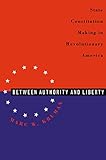
Marc W. Kruman. Between Authority and Liberty: State Constitution Making in Revolutionary America. Chapel Hill and London: University of North Carolina Press, 1997. xiv + 223 pp. $39.95 (cloth), ISBN 978-0-8078-2302-6.
Reviewed by Gaspare J. Saladino (University of Wisconsin-Madison)
Published on H-SHEAR (October, 1998)
Marc W. Kruman, the chair of the history department at Wayne State University and a student of nineteenth-century politics and political parties, reveals in his preface that he set out to study the history of the right to vote from the Revolution to Reconstruction. Kruman turned first to the voluminous secondary literature, beginning with Gordon S. Wood's monumental and seminal The Creation of the American Republic, 1776-1787 (1969), a detailed description and acute analysis of American political culture, based upon extensive research, that emphasized state and federal constitution-making. Between Authority and Liberty is studded with references to the Creation and the writings of other scholars of "revolutionary constitutionalism," but Wood holds center stage.
Kruman carefully outlines Wood's conclusions that are pertinent to his projected study. According to Kruman, Wood declared that upon breaking with Great Britain, American legislatures--the embodiments of the sovereign people--wrote new state constitutions creating state governments based upon British and colonial models. Intended to be temporary, these state constitutions were subject to legislative revision, indicating that constitution-makers did not distinguish between fundamental and statute law. Most particularly, Americans wanted to restrain magistrates because of the tyrannical behavior of many colonial magistrates. Constitutional mechanisms providing for the separation of powers stripped magistrates of their independence and prevented them from interfering with supreme legislatures whose powers were increased and strengthened. Most legislatures were bicameral, with each house representing a different social estate (i.e., mixed government). Magistrates were further restrained by declarations of rights that became integral parts of the new constitutions.
Since legislators represented all people (including the disfranchised) and were virtuous, selfless classical republicans devoted to the common good, Wood paid little attention to voting rights. Americans, Wood believed, did not become interested in such rights until they became disenchanted with the vagaries of state legislatures during the war and Confederation years. Legislatures had emerged as the most dangerous branch. By 1789, such disillusionment had led Americans to formulate a new science of politics. This science recognized the existence of a common good for the entire community, which included--but which could sometimes override--individual rights and liberties. It also informed the writing of written, permanent constitutions, which gave power to achieve the common good to the people's elected representatives, both legislative and executive. These elected officials were to be well-educated, and, although they might hold different views and might have different interests, they represented the people. In exercising their powers, legislatures and executives were curbed--by one another--through the establishment of elaborate constitutional mechanisms and by ever-vigilant citizens, who were supposed to remain politically alert and active between elections. According to Wood, by 1789, when the new federal government was launched, classical republicanism had been overturned by a liberal or modern ideology.
Hoping "to stuff" his research into Wood's "framework," Kruman--who has the deepest admiration for Wood's "extraordinary" Creation--became dissatisfied when writing the first chapter of his book on suffrage because his own research forced him to draw conclusions contradicting Wood's findings. (So much for paradigms!) The core of Kruman's study is the profound distrust that early constitution-makers (1776-79) had for all branches of government, including legislatures which were as dangerous as magistrates. Kruman effectively demonstrates that the distrust of legislatures was born of experience with Parliamentary tyranny, best reflected by such measures as the Declaratory (1766) and Coercive (1774) acts that violated the English constitution and colonial charters or constitutions. Americans denied Parliament could legislate for the colonies on any matter whatever since they were not represented in that body. When Americans turned to drafting new state constitutions, they wanted to make certain that such legislative tyranny would not be repeated. Written constitutions and declarations of rights were the best means to prevent tyranny. Kruman rightly emphasizes "the pervasive fear of arbitrary power" that existed in Revolutionary America; Americans believed "tyranny lurked everywhere in government." To good effect, he quotes John Adams who charged that in power every man became "a ravenous beast of prey." No American feared the corrupting influence of power more than "the passionate sage."
Since legislatures could not be trusted to draft constitutions, provincial congresses or constitutional conventions were called on the authority of the people, who had the right to determine the kind of government they wanted. Electorates were broadened so that more people could vote for congressional or convention delegates. Provincial congresses and constitutional conventions were temporary bodies, which, unlike legislatures, had no entrenched interests and therefore could be trusted. These bodies proceeded cautiously and seriously, fully realizing they were creating fundamental law--law that was permanent and not subject to legislative revision. Superior to statute law, constitutions were designed to create republican governments that would pursue the public interest and protect people's rights. Some early constitution-writing states even asked the people for permission to draft or to approve new constitutions. Kruman's discussion of the role of provincial congresses and constitutional conventions is a highlight of his study.
Before drafting constitutions, provincial congresses or constitutional conventions in seven states drafted declarations of rights, borrowing from such great documents of English constitutional history as the Magna Carta (1215) and the Bill of Rights (1689) and the writings of John Locke and other political writers. Designed to prevent arbitrary government, "declarations," asserts Kruman, "explained fundamental principles of government, identified inviolable and violable rights originating in these principles, and furnished the theoretical underpinnings for the rule of law" (p. 38). The principles of government affirmed that the people had created their governments and that they could regulate, alter, or abolish them. Declarations protected ancient common-law procedures and the rights of individuals and the community against legislatures, executives, and judges. No right received more extensive treatment than freedom of religion. Other oft-protected rights included the right to a trial by jury, the freedom of the press, the rights of assembly and petition, and the right to due process. Hearkening back to imperial experience, declarations forbade taxation without legislative consent. Some rights were also enunciated in the bodies of constitutions.
Constitutions thwarted arbitrary government by creating two-house legislatures, by providing for the separation of powers, by broadening the suffrage, by reducing qualifications for office-holding, by allowing for rotation in office, by placing restrictions upon the manner in which legislatures performed their business, and by making constitutions difficult to amend.
Most states' constitutions established two-house legislatures because constitution-makers generally equated a one-house assembly with arbitrary government. Each house, representing the people, would act as a check upon the other, and the two would cooperate for the common good. Bicameralism was designed more to restrict legislative power than to reinforce the notion of a mixed government. Fear of power prompted unicameral states to restrict their legislatures by bringing the people into or by delaying the legislative process.
Separation of powers was viewed as the best means to prevent tyranny and to protect people's rights. Constitution-makers divided the functions of each branch of government to forestall a consolidation of power. They did not want either the executive or the legislature to manipulate the other; both branches were hobbled. Plural-office holding by magistrates was prohibited. Officials in one branch of government were prevented from holding offices in other branches; this was directed against both the legislature and the executive. In almost all states the governor was denied a legislative role by stripping away his veto and pardoning powers. Most states divided the duties of the once powerful colonial councils between executive (privy) councils and legislative (senates) councils. Both councils, especially the former, checked the powers of the governor.
The establishment of full, fair, and equal representation in state legislatures was an outgrowth of America's imperial experience. Constitution-makers reacted to Parliament's taxation of unrepresented Americans and to the Crown's exclusion of newly settled regions from representation in colonial assemblies. Eleven of twelve states that wrote constitutions provided for the representation of every political community; legislatures were miniatures of the people at large. Eight states allowed for changes in representation at regular intervals, and seven took into account population declines. Direct representation required legislators to reside in the districts electing them. Electors exercised control over representatives through instructions and annual elections. The right of instruction, an ancient English right, appeared in four of the seven states adopting declarations of rights. Greater attention was given to the public's right to know. Some state constitutions provided for the publication of legislative proceedings and the opening of legislative doors. Americans considered frequent elections the cornerstone of freedom since they were the best means of keeping representatives honest. Annual elections were most popular because since they also meant that legislatures would meet every year.
Constitution-makers increased the number of people taking part in government as another means of protecting rights, lives, and property. The right to vote became "the standard of full citizenship"; it was the best means by which men could become "politically competent." Men who could not vote were not represented; if they could not vote, they could not protect themselves against oppressive legislatures. Men could not depend on independent, virtuous representatives, acting for the common good. The right to elect representatives, then, was viewed as the greatest of rights. Consequently, framers lowered property qualifications for voting. A wide-ranging debate on suffrage took place. States considered taxpayer and female suffrage, the right of free blacks to vote, and whether or not disfranchised Loyalists should be given the vote. In the end, voting was restricted primarily to free, white males, with a stake in society, but the suffrage debate showed that more people wanted political competence. Kruman's close analysis of this debate and the constitutional provisions on voting bodes well for his forthcoming study on suffrage.
Constitution-makers protected their handiwork by making constitutions difficult to amend, thereby further establishing that constitutions were fundamental law, whose purity was to be retained for posterity. Some constitutions prevented legislatures from tampering with them; others made it difficult for legislatures to revise them; and still others provided no means for amendment. Occasionally, framers exempted certain constitutional provisions from alteration. The Pennsylvania constitution, distrustful of the legislature, allowed for a council of censors to review the constitution every seven years.
Although Americans differed about the nature of republicanism, they considered themselves revolutionary republicans because they had created and were citizens of republics. They were neither classical republicans nor Lockean liberals, but nevertheless they were concerned about "civic virtue, the public good, citizens' obligation to the polity, or the corrupt exercise of power" (p. xii), and they had a "liberal" commitment to preserving individual rights. A pragmatic and eclectic people, they borrowed from numerous political, constitutional, and legal traditions. (Mercifully, Kruman does not get bogged down in the never-ending scholarly debate over republicanism and liberalism, but for a fine study that more fully illustrates the many strains of thought influencing constitution-makers, see Herman Belz, Ronald Hoffman, and Peter J. Albert, eds., To Form a More Perfect Union: The Critical Ideas of the Constitution [1992].) The new science of politics, Kruman asserts, was "largely in place" by 1776 and was refined after that date. This "new understanding of the political order" was forged, not by the crucibles of the American Revolution and the Confederation, but in "the years of imperial controversy." Americans had created republican governments in which "ordinary citizens and members of government could defend the public good and private rights against the designs of men intent upon abusing the public trust and securing arbitrary power" (p. 169). They had struck a good balance "between authority and liberty." Between Liberty and Authority provides a corrective to the Creation by placing greater emphasis on the efforts of state constitution-makers to restrict legislative tyranny. Legislators, like governors, were also rulers and constitution-makers believed that a strict dichotomy had to exist between rulers and ruled. Kruman, however, has overstated his case because the framers plainly made legislatures supreme, placing fewer restraints on them. Constitution-makers were probably not as distrustful of legislators as Kruman believes. Perhaps they should have been. During the 1780s, complaints about abuses of power were directed largely against legislatures; the restrictions placed upon them, so diligently and painstakingly itemized by Kruman, did not effectively inhibit them. Legislative majorities, to the chagrin of such men as James Madison (their severest critic), generally did whatever they wanted to do.
Governors had, for the most part, been taken out of the legislative process when they were deprived of their all-important veto power, a power too often exercised in the colonial period. Some governors were even elected by legislators. Executive officers were kept out of legislatures. The bans on plural office holding was largely directed against the executive branch, which had been most corrupted during the colonial period. As Gordon Wood indicates, constitution-makers struck out against the colonial "oligarchies of office holding by which men had so long selfishly fed their own interests and fattened themselves at the expense of the public" (p. 156). By stripping governors of their appointment powers and their powers to distribute government contracts, the opportunities for the executive manipulation and corruption of legislators were severely curtailed. A majority of the first state constitutions limited the number of years that governors could serve consecutively. Rotation in office was one of the best securities of freedom. However, state constitutions did not restrict the numbers of years that legislators could serve. The restriction of executive power was the most conspicuous aspect of early state constitution-making.
Kruman provides another corrective by showing that state declarations of rights were directed as much against legislatures as against executives. But he fails to understand fully the legal significance of the wording of the rights restraining the legislatures or their function as preambles to constitutions. The first declarations expounded principles of government to which legislatures were expected to adhere, rather than sovereign commands or legally binding principles of law. Declarations employed the word ought instead of the mandatory word shall. Ought means obligation, while shall is a command. The word ought was often succeeded by a statement allowing the legislature to alienate a right for the common good. This was not surprising because, as principles, rights could be alienated; they were not guarantees. The word ought also implies that people had considerable faith in majoritarian legislatures; they expected legislators to do the right thing. Perhaps, their faith in legislators was derived from the fact that delegates to provincial congresses and constitutional conventions had been colonial legislators or expected to be legislators under the new state constitutions. Kruman sometimes gives the impression that the congresses and conventions were composed of essentially disinterested men without prior legislative experience.
In short, bills of rights did not restrain legislatures. James Madison described them as "parchment barriers" that unchecked legislative majorities violated repeatedly. By permitting the alienation of rights, framers admitted that bills of rights were not fundamental law. (See especially Donald S. Lutz, Popular Consent and Popular Control [1980]; William E. Nelson and Robert C. Palmer, Liberty and Community: Constitution and Rights in the Early American Republic [1987]; and Jack N. Rakove, Original Meanings: Politics and Ideas in the Making of the Constitution [1996]. Lutz's book is also valuable on the colonial origins of American rights, a topic not sufficiently emphasized by Kruman. Bernard Schwartz's The Great Rights of Mankind: A History of the American Bill of Rights [1977] also deals effectively with these origins.)
When the early state constitutions were written, the Second Continental Congress was drafting the Articles of Confederation--America's first constitution--for all thirteen states. Kruman ignores the Articles which is unfortunate because Between Authority and Liberty might have been enhanced by comparing the provisions of that document with those in the state constitutions. (Gordon Wood also failed to take seriously the Articles as a constitutional document.) The Articles did not give the unicameral Congress the critical power to tax, and, in fact, an early draft specifically prohibited it from doing so. Nine of thirteen states in Congress, two above a majority, were needed to adopt certain measures. Congress was required to meet annually. Congressional delegates, elected by state legislatures (not the people), could not serve more than three years in six; delegates could not hold other offices under the United States for which they would be compensated. All thirteen states had to ratify any amendment to the Articles, a task so difficult that the Articles were never amended before expiring in 1789. Even before the states ratified the Articles in 1781, the Second Continental Congress rejected more than thirty-five amendments recommended by the states. The Articles did not provide for any separate federal executive; Congress retained that power for itself. Congress eventually created executive departments, answerable to it, in order to improve efficiency.
These reservations aside Marc Kruman's highly suggestive, well-written, and superbly argued book, in just over two hundred pages, reveals that considerably more research and thinking needs to be performed on the writing of the early state constitutions. After examining a wide range of primary and secondary sources, he cogently synthesized his findings and those of others, ever aware of the complexity of the many topics that he and others covered. The awareness of this complexity is attested by the numerous qualifying words, phrases, and sentences that fill the volume. As most good historians do, Kruman raises as many worthwhile questions as he answers. Between Authority and Liberty has not unseated Gordon Wood's Creation, not by any means, but it forces scholars and students to reexamine, rethink, and reevaluate Wood's conclusions. Wood himself probably never expected Creation, despite its 650-plus pages, to be the last word on revolutionary constitutionalism. To his own credit, Kruman discovered that much (however reluctantly and disappointedly) and his readers are the richer for it.
Copyright (c) 1998 by H-Net, all rights reserved. This work may be copied for non-profit educational use if proper credit is given to the author and the list. For other permission, please contact H-Net@h-net.msu.edu.
If there is additional discussion of this review, you may access it through the network, at: https://networks.h-net.org/h-shear/.
Citation:
Gaspare J. Saladino. Review of Kruman, Marc W., Between Authority and Liberty: State Constitution Making in Revolutionary America.
H-SHEAR, H-Net Reviews.
October, 1998.
URL: http://www.h-net.org/reviews/showrev.php?id=2416
Copyright © 1998 by H-Net, all rights reserved. H-Net permits the redistribution and reprinting of this work for nonprofit, educational purposes, with full and accurate attribution to the author, web location, date of publication, originating list, and H-Net: Humanities & Social Sciences Online. For any other proposed use, contact the Reviews editorial staff at hbooks@mail.h-net.org.

