



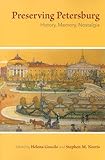
Helena Goscilo, Stephen M. Norris, eds. Preserving Petersburg: History, Memory, Nostalgia. Bloomington: Indiana University Press, 2008. 264 pp. $60.00 (cloth), ISBN 978-0-253-35142-5; $22.95 (paper), ISBN 978-0-253-21980-0.
Reviewed by Michael Hamm (Centre College)
Published on H-Urban (September, 2009)
Commissioned by Alexander Vari (Marywood University)
Preserving St. Petersburg: Sketches of Memory and Survival
Preserving Petersburg. History, Memory, Nostalgia gives us tidbits of history but lots of memory and nostalgia. Collectively, the essays underscore the fact that for many Russians, Piter is a nostalgia museum, a sacred place. Owing to the radical makeover of Moscow during Iurii Luzhkov’s many years as mayor, Helena Goscilo tells us, Russians no longer view the capital but rather “Petersburg, with its crumbling edifices, peeling paint, and all too visible lack of renovation, as the repository of Russia’s national traditions” (p. 84).
In one particularly interesting essay, “Leningrad Culture under Siege (1941-1944),” Cynthia Simmons observes that some Leningraders welcomed the war if only because it promised to end the Stalinist terror. Upon hearing about the declaration of war, literary scholar Lydia Ginzburg told her diary: “There was as yet no suffering, no mortal anguish, no terror; on the contrary, there was an excitement–and a feeling bordering on elation that this life was coming to an end" (p.165). Having lived through the thirties, many had become impervious to fear. Memoirist Dmitrii Likhachev offers this summary of wartime Leningrad: “In starvation people showed themselves, revealed themselves, freed themselves from any kind of trumpery: some turned out to be wonderful, unparalleled heroes; others--villains, scoundrels, murderers, cannibals. There was no middle ground" (p.173). Simmons’s theme overall is that “pride of place” made Leningraders determined to defend their city.Defense of their “cultural monuments, whether written, painted, sculpted, or performed, had the power, for some, to reaffirm humanity and transcend the horrors of war" (p.179).
Of the city’s signature identities–the cradle of revolution, the site of the siege, and the home of imperial culture, Richard Stites argues that “only the grandeur of St. Petersburg imperial culture is left" (p. 182). However, the 1,100-room Hermitage, formerly the Winter Palace, which overshadowed the city’s other cultural monuments even in Soviet times, stands even taller on the tourist trail in the post-Soviet era of marketized arts. Stites bemoans the fact that other testaments to the city’s glorious cultural past, particularly its concert halls, have been left to decay. The Russian Museum, which has a fabulous collection of Russian masterpiece art, also remains a poor relative to the Hermitage. Stites spent several months perusing what appear to be scores of unknown paintings in the attic of the Russian Museum. These paintings, which depict everyday scenes such as peasants at work, metallurgical foundries and other enterprises, drunken tavern patrons, and bourgeois home interiors, have never been displayed. Because of “pious and elitist selectivity" (p. 191), he argues, the viewing public is denied exposure to a more nuanced and balanced account of Russia’s history.
According to Vladimir Khazan’s essay, “Petersburg in the Poetry of the Russian Emigration,” “the lament for the ‘dead city’ became one of the recurrent themes of poetry in emigration" (p.124). Of course, former natives felt the greatest nostalgia for the city, dreaming of “the miasmas of the Marquisan Meadow, smoked by the Petersburg fogs" (p.116). But even those émigrés who had never visited St. Petersburg wrote poems to this symbol of paradise lost, at least in part because this city, more than any other, had become “inseparable from Russian literature" (p. 118).
Helena Goscilo’s essay, “Unsaintly St. Petersburg? Visions and Visuals,” highlights the works of sculptor Evgenii Lansere (1875-1946); graphic artist and engraver Anna Ostroumova-Lebedeva (1871-1955), a student of Russian master Il’ia Repin who also spent two years in the studio of American painter James Whistler; and Mstislav Dobuzhinskii (1875-1957), whose drawings also depicted Naples, London, Bruges, and Vilnius. Goscilo’s essay includes a number of haunting illustrations: among them, Boris Kustodiev’s eerie depiction of Akakii Akakievich’s solitary nighttime walk along the city’s streets from the 1905 edition of Gogol’s Overcoat (p. 64); Vasilii Surikov’s “intensely atmospheric” View of the Monument of Peter 1 (1870) (p. 68); and Ostroumova-Lebedeva’s engraving of The Summer Garden (Catherine’s Palace, 1902) (p. 74).
Preserving Petersburg also includes essays on architecture by William Craft Brumfeld; on “The City’s Memory: Texts of Preservation and Loss in Imperial St. Petersburg” by Julie Buckler; on Rome and St. Petersburg in Osip Mandelstam’s poetry by Zara Torlone; and on the city’s minority groups by Steven Duke. Scandinavian peoples had settled the area before Peter the Great acquired the region in the Great Northern war in 1703, Duke reminds us. Thousands of non-Russians then came to the city, providing various kinds of construction and commercial skills. During the eighteenth century, most non-Russians lived in separate slobody, or neighborhoods. Baltic Germans, many of whom served in the imperial bureaucracy, played a particularly important role in the social, educational, and economic life of the city, as did thousands of Finns, many of whom became prominent in professional trades such as gold- and silversmithing, metalworking, clockmaking, textiles, and carpentry. These middle-class Finns played an important role in demanding that educational opportunity in the Finnish language be afforded to the empire’s Finnish population.
Stephen M. Norris concludes the collection with a stroll through the city during its tercentenary in 2003, noting that post-Soviet Petersburg has suffered a serious economic decline while acquiring the reputation as Russia’s capital of crime. Indeed, a television series Banditskii Petersburg (Bandit Petersburg) managed to air forty-two episodes. Ex-president Vladimir Putin, a native Petersburger whom some say “aspires to be Peter the Great” (p. 211), allocated forty billion rubles to renovate the city’s core. In May 2003 Putin turned tour-guide, leading some forty heads of state through the city’s monuments. (American president George Bush, embroiled in controversy over the Iraq War, attended a ballet and a laser show on the second day of the gala). In preparation for this event, Putin mandated that entire neighborhoods be cordoned off, that walls be built around unsightly buildings, and that local citizens be encouraged to leave. In short, to the howls of Russian comedians, Petersburg became something of a Potemkin Village. One bold Moscow professor went so far as to claim that Putin was hardly Peter the Great. “[P]sychologically he is much closer to the Emperor Paul--a tragic figure, contradictory, and slow-witted" (p. 231).
On the very first page of the collection, William Craft Brumfeld tells us that even as the City of Peter became the City of Lenin, “its perverse climate and monumental architecture served to remind one of an almost mythical past--and of a capacity for survival against unthinkable odds.” In this statement he sets the tone for the book, for collectively the authors remind us that Petersburgers have always known that they have something special, something they have worked hard to protect and preserve. Challenges continue. The Russian energy giant Gazprom wants to build a business center that includes a 300–meter (nearly 1,000-foot) modernistic tower that would fundamentally alter (or for many, destroy) the city’s historic skyline. The giant tower and its glitzy auxiliary office buildings appeal because they would symbolize Russia’s arrival as a global energy giant; so, as Norris reminds, postmodern Petersburg once again has become a focus for discussions both about Russia’s history and its place in the modern world.
In their introduction, editors Goscilo and Norris say very little about the exceptional industrial and commercial importance of St. Petersburg and its port, or about the role of the city in the revolutionary events of 1917. These topics have indeed been covered in other, more comprehensive histories of the city.[1] Preserving Petersburg will appeal mainly to scholars who are interested in the arts and those who are already familiar with the city’s history and monuments. For that audience, this collection is a good read.
Note
[1]. Readers who know little about the city may therefore wish to consult Alexander Rabinowitch, The Bolsheviks Come to Power: The Revolution of 1917 in Petrograd (New York: W. W. Norton, 1976); Alexander Rabinowitch, The Bolsheviks in Power: The First Year of Soviet Rule in Petrograd (Bloomington: Indiana University Press, 2007); Harrison Salisbury, The 900 Days: The Siege of Leningrad (New York: Harper & Row, 1969); James H. Bater, St. Petersburg: Industrialization and Change (Montreal: McGill-Queen’s University Press, 1976); James H. Bater, “Between Old and New: St. Petersburg in the Late Imperial Era,” in The City in Late Imperial Russia, Michael F. Hamm, ed. (Bloomington: Indiana University Press, 1986), 43-78; Solomon Volkov, St. Petersburg: A Cultural History (New York: Free Press, 1995); Dmitri Shvidkovsky St. Petersburg: Architecture of the Tsars, trans. John Goodman, (New York: Abbeville Press, 1996); Arthur L. George with Elena George, St. Petersburg: Russia’s Window to the Future: The First Three Centuries (Lanham, MD: Taylor Trade Publishing, 2003); W. Bruce Lincoln, Sunlight at Midnight: St. Petersburg and the Rise of Russia (New York: Basic Books, 2002); and George E. Munro, The Most Intentional City: St. Petersburg in the Reign of Catherine the Great (Madison: Fairleigh Dickinson Press, 2008).
If there is additional discussion of this review, you may access it through the network, at: https://networks.h-net.org/h-urban.
Citation:
Michael Hamm. Review of Goscilo, Helena; Norris, Stephen M., eds., Preserving Petersburg: History, Memory, Nostalgia.
H-Urban, H-Net Reviews.
September, 2009.
URL: http://www.h-net.org/reviews/showrev.php?id=24136
 | This work is licensed under a Creative Commons Attribution-Noncommercial-No Derivative Works 3.0 United States License. |

