



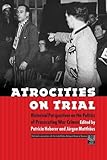
Patricia Heberer, Jürgen Matthäus, eds. Atrocities on Trial: Historical Perspectives on the Politics of Prosecuting War Crimes. Published in association with the United States Holocaust Memorial Museum. Lincoln: University of Nebraska Press, 2008. xxx + 327 pp. $29.95 (paper), ISBN 978-0-8032-1084-4.
Reviewed by Jonathan Lurie (Rutgers)
Published on H-Law (September, 2009)
Commissioned by Christopher R. Waldrep (San Francisco State University)
Waning of the Vandetta
To observe the passage of half a century since the Nuremberg Trials and their progeny, the United States Memorial Holocaust Museum planned a volume of essays, based on recent scholarship, seeking to reinterpret these events in the light of changing historical perspectives. This book is the result, and while the fourteen essays in it are far from easy reading, they comprise a well-written, thoroughly researched, and thought-provoking volume. It leaves the reader (if this reviewer's reaction is typical) depressed and somewhat pessimistic concerning the future of any meaningful international policing of nation/state misconduct. Of course there can be no happy ending here. But even worse is the dim prospect of improvement, however minimal it might be. Is it possible after so much horror, slaughter, and destruction of individuals as well as entire communities that genocide and mass extermination could continue? After reading this book, regardless of whether or not you are familiar with recent international events, the answer is clear: not only possible but probable.
Patricia Heberer and Jürgen Matthäus have divided their book into four sections following an introduction called "War Crimes Trials and the Historian." They are: "Precedents in Punishment," "Allied Courts and German Crimes in the Context of Nuremberg," "Postwar Society and the Nazi Past," and "Current Aspects and Implications." If one theme unites the essays, it is the existence of laudable intentions with diminishing results, as France, Great Britain, the Soviet Union, and the United States turned to planning for punishment as the Second World War ended in Europe. But it was more than punishment that motivated the victors. Telford Taylor, a key American prosecutor, stated, "It is our deep obligation to all the people of the world to show how and why these things happened" (p. x). Similarly, Justice Robert Jackson, on leave from the U.S. Supreme Court to serve as chief prosecutor for the initial Nuremberg Trials, emphasized "the wrongs which we seek to condemn and punish have been so calculated, so malignant, and so devastating, that civilization cannot tolerate their being ignored because it cannot survive their being repeated" (p. 103). Two questions should be kept in mind as one reads these essays: First, besides the obvious exceptions of the death penalty, how effective were the punishments handed down? And second, in terms of history since 1947, how lasting have been the lessons so important to Taylor and Jackson?
The negative label of "victors' justice" has been intermittently applied to European war crimes trials since 1945. It would seem that the harsher the imposed penalty, the more strident the outcry. Criticism is implied by the label, but one wonders about its validity. Of course, favorable outcome of a war will invariably result in victors' justice. Who else would be in any position either to exercise it directly or else to order that it be carried out? Early in this volume, one reads about an intriguing incident where the victor ordered the vanquished to administer victors' justice.
In his essay, "The Lessons of Leipzig," Matthäus broadens our perspective of victors' justice, by analyzing the lesser-known German efforts at the end of World War I to try German natives for war crimes. Although badly defeated militarily by 1919, unlike the end of WWII Germany was neither invaded nor occupied. Further, the army "had lost neither its prestige as a bastion of national honor nor its close links to the centers of state power" (p. 7). In 1921, there was no international tribunal convened to try war crimes, a proposal opposed by Secretary of State Robert Lansing as well as Woodrow Wilson. Lansing feared the precedent of a tribunal "which would be ex post facto in nature" (p. 6). Instead, those who were accused faced German prosecutors and were defended by German counsel before the German Supreme Court (Reichsgericht). Nevertheless, resentment over these trials, especially from the German conservatives who considered them a national disgrace, contributed to the general political instability of the Weimar Republic. This negative reaction set an unfortunate precedent, which would be echoed--albeit in a more subtle manner--between 1945 and 1948.
By 1949, again the United States had turned prosecution of war crimes over to West Germany. It comes as no surprise to see that with the onset of the Cold War, replete with the perceived need to receive strong support from Konrad Adenauer, the new chancellor of the West German Federal Republic, continued severity of the war crimes trials was an early casualty. Jonathan Friedman observes that "American policy towards Germany shifted from one of occupation and denazification ... to one of reconstruction and integration" (pp. 92, 95). In the context of such events as the Berlin Air Lift, articulation of the Truman Doctrine, and the founding of the North Atlantic Treaty Organization (NATO), a growing number of observers argued that "the prosecution of former Nazis had become counterproductive, if not entirely pointless" (p. 150). The result was what Ulf Schmidt aptly describes as "a long and twisted process of German vergangenheitspolitik--the politics of dealing with a country's past--which ... aimed to annul Allied war crimes by invalidating trial sentences and by granting amnesty to alleged and real war criminals" (p. 150).
One important contribution of these essays is that they place war crimes in a much broader context and perspective than simply the well-known trial of twenty-four major military and Nazi officials. Between June 1945 and December 1947, the United States Army alone undertook to try almost 600 accused in some 226 trials. Of that number, 299 were sentenced to death, and 93 to life in prison. With one exception, these proceedings involved not the crimes against the Jews or crimes against humanity, but rather crimes against the American armed forces, a distinction of major importance to the American military. The exception was a trial of Germans associated with the killing center in Hadamar where at least 15,000 mentally ill and physically infirm officers, soldiers, and children were murdered. Indeed, there were half a dozen "euthanasia" centers in Germany prior to 1945, and "historians estimate" that at least 200,000 human beings died in them (pp. 28-29). Of special interest is the fact that the prosecuting JAG (Judge Advocate General) at the Hadamar trial was Leon Jaworski, later to gain distinction, if not fame, as the Watergate special prosecutor.
The essays reveal two traits common to the war crimes trials, whether they were held in the western zone or in East Germany. The allies were more interested in prosecuting crimes committed against their own military than against humanity. In Germany, in contrast, even as the allies' fervor for retribution lessened, the desire to punish the guilty also weakened in the perceived "suffering of the German population from the consequences of the war, be it Allied strategic bombing, the breaking up of the Reich, or the expulsion of Germans from its Eastern provinces" (p. 191).
This weakening of resolve was aided by a subtle transformation of law, orchestrated if not established by the German judiciary. In her essay "Tainted Law: The West German Judiciary and the Prosecution of Nazi War Criminals," Rebecca Wittman explores another dimension to the waning war crimes trials. In addition to the onset of the Cold War and other factors just discussed, she points to the extraordinary number of former Nazi judges who reclaimed their functions. In Bavaria, for example, in 1949 "81 percent of [its] former judges were former Nazis" (p. 212). Historically, never prone to question judicial authority, between 1946 and1952, Germans acquiesced "in an acceptance of criminal norms shaped entirely by a judiciary trying to shield itself from legal scrutiny" (p. 212). Accused Nazi offenders might be valiantly pursued by German authorities, but most of them escaped punishment. The problem, according to Wittman, "is to address the extent to which Nazi jurists infiltrated and shaped the West German justice system," a challenge that, in turn, brings under scrutiny "the legitimacy of the entire legal system," and "the will to do this did not [and does not] exist" (p. 226).
Heberer analyzes a related difficulty with Austrian trials of Nazi war crimes: an inability to determine guilt. Although it describes itself as the "first victim of Nazi aggression," since it "reemerged as an independent state in 1955," Heberer notes that Austria's record for trying war criminals is abysmal--thirty-five in more than half a century (p. 239). She points to Austria's "enduring refusal to accept responsibility for its citizens for the crimes of the Nazi era" (p. 241). Such avoidance confirms Austria's schwerer Umgang mit der Gesichte, "its difficult dealings with its history" (p. 241).
With one exception, these essays all point to the tragedy of terrible criminal wartime wrongdoing, augmented by consistent postwar avoidance after the initial outrage in 1945. Be it judges, physicians, bureaucrats, "desk murderers," be it in West or East Germany, Austria, Poland, or even France--the events are all too similar. Trials, once envisioned as a "history and morality lesson to the German public," were seen by the 1950s and thereafter "as an embarrassment and an obstacle to be removed" (p. 271). In spite of this fact, as Donald Bloxham argues in "Milestones and Mythologies: The Impact of Nuremberg," hugely expensive showpiece international trials can be expected to continue. "They create, a reassuring if often misleading sense of the restoration of order, a comforting illusion" that values so common to our society "are being upheld, even as they palpably are not in so many cases, and even as the greatest powers within that community continue to act as laws unto themselves" (p. 279). While we continue to glorify the role of law, Bloxham suggests that we "ponder the threats [from] wars of resource scarcity, or massive cross-border refugee movements likely to be brought on by global warming" (p. 280).
Which brings me to the final essay in this collection by Jon Roth, "Prosecution, Condemnation, and Punishment: Ethical Implications of Atrocities on Trial." What, he asks, has happened to the ethical conviction that the taking of human life is wrong? The conviction remains, but commitment to it is another matter. In this area, Roth observes, correctly, that the United States has been less than impressive during the half century since Nuremberg. Alone among its old Western allies, it has refused to join in establishing the International Criminal Court; and its role in the Saddam Hussein trial remains dubious at best. "The appearance, if not the reality, of political interference undermined confidence that the trial could be fair, a suspicion exacerbated by criticism that the trial" should have taken place "in an international court rather than in American-controlled Iraq" (p. 287). Recent events in the Balkans and Darfur, are only two examples of the truth that "the history of international trials regarding human rights abuses, crimes against humanity, and genocide creates melancholy more than celebration" (p. 288).
Roth also places Justice Jackson's famous rhetoric in more appropriate perspective. Repeated atrocity has continued and no demise of civilization has yet taken place. This fact suggests to Roth that "humankind is just civilized enough not to succumb completely to atrocity but not to keep it in check, either" (p. 289). This point leads him to a discussion of the sixth commandment (Thou shall not kill). Seen in the context of these essays, which Roth appears to have examined, he does not shy away from the truth "that the most distinctive quality about [the commandment] is the extent to which it has been violated--disregarded, dismissed, and disrespected" (p. 298). Further, the commandment "has never been backed sufficiently by credible sanctions, divine or human, that would ensure full respect for and obedience to it" (p. 298).
One can understand Roth's reference to Hegel's famous comment that "history is a slaughter bench" (p. 298). His point becomes even more poignant with the reference to Elie Wiesel who survived the concentration camps. "'At Auschwitz,' wrote Wiesel, 'not only man died, but also the idea of man.... It was his own heart the world incinerated at Auschwitz'" (p. 298). Roth does not note, but we should, that Wiesel mentions not Nazi Germany, but rather "the world." He insists that either God's inability or refusal "to prevent human beings from murdering one another ramps up humankind's responsibility for itself" (p. 301). For "the God who prohibits murder is also the same one who [has done or] will do relatively little, if anything, to stop human beings from committing homicide, genocide" (p. 301).
Thus in drawing his essay together, Roth also provides an epilogue for the offerings that preceded it. If "you shall not murder" also means that "you shall defend the life of the other, 'what can guarantee' respect for either of those imperatives?" (p. 301). Only mankind, and "nothing is more important than making them our key responsibility, for they remain as fundamental as they are in jeopardy, as vitally important as they are threatened by humankind's murderous destructiveness and indifference" (p. 302). The lesson of Nuremberg half a century later is that "effective prosecution, condemnation, and punishment against murderous atrocities depend on keen understanding of those truths and on sound and sustained ethical responses to them" (p. 302). In summary, this collection of essays is a challenge to read, but valuable insights await the reader who takes them up.
If there is additional discussion of this review, you may access it through the network, at: https://networks.h-net.org/h-law.
Citation:
Jonathan Lurie. Review of Heberer, Patricia; Matthäus, Jürgen, eds., Atrocities on Trial: Historical Perspectives on the Politics of Prosecuting War Crimes.
H-Law, H-Net Reviews.
September, 2009.
URL: http://www.h-net.org/reviews/showrev.php?id=24133
 | This work is licensed under a Creative Commons Attribution-Noncommercial-No Derivative Works 3.0 United States License. |

