



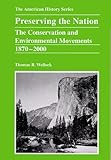
Thomas Raymond Wellock. Preserving the Nation: The Conservation and Environmental Movements, 1870-2000. The American History Series. Wheeling: Harlan Davidson, 2007. 384 pp. $21.95 (paper), ISBN 978-0-88295-254-3.
Reviewed by Megan Jones
Published on H-Environment (March, 2009)
Commissioned by Charles-François Mathis (Paris-Sorbonne University)
Conservationism, Preservationism, and Urban Environmentalism
In Preserving the Nation, Thomas Raymond Wellock aims to complicate the narrative of the conservation and environmental movements in the United States by relying on recent scholarship in environmental history from the past fifteen years. Wellock contends, as have many others, that the traditional narrative of conservation vs. preservation, best represented in the epic fight between John Muir and Gifford Pinchot over the Hetch Hetchy Dam, is too simplistic and omits important threads in the overall story. He argues that “the contemporary conservation and environmental movements grew out of America’s particular, and even peculiar, responses to nature and the dynamics of global industrial expansion and political modernization” (p. 3). He aims to integrate four new themes into the overall narrative: the impact of economic modernization on the conservation and environmental movements; transnational roots of environmental concern and thought; the role of race, class, and gender; and the role the conservation and environmental movements played in state formation.
Preserving the Nation is a synthetic study that integrates new sources and new interpretations into an overarching narrative about the origins and formation of the American conservation and environmental movements. This is not the first; Carolyn Merchant's Columbia Guide to American Environmental History (2002) is perhaps the best well-known work tracing the emergence of the American environmental movement. Wellock’s survey is part of The American History Series, edited by John Hope Franklin; all books in the series are intended for undergraduate and graduate students. Wellock’s good, if brief, synthesis adds to the growing historiography on the history of the American environmental movement, and is easily accessible, providing a very useful bibliographic essay as its conclusion.
Wellock defines the conservation movement in general as encompassing three distinct movements that emerged in the late nineteenth century: conservationism, preservationism, and urban environmentalism. In large part, this conservation movement emerged from growing concern about the adverse effects of industrialization and the consumption of natural resources. In his chronology, the latter two movements combined to form the new “environmentalism” that emerged in the postwar period, winning bipartisan support by 1970 (p. 4). This new movement became so fractured and weakened that some even claimed the death of environmentalism.
Wellock’s first chapter addresses the roots of conservation and the Progressive Era. Older narratives of the conservation movement, as it was called until the 1960s, usually placed the origins of this concern regarding the protection and management of natural resources at the turn of the twentieth century. Individuals who focused on preservation and conservation, like forester Pinchot and President Teddy Roosevelt, generally came from elite backgrounds, and wished to either preserve nature for aesthetic reasons or to manage it for the greater good. Wellock relies on recent scholarship to push the origins of the conservation and environmental movements back to the early nineteenth century, beginning with the regulation of commons land in New England. He also uses this new research to challenge the characterization of conservationists as solely elite women and men. Instead, Wellock points to research that indicates that this new movement, “grassroots in origins but global in scope,” drew inspiration from international developments and intellectual trends (p. 16). American conservation emerged “in part as a response to Euro-American colonial expansion,” though it was unique in its “national identity and democratic politics” (p. 17). Wellock states that nature was an important part of the American identity and that any European ideas regarding the management of nature were altered to fit the unique environment and political institutions in the United States. Individuals interested in conserving the environment had to persuade their fellow citizens of the idea that the urban and natural environments belonged to all, and that these environments needed the regulation and oversight of the government. Two conflicting elements emerged, which emphasized efficiency and equity, or economics versus morality. These elements struggled to gain the upper hand in directing the formation of the national state and controlling the nation’s natural resources. Wellock traces the early formation of government regulation from early management of fish harvests in mid-nineteenth-century New England to urban sanitary reform to sportsmen’s campaigns for wildlife preservation. Though hampered by their anthropocentric view of the environment, focus on one part of nature rather than the whole, and biases of status, these early conservationists “constructed a democratic consensus around the need to treat parts of the environment as a national commons,” setting the stage for a larger cohort of Americans to visit and appreciate nature, and therefore widen the movement (p. 73).
Wellock’s second chapter addresses the interwar period, in which experts bent on efficiency dominated and grassroots activists lost their edge. Historians of the environmental movement frequently speak of this period as a lull between two periods of intense environmental activism. Wellock instead emphasizes the dramatic shift in thinking that set the intellectual underpinning for the mass movement that would arise in the 1970s. Wellock indicates that, during the interwar and World War II periods, important shifts in thought occurred, namely concerns about the rise of consumer culture (particularly the dramatic rise in automobile usage) and pollution, and ecological thinking. The term “ecology” actually entered the American lexicon at the end of the nineteenth century, with Ellen Swallow Richards’s work integrating applied sciences into home economics.[1] However, it was not until Aldo Leopold and others began to think critically about game management practices and control of predator species in the 1920s that the concept of ecology did take root and shift how conservationists approached management of natural resources and considered entire ecosystems.
The major concerns of conservationists during the interwar period were game management and water reclamation, which often brought conflict between government agencies, like the Forest Service and Park Service. In the 1920s and early 1930s, government regulation of natural resources expanded under relatively conservative circumstances, with Republican presidents who generally favored cooperation with private industry. Concerned with restoring damaged environments, maximizing human benefits, and creating new governmental institutions, Franklin Delano Roosevelt’s New Deal conservation programs attempted to equalize rural and urban America. Roosevelt’s conservation plans had three main components: restoring damaged environments, maximizing human benefits through development programs, and creating new government institutions. The Civilian Conservation Corps democratized conservation by recruiting some three million unemployed, generally blue-collar men, to the movement. A more elitist aspect of conservation also grew during this period--wilderness preservation became the concern of a few, prompted by the growing consumerism in nature and the dramatically expanded use of cars to travel in parks. At the end of this period, the conservation movement had changed dramatically, and encompassed three different themes: “resource conservation, pollution control, and wilderness preservation” (p. 128). The presence of the federal government was the common thread that drew these concerns together. World War II acted as a watershed for conservation; afterward, a mass movement emerged in response to “social change, economic affluence, and suburban growth” (p. 129).
Wellock centers his third chapter on the evolution of the environmental movement between the years 1945 and 1973, focusing on the rising anxiety over the effects of affluence, suburbanization, and the Cold War. Nuclear weapons testing triggered the mass movement that emerged in the 1960s, largely in response to chemical pollutants and pesticides. The environmental movement was one of the many rights movements of the sixties, drawing many radicals into the fold and inspiring widespread activism. Wellock emphasizes that this new postwar environmentalism had much in common with its Progressive Era and interwar predecessors, particularly the fear that unchecked industrial capitalism and human intrusion would damage the environment. Activists still viewed the federal government as the appropriate authority in controlling and managing nature, though in this period many grassroots organizations formed in response to what they saw as government mismanagement and neglect. In response to this phenomenon, the Richard Nixon administration passed moderate environmental legislation to appease environmentalists and curry favor. After this period, the environmental movement fractured and lost much of its coherence.
The political awakening for the environmental movement came in the late 1950s, stemming from the debate over Echo Park Dam and the potential destruction of Dinosaur National Monument. One of the themes Wellock develops throughout his narrative is the struggle between proponents of efficiency, equity, and aesthetics; in this case, efficiency threatened to trump the others, as Cold War concerns drove the huge dam building projects proposed in the 1950s. Efficiency, however, became less and less of an important imperative in the postwar era, as individuals focused more on what Samuel Hays has termed “beauty, health, and permanence” (Beauty, Health, and Permanence: Environmental Politics in the United States, 1955-1985 [1987]). A new affluence allowed many Americans to focus on clean suburbs, good health, and expanded leisure time. This led many to protest the development of monstrous projects like Echo Park Dam, particularly as other natural wonders had been lost to dams in the past. As a result of this campaign against Echo Park, older conservation organizations grew to national stature and importance, particularly the Sierra Club. After this political awakening, organizations like the Wilderness Society began pushing for more radical legislation, namely the Wilderness Act that was eventually passed in 1964.
In the sixties, the environmental movement was reshaped by the emergence of grassroots activist groups, many led by women, who protested the indiscriminate use of chemicals and pesticides. The counterculture also fueled the new movement, as many rejected the suburban lifestyle and embraced a return to nature. The environmental movement appealed to both the Right and Left in this decade, making it unified. This would not last, as the environmental movement became institutionalized, forming a solidified movement rather than the more fluid one that had inspired many.
Wellock’s fourth chapter deals with the backlash against environmentalism and the fragmentation of the movement, ending his narrative in the year 2000. The 1970s became a decade of economic decline, oil shortages and rising fuel prices, and restricted federal budgets. The environmental movement no longer remained bipartisan as Republicans grew increasingly conservative and less friendly to green issues. More and more, it seemed as if people would be forced to choose between the economy and the environment, particularly in the Ronald Reagan years. Though the movement gained in popularity and strength in the 1960s and 1970s, this rapid growth led in part to the movement’s eventual deterioration. Like other rights movements of the sixties, environmentalism attracted a radical following. This varied group of activists clashed repeatedly with the more traditional conservationist groups focused on lobbying in Washington for change. The institutionalization of the environmental movement during this period and the reaction of radical fringes and minority environmental groups against corporate America led to disunity in the movement and an impotence not seen since the 1920s. Some good did arise from the splintering of the movement, as environmentalism came to encompass environmental justice activists and cultural critics who added their critiques of class, race, gender, and economic inequality.
Wellock succeeds in presenting a narrative that uses new scholarship to expand the boundaries of the old story of the conservation and environmental movements. He is not as successful in keeping his argument at the forefront. Part of his thesis speaks of the unique, even peculiar, nature of American conservationism and yet he does not compare the American phenomenon with the movement in any other nation. Wellock’s case for exceptionalism would be better supported had he included a comparative element to his narrative. This lack of a transnational flavor is the weak link in Wellock’s argument, particularly as he declares that these movements “grew out of America’s particular, and even peculiar, responses to nature” (p. 3). He does include a brief discussion on the European roots of the ecological ideal and the impact of imperialism on conservation, but places this in the bibliographic essay. Wellock’s thesis and narrative would have been strengthened by the inclusion of some of the excellent scholarship on foreign environmental histories and environmentalist movements.
Wellock does not present any new or striking arguments in his study; what is new is the synthesis of scholarship from the past few decades into an overall narrative detailing the rise of the conservation and environmental movements. Much of the findings in this book will not be new to environmental historians, but instead this study serves as an updated textbook of sorts for younger scholars and students of environmental history. Preserving the Nation is a fairly short, compact book that reads well and will be useful for classes in environmental history, or as a succinct refresher for more experienced scholars.
Note
[1]. Mary Joy Breton, Women Pioneers for the Environment (Boston: Northeastern University Press, 1998), 59.
If there is additional discussion of this review, you may access it through the network, at: https://networks.h-net.org/h-environment.
Citation:
Megan Jones. Review of Wellock, Thomas Raymond, Preserving the Nation: The Conservation and Environmental Movements, 1870-2000.
H-Environment, H-Net Reviews.
March, 2009.
URL: http://www.h-net.org/reviews/showrev.php?id=24098
 | This work is licensed under a Creative Commons Attribution-Noncommercial-No Derivative Works 3.0 United States License. |

