



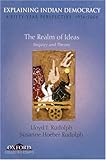
Lloyd I. Rudolph, Susanne Hoeber Rudolph. Explaining Indian Democracy: A Fifty Year Perspective, 1956-2006, vol. 1, The Realm of Ideas Inquiry and Theory. Oxford: Oxford University Press, 2008. 336 pp. $50.00 (cloth), ISBN 978-0-19-569364-5.
Reviewed by Maya Chadda (William Paterson University of New Jersey)
Published on H-Asia (April, 2009)
Commissioned by Sumit Guha (The University of Texas at Austin)
Politics in India
The task of reviewing scholarly work that spans half a century is difficult to say the least. It is all the more daunting when the contributors have shaped (as Lloyd I. and Susanne Hoeber Rudolph have) the substance and direction of inquiry in a field. A whole slew of younger scholars have drawn on this inheritance to enrich academic understanding of India. To a no small degree, Lloyd and Susanne Rudolph and their intellectual progeny have made the study of India one of the most dynamic and exciting fields of area studies today.
Lloyd and Susanne Rudolph’s The Realm of Ideas Inquiry and Theory is the first in a series of three volumes (Explaining Indian Democracy) and consists of several chapters--essays written by the two authors over half a century beginning with their own careers in the 1950s. It is devoted largely to explaining change and political developments in India. The volume consists of two parts. The first part is devoted to critical essays on existing modes of inquiry and to ideas and concepts that explain India’s changing political economy. Here, the authors make their seminal contribution in rejecting the dichotomy of tradition and modernity. They argue that these should not be seen as a pair of opposites but as a continuum in which modernity is integrated into traditional ways of doing things. For example, caste, they argue, should not be viewed as an obstacle but a vehicle of the electoral democracy. The essays in this part of the volume question settled assumptions and suggest alternative ways of understanding political developments and change in India.
Two essays deserve special mention: “Determinants and Varieties of Agrarian Mobilization” and “The Imperialism of Categories: Situating Knowledge in a Globalizing World.” The first provides an account of the agrarian transformation in great detail and questions many assumptions scholars of India studies have routinely made. For example, the authors argue that poverty, landlessness, or declining status does not automatically lead to protest or political mobilization. Not only do the possibilities and potential vary depending on local conditions, but they also do not automatically and necessarily translate into political mobilization. In short, poverty or landlessness is not a self-mobilizing condition, and they need an intervening agency to become protest. While on the face this conclusion seems unexceptional, it is not. A large number of scholars have argued that poverty or some other form of deprivation is the principal cause of political mobilization. Based on field studies they conducted or drawing on works of others, Lloyd and Susanne Rudolph demonstrate how agrarian mobilization actually occurs, and how different rural conditions and availability of mobilizing agency lead to different responses and outcomes. They provide us with an operational methodology to compare development and change in different parts of India.
In the second essay, written much later, the Rudolphs attack the Western, colonial categories of ideas and concepts that have held sway over modes of inquiry. Their objective was to build a bridge between "theory" and empirical reality. The purpose was to reshape theory in light of what they had found in the passage of their research and thinking. But they were acutely aware of the unexamined assumptions they themselves and others had made. These assumptions limited scholarly imagination in their view and turned India into no more than a faint echo of early modernizers in the West. Devoted largely to examination of concepts, categories, and modes of inquiry, these essays have performed an invaluable service to area studies and comparative politics, not to mention understanding the transformations that have occurred in India. Indeed, one might see how the authors evolved the design for their seminal work on India’s political economy represented in In Pursuit of Laxmi: Political Economy of the Indian State (1987).
The Rudolphs wrote the eight essays in the second part over forty years between 1961 and 2001. These essays explore how political culture shapes India’s institutions and why we need to revise the Weberian perspective on bureaucracy to correctly capture the mode and pace of political change. Several essays in this part examine the role of civil society and media in shaping political discourse. One can see the gradual shift in focus of inquiry as they incorporated findings and works by anthropologists, historians, and social psychologists. This is one of the wonderful aspects of this volume. It provides an account of how a field of inquiry can expand and deepen by incorporating insights from a whole range of social sciences. Lloyd and Susanne Rudolph’s own work is a testimony to the merits of such an inclusive approach. What is invaluable is to actually walk the path with them as they integrate new knowledge and connect new modes of inquiry to existing body of knowledge, on the one hand, and, on the other, expand the purview of theory to include new empirical knowledge. In this endeavor, one can trace the evolution of new sensitivities derived from pathbreaking new theories of Edward Said’s Orientalist epistemology or Michel Foucault’s deconstructionist approach or the concerns raised by subaltern studies. These developments have generated new questions or at least new ways of asking questions. The Rudolphs have shown remarkable capacity to subject their own vast body of knowledge to lenses of new perspectives.
Lloyd and Susanne Rudolph’s The Realm of Ideas Inquiry and Theory is an indispensable reading for students of area studies and India studies in particular, even though they might be familiar with the debates and arguments presented here. What this volume does is to provide the means to map the evolving modes of inquiry and body of empirical knowledge important to India’s political transformation within the democratic framework. General readers might find the essays somewhat difficult to pursue, but if they persevere their efforts will be richly rewarded.
If there is additional discussion of this review, you may access it through the network, at: https://networks.h-net.org/h-asia.
Citation:
Maya Chadda. Review of Rudolph, Lloyd I.; Rudolph, Susanne Hoeber, Explaining Indian Democracy: A Fifty Year Perspective, 1956-2006, vol. 1, The Realm of Ideas Inquiry and Theory.
H-Asia, H-Net Reviews.
April, 2009.
URL: http://www.h-net.org/reviews/showrev.php?id=24092
 | This work is licensed under a Creative Commons Attribution-Noncommercial-No Derivative Works 3.0 United States License. |

