



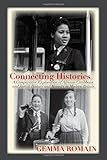
Gemma Romain. Connecting Histories: A Comparative Exploration of African-Caribbean and Jewish History and Memory in Modern Britain. Anthropology, Economy and Society Series. London: Kegan Paul, 2006. 300 pp. $135.00 (cloth), ISBN 978-0-7103-1223-5.
Reviewed by Anne Clendinning (Department of History, Nipissing University)
Published on H-Albion (February, 2009)
Commissioned by Mark Hampton (Lingnan University)
Collective Myth and Comparative Ethnic Histories
In this study, Gemma Romain explores the use of autobiography and collective myth in ethnic history with a comparative focus on Britain’s Jewish and African Caribbean immigrant communities. Although Jewish and African American populations have been the topic of frequent comparative studies in the American context, until recently, British academics have overlooked this promising field of enquiry. Romain’s study offers some much needed introductory work in this area. Published in Kegan Paul’s series on Anthropology, Economy and Society, the book’s focus is highly theoretical. The extensive literature surveys in the introduction, at the beginning of each section, and then in each chapter demonstrate the author’s familiarity with theories of autobiography, oral history, memory, race, and diasporas. However, the author is unable to apply so much theory to so few case studies and still develop a convincing argument. Consequently, the book’s conclusion that there are “divergences and differences within ethnic groups,” but, at the same time, "shared cultural memories and experiences” suggests that there is room for additional research in comparative ethnic history (p. 246).
In her examination of published immigrant autobiographies from both minority groups, Romain identifies “comparable experiences” (p. 2) and observes the similar ways that Jewish and African Caribbean immigrants to Britain remembered, recorded, and interpreted their relocation experiences despite the differences of skin color, religion, ethnicity, language, geographic origin, and arrival time. Of particular interest to Romain is the manner in which immigrant autobiographers recall, mask, or omit racist and anti-Semitic treatment. By undertaking “historical assessments of memory,” the author asks whether or not there is “a particular way that ethnic minority groups remember and document their experiences,” and if so, whether Jewish and African Caribbean immigrants share a common albeit “hidden history” based on their respective “remembering and re-remembering” of immigration to a new land (p. 36). Although the author poses a series of questions with every section and chapter introduction, it appears that this is the underlying issue that runs throughout the study.
The book is divided into three thematic sections. Section 1 focuses on the paradoxes of migration and arrival, and considers the impact of collective migration myths, of either the Promised Land or the Mother Country, on individual immigrant autobiographies. Section 2 assesses the “diasporic consciousness of Blacks and Jews” whose writing reflects on their own communities and the complexities of combined British and Pan-African or Zionist identities (p.112). Section 3 examines the suppression of ethnic memory, and subsequently, the reclamation of repressed and hidden histories, with an emphasis on incidents of racial violence. Despite the nod given to oral history in the introduction, Romain’s study is based on published immigrant autobiographies. Her examples are either the writings of first generation African Caribbeans who are reflecting on their personal experiences or the work of second and third generation Jewish migrants who recorded multigenerational histories beginning with their parents and grandparents, up to and including their own lives.
In all three sections, Romain considers how myths of belonging, exclusion, and identity define the history of the immigrant experience. For example, in section 1, for Jews escaping pogroms and conscription in Russia and Eastern Europe during the late nineteenth century, Britain was a Promised Land of economic prosperity and religious toleration, where a Jewish man could even rise to the post of prime minister. African Caribbean immigrants, the majority of whom arrived after 1945, were taught by the colonial school system to see Britain as the Mother Country. Already British Commonwealth citizens, they emigrated in search of employment and opportunity after the war. On arrival in Britain, both groups experienced racial discrimination; however, in their published autobiographies, African Caribbean immigrants reflected more openly on this treatment than their Jewish counterparts, thereby rejecting the myth of the welcoming Mother Country. Not surprisingly, the disappointment of African Caribbean immigrants, like Floella Benjamin and Willie Collins, with their academic knowledge of the Mother Country, was far greater than their Jewish counterparts, whose family members, according to Jewish autobiographer Linda Grant, had intended to move to the United States, but for various reasons, ended up in Britain. While Jewish immigrants faced discrimination under the 1905 Aliens Act and even racial violence in Leeds and Bethnal Green, according to Romain, Jewish autobiographers like Louis Teeman, quoted below, believed that the "‘English tradition of justice, hospitality and fair play’" had overridden initial ethnic prejudice (p. 104). Despite this difference, Romain concludes that Jews and African Caribbeans share “an analogous disillusionment narrative,” although this disillusionment has been subverted in the Jewish context (p. 106). To further qualify this conclusion, Romain states that none of the autobiographies she has analyzed in this section could be described as “traditional ‘everyday’ works,” defined as the products of community history projects, which then begs the question of why they were selected as representative histories singled out for such careful analysis (p. 106). Would Romain’s conclusions be different had the study examined “everyday” works?
Section 3 is the strongest in the book and potentially of greatest interest to historians. Herein, Romain considers the role of collective memory in Jewish and African Caribbean ethnic history comparing responses to the anti-Semitic disturbances in South Wales in 1911 and Leeds and Bethnal Green in 1917 to the Liverpool 1919 racial riots. These three events work well as historical case studies. Contemporary reporting of the riots in the national, local, and ethnic press is juxtaposed against published accounts and recorded memories. Attributing the 1911 and 1917 riots to “hooligans” responding to economic hardship and the frustration of war fatigue, at the time, the Jewish community was unwilling to label the outbreaks in South Wales, Leeds, and Bethnal Green as expressions of overt anti-Semitism. So anxious were they to appear as “loyal citizens to the state” that Jewish community leaders in Leeds thanked the local police, even though the officers had reacted slowly to the call for help and did little to protect Jewish businesses (p. 188). In contrast, African Caribbeans living in Britain recognized that the violence directed against black seamen in 1919 was racially motivated, and they responded through formal protest and demanded an enquiry into the death of Charles Wootton, who was killed by police in the fighting.
All three events were largely forgotten, until postcolonial scholarship focused attention on race and ethnicity studies. Oral history projects, like that commemorating the arrival of the SS Empire Windrush, and television and film, such as Paul Morrison’s 1999 production, Solomon and Gaenor, set against the 1911 riots, have facilitated the “re-remembering” or reinstatement of these events into public memory. Despite these examples, Romain offers no sense how ethnic re-remembering, as a collective process, actually works. Take the case of Wootton, for example. Sometime after the “remembering and forgetting concerning the 1919 riots,” Wootton’s death, and by extension the events of the 1919 riots, have been commemorated in a street and an adult education college (p. 204). How did this come about, and under what circumstances was a college built in 1974 named after an African seaman killed in 1919? By expanding on even this one example, readers might have learned a great deal about the relationship between ethnic history, popular memory, and the public commemorative process.
Like many academic monographs, Connecting Histories began as a doctoral dissertation. Unfortunately, the work might have gone too quickly to press since it appears to lack the kind of thoughtful and painstaking revisions of content and style that are necessary to convert a good thesis into an excellent book. A final comment on presentation: the bibliography is arranged alphabetically, but without the usual inversion of the first and surnames, making it not only bizarre, but also difficult to read, and surprising to find in book from a reputable academic press.
If there is additional discussion of this review, you may access it through the network, at: https://networks.h-net.org/h-albion.
Citation:
Anne Clendinning. Review of Romain, Gemma, Connecting Histories: A Comparative Exploration of African-Caribbean and Jewish History and Memory in Modern Britain.
H-Albion, H-Net Reviews.
February, 2009.
URL: http://www.h-net.org/reviews/showrev.php?id=23997
 | This work is licensed under a Creative Commons Attribution-Noncommercial-No Derivative Works 3.0 United States License. |

