



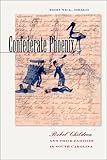
Edmund L. Drago. Confederate Phoenix: Rebel Children and Their Families in South Carolina. New York: Fordham University Press, 2008. Illustrations. x + 204 pp. $45.00 (cloth), ISBN 978-0-8232-2937-6.
Reviewed by Caroline Cox (University of Pacific)
Published on H-Childhood (August, 2009)
Commissioned by Patrick J. Ryan (University of Western Ontario)
Children and the Legacy of War
Edmund L. Drago’s mission in this thoughtful book is to bring the lives of children out from the shadows and expose them to light. According to the 1860 Federal census, children under fifteen years old made up 40 percent of the population of South Carolina, thus they were central to the state’s wartime experience and pivotal to the ways in which the war and Confederate ideals were later remembered.
Focusing his attention on white households, he examines topics as varied as boy soldiers, child-rearing practices, education, marriage, and the experiences of widows and orphans. In doing so, Drago has unearthed a wonderful range of materials about family life. He has found some rich stories in published memoirs, a vast array of archival sources, and contemporary newspapers. He faced the same dilemma many historians of childhood have: children do not leave many records. Most of the extant information about them comes from the adults around them and tends to be prescriptive. However, by careful digging, he has found the extant voices of children wherever possible and he has blended these deftly together with other sources to create a youthful world.
Drago uses the title image of a phoenix in two ways. Firstly, with secession, it symbolizes a rebirth of what white citizens saw as the good society that they believed would emerge through the storm and stress of war. Secondly, it represents the series of rebirths of Confederate ideals that occurred during Reconstruction and its aftermath, the economic crisis of the 1890s, and repeatedly through the twentieth century.
The dual focus on childhood and the image of the phoenix leads to problems in the work. The first is that, perhaps because of the lack of sources, Drago stretches childhood, as some contemporaries did, to include people in their twenties. For example, in the chapters on boy soldiers and education, he is clearly focused on younger children and youth, but in the one on marriage, he draws on the experiences of a significantly older cohort. Of course, this connects to the case he wants to make about the larger community and the carriers and transmitters of Confederate ideals, but, in the process, it blurs the focus on childhood. This creates tension in the text. The former requires a subtle exploration of a community in which children are an important but not all-encompassing part. The latter has them under the microscope. The larger issue of the community then competes with children and childhood for our attention.
Drago faces another dilemma with the symbol of the phoenix. He is concerned with the broad experiences of war and Carolina society, in this work and in his previous scholarship; this concern both illuminates and detracts from this book, which has an ostensibly narrower focus. For example, his chapter “Going Up the Spout” examines how the community faced the combined problems of military defeat and domestic upheaval and distress. It is an important story, and, as he observes in a footnote, one of his goals is to show how the battlefronts and home fronts “were connected in a symbiotic relationship” (p. 158). He has assembled some wonderful data on requests for draft exemptions in the state by region and craft skill. He has teased out from these petitions the anxieties men felt about either leaving their families or needing to return to them to help relieve hardship. These are key to the larger account of the state’s experience in defeat and links to the image of the phoenix--but children are largely missing from it. Having children leave the stage for this key part of the story creates a tension that remains unresolved.
That said, the wealth of stories Drago has uncovered makes this a rich resource. The experiences of the larger home community--of women and children, widows and orphans, and fathers desperate to stay at home or return there to support their families--bring wartime South Carolina society vividly to life. While most families had to rely on their own resources or relatives to cope with the crises they faced, there was also overwhelming personal generosity from strangers and a ramping up of institutional arrangements, such as the Charleston Orphan House to care for some of the newly destitute and alone.
Drago is a clear writer, always a plus, and his text is not burdened by historiographic debates that only interest scholars in the field. This adds to the accessibility of his prose. Clearly, on the experiences of South Carolina in the war, few people know more. However, the book would have benefited by being informed by some scholarship from other areas, which could have added context and perhaps prevented some jarring phrases. For example, when Charleston City Council felt compelled to sift out the undeserving from the deserving poor in its almshouse, it was acting in concert with policies that western philanthropists and municipalities had articulated for decades. Indeed, it would have been surprising if they had not done so and making that clear would have helped explain this institution’s actions. Similarly, Drago writes with concern that folk beliefs about medicine “persisted” even though college-trained doctors could offer little better until there was knowledge of sepsis later in the nineteenth century and much that they did offer was worse (p. 39). When Drago touches on the history of psychiatry, the absence of background scholarship becomes more problematic. For example, diagnosing depression or applying the modern label of “post traumatic stress disorder” from a distance of 150 years is very problematic for scholars in that field (p 110). It happens here without any caveats or context and begged for some clarification. Matters such as these detract from a work otherwise deeply informed by the scholarship of its primary field.
Confederate Phoenix has much to recommend it even though clarity of purpose would have greatly enhanced it. Drago has amassed some wonderful sources and informs his scholarship with a deep knowledge of the geographic and temporal world about which he writes.
If there is additional discussion of this review, you may access it through the network, at: https://networks.h-net.org/h-childhood.
Citation:
Caroline Cox. Review of Drago, Edmund L., Confederate Phoenix: Rebel Children and Their Families in South Carolina.
H-Childhood, H-Net Reviews.
August, 2009.
URL: http://www.h-net.org/reviews/showrev.php?id=23984
 | This work is licensed under a Creative Commons Attribution-Noncommercial-No Derivative Works 3.0 United States License. |

