



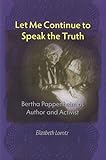
Elizabeth Loentz. Let Me Continue to Speak the Truth: Bertha Pappenheim as Author and Activist. Cincinnati: Hebrew Union College Press, 2007. x + 313 pp. $34.95 (cloth), ISBN 978-0-87820-460-1.
Reviewed by Katharina Gerstenberger (Department of German Studies - University of Cincinnati)
Published on H-Judaic (April, 2009)
Commissioned by Jason Kalman (Hebrew Union College - Jewish Institute of Religion)
German, Jew, Woman: The Identities of Bertha Pappenheim
Elizabeth Loentz’s book on Bertha Pappenheim (1859-1936) is not a conventional biography of the woman who is most famous for her position as leader of the League of Jewish Women and as the translator from Yiddish into German of seventeenth-century merchant Glikl of Hameln’s memoir. Neither is it yet another critical engagement with Pappenheim’s role as Anna O., Joseph Breuer’s famous patient to whom the “talking cure” is attributed. Instead, Loentz draws on Pappenheim’s literary works, her newspaper and journal publications, her correspondence, and her public lectures for her portrait of Pappenheim as an activist who put her writing into the service of her social, political, and religious convictions. Loentz shows how Pappenheim turned her identities as a German, as a Jew, and as a woman into a political agenda with which she intervened in some of the most virulent debates of her time. What is more, Loentz expands this discussion well beyond Pappenheim’s lifetime by analyzing how her biographers chose to present her and by examining representations of Pappenheim in works of art. Pappenheim thus comes to life through a series of texts--her own as well as those of others.
The book consists of seven chapters. The first four treat the major social and cultural issues in which Pappenheim was involved, namely the use of Yiddish among European Jews, the question of Zionism, conversion to Christianity, and the issue of white slavery. All of them show Pappenheim to have been a passionate agitator for her causes. Her positions, importantly, were generally moderate, aimed at presenting German Jewish identity as a model that successfully combined rather than separated the two categories. For example, she strongly discouraged the use of Yiddish among contemporary European Jews while at the same time acknowledging its importance in Jewish history. Chapter 5 is the most biographical, giving an account of Pappenheim’s spiritual development and religious practice. Each chapter usefully situates Pappenheim’s political views within their larger historical contexts. Chapters 6 and 7 address how Pappenheim’s biographers portrayed her and how artists incorporate her into works of their own, highlighting the remarkable range of ways in which her life as a public figure, but also, of course, as Anna O., continues to reverberate. She appears, for instance, in German writer Thomas Meinecke’s experimental novel Hellblau (2001). The brief afterword refers to the recent republication of Pappenheim's Gebete/Prayers (2003), and speculates how she might have reacted to the demands of contemporary Jewish women in Germany who, unlike Pappenheim, seek recognition as feminists, as religious Jews, and--here Pappenheim would have agreed--as Germans. With her closing reflections, Loentz also draws attention to the efforts of Jews in Germany today to assert and to shape Jewish life.
The issue of multiple and often contradictory identities, which is the underlying concern of this study, is by now a well-established theme among writers and critics. Pappenheim, Loentz shows, was a German, a Jew, and a woman who sought to demonstrate in her public as well as her private life that these three categories form a powerful and positive nexus. As a German, she was an anti-Zionist and a critic of Eastern European Jewish culture. As a practicing Jew, she was against conversion and emphasized the importance of women within Judaism. As a woman, she fought against the sexual and economic exploitation of women and children, a problem that was, in her view, particularly virulent among Eastern European Jews. Within each of these identity categories, she combined political agendas with private concerns, including her often remarked upon status as a single woman. Loentz’s study is, on a basic level, indebted to the feminist identity politics of the 1970s, a time during which Pappenheim gained some attention. It exemplifies perfectly how much these debates have benefited from theoretical advances like the ones suggested by Judith Butler and other scholars, and the greater inclusivity demanded by scholar-activists like Audre Lorde. Loentz adds to these advances extensive archival research. The resulting study is a detailed and sophisticated assessment of complex historical realities.
The works of writer and activist Pappenheim present a dual challenge to the scholar: first, it is virtually impossible to establish a complete corpus of her writings; second, much of the writings were written for political purposes, raising questions of genre and its status as literature. As a Jew who died in Germany in 1936, Pappenheim did not have the option of placing her works and papers in the safety of an archive. Despite the efforts of a friend, much of it was lost during the war. As a woman born in the late nineteenth century, she did not conform to the traditional profile of an artist. As a political activist, she published many of her works in newspapers and periodicals where they were not methodically preserved and registered. The conceptual challenges are just as vexing. Loentz acknowledges that Pappenheim’s writings might be described as "utilitarian literature," which is to say that they serve to convey social or political agendas (p. 8). Scholars, in particular feminists who set out to recover a tradition of women’s writing, have trained themselves to read and make productive non-canonical writings like Pappenheim’s. Loentz follows in this tradition, yet at times I wished she had examined these texts more closely for the “excess” of meaning inscribed in the work of art.
Loentz’s study is a pleasure to read. The prose flows beautifully with just the right combination of description and analysis. The narrative even contains an element of suspense, inspiring one to read on and to find out how Pappenheim’s story continues. The bibliography, which contains a significant number of sources that have not been examined or even documented before, is a tremendous accomplishment certain to inspire others to conduct further research on Pappenheim. The book will be of interest to readers in Jewish studies, German studies, women’s studies, history, or any combination thereof. It should also appeal to those immersed in border studies or comparative history, as Pappenheim was active not only in Germany but also in places like Poland, Ukraine, and Palestine. I believe that this work will also draw in a more general audience fascinated by this extraordinary woman for whom history records two different names. In Loentz’s book, we hear her in her own voice.
If there is additional discussion of this review, you may access it through the network, at: https://networks.h-net.org/h-judaic.
Citation:
Katharina Gerstenberger. Review of Loentz, Elizabeth, Let Me Continue to Speak the Truth: Bertha Pappenheim as Author and Activist.
H-Judaic, H-Net Reviews.
April, 2009.
URL: http://www.h-net.org/reviews/showrev.php?id=23963
 | This work is licensed under a Creative Commons Attribution-Noncommercial-No Derivative Works 3.0 United States License. |

