



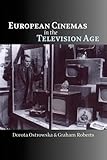
Dorota Ostrowska, Graham Roberts, eds. European Cinemas in the Television Age. Edinburgh: Edinburgh University Press, 2007. xi + 192 pp. $100.00 (cloth), ISBN 978-0-7486-2308-2; $30.00 (paper), ISBN 978-0-7486-2309-9.
Reviewed by Claudia Pummer (Department of Cinema and Comparative Literature, University of Iowa)
Published on H-German (June, 2009)
Commissioned by Susan R. Boettcher
Kinesthetics: Towards a New Cine-Televisual Aesthetics
Dealing with the relation between cinema and television, Dorota Ostrowska and Graham Roberts's anthology sets itself effectively apart from the bulk of recent publications that examine film and media in a specifically European context.[1] Echoing, at the outset, Tino Balio's similar project on the relations between Hollywood and television, European Cinemas in the Television Age significantly differs from its American "precursor," especially since it investigates cinema in the plural.[2] Following the basic structuring principle of most studies on Europe, each chapter focuses on a specific European country. However, this survey of film-producing nations in Europe appears rather imbalanced, insofar as only one chapter, Ostrowska and Malgorzata Radkiewicz's study of Poland, explicitly engages with eastern Europe. This underrepresentation of former communist nations is unfortunately also manifest in Margit Grieb and Will Lehman's chapter on Germany, which treats "German National Cinema in the Age of Television" exclusively as a West German phenomenon.
The book is nevertheless a compelling and comprehensive contribution to the contemporary discussion of cinema and media relations, precisely because it aims not so much at providing an all-inclusive European cinema/television history, than rather to produce a new understanding of a cine-visual aesthetics. The specific (national) history of the industrial, cultural, ecological, and aesthetic ties between film and television presented in each national chapter provides the editors with a rich selection of different kinds of cine-televisual relations, from which they develop their notion of "kinesthetics," presented in three final chapters. This book is, then, not only an account of the past fifty years of European cinema and television history, but rather develops by way of multiple histories a strategy of coming to grips with the present cultural challenges and transformations that impact both cinema and television in the digital age. "We have not yet learned how to think clearly about the result of media convergence," Ostrowska and Roberts explain in conclusion, "we are on the cusp of a paradigm shift to a (post) cinema (post) television age" (p. 157).
Ostrowska and Roberts argue ostensibly against the "apocalyptic mood" (p. 3) and the cultural antagonism that has dominated prior studies of cinema's relationship to television, insisting instead that television is not necessarily a threat to cinema or the film industry.[3] In their final chapter on "reproduction" they point to the televisualization of cinema by means of VCR and DVD technologies as follows: "If we rethink the relationship between cinema and television employing this idea of re-creation we can trace how the process whereby the difference between the two has been gradually erased: not in the way which resulted in the death of cinema but in its digitally enhanced rebirth" (pp. 162-163). Even though all nations experienced distinct forms of the televisualization and rebirth of cinema, they have in common that television provides the financial base for most European cinemas, often in conjunction with state funding and subsidies, sometimes following an explicit political agenda, as in the cases of post-fascist Spain (chapter 5) or communist Poland (chapter 8).
Chapter 1 on Britain, by Graham Roberts and Heather Wallis, cross-examines the different funding strategies of the BBC and Channel 4. The authors examine, for instance, how the specific selection strategies of the financers exclude rather than support new talents among filmmakers. Ostrowaska's second chapter focuses similarly on the two major film production bodies in French television, INA and Canal+. In addition, she outlines how French television incorporated the cinema d'auteur into its programming structure in order to raise its legitimacy and, beginning in the 1980s, created a new type of cinema when it began to produce a number of lavish heritage and costume films.
Heritage and costume films play also an important role in Polish cinema and television, both before and after the fall of state communism (chapter 8). In contrast to the situation in the West, as Ostrowska and Radkiewicz explain, television in Poland and other eastern bloc countries was not perceived as a threat to the cinema. The two media profited instead from a synergy that manifested itself especially in the production of cinematic films and TV serials and their simultaneous adaptation of a classic title from national literature. The adaptation of classics is also an important feature in early Italian television, as Luisa Cigognetti and Pierre Sorlin point out in chapter 4. In contrast to most countries in Europe, Italian television in the 1950s did not immediately cause a significant decline in cinema attendance. Television focused not on the entertainment of the masses, but rather followed an educational pursuit, for instance, by adapting national classics, yet without trying to copy cinematic aesthetics. A cinematization of television only occurred in the 1980s with the emergence of private television and the rise of the Silvio Berlusconi media empire.
In the following chapter, Valeria Camporesi examines Spanish television by tracing the transition from the last years of Francisco Franco's rule to the democratic era. In an attempt to distance itself from its previous role as a medium of propaganda, Spanish television followed the cinema in its embrace of popular culture and thus underwent a process of "youthification." The relationship between cinema and television, however, remained largely virtual. While television in Germany, France, or Britain became the prime financer of cinema in the 1960s and 70s, Spanish television began to occupy this role only sincethe 1990s.
Margit Grieb and Will Lehman's chapter on Germany describes paradigmatically how West German television, backed by state subsidies, began to finance German films in the mid-1960s, an institutional framework that significantly supported the emergence of the New German Cinema. Focusing on two directors, Alexander Kluge and Wim Wenders, the authors examine the relationship between television and cinema from the perspective of the film auteur. Both authors maintained very different attitudes and work relations towards the medium of television, yet each one attests to the fact that television has evolved into an undeniable economic and aesthetic force that significantly reshapes our current idea of cinema.
The seventh chapter, on Denmark, written by Ostrowska in collaboration with Gunhild Agger, presents the most compelling discussion of a national cinema's relation to television. The authors outline how Danish children's television of the 1970s and 1980s had a major institutional and aesthetic impact on the creators of the Danish dogme 95 film movement, which effectively contests, for instance, the general critical assumption that dogme 95 was predominantly modeled after the cinematic French New Wave.
In the three final chapters, Ostrowska and Roberts interrogate the findings reached by the contributing authors in each chapter and from there develop a convincing reading of a new aesthetics and history of cine-televisual relations. Chapter 9 provides a succinct overview of the history of television and cinema that does not offer any new radical insights, but sets the stage for their following theoretical conceptualization of the two mediums' mutual influences and ultimately their osmosis into a new form of cine-televisual aesthetics. "The presence of cinema in this televisual framework transforms television into something else," the editors write. "There is a limited part of television, which is shaped by cinema into kinema. It is in cinema where the contamination is much more visible and detectable" (p. 157).
Chapter 10 develops consequently the concept of "kinesthetics" by focusing on the filmmaker Pawel Pawlikowski who not only bridges the aesthetic realm of television and cinema, but interestingly also the national borders of the Polish and British film/TV industries. "Because of Pawlikowski's movement between cinema and television," the authors suggest, "he is a kineaste and his are not cine- or televisual aesthetics but kinesthetics--this new type of form which can only exist when a kineaste is entrenched in both worlds and is constantly moving between the two.... Many of the film-makers have crossed into television in order to renew public interest in their film-making, in order to reach a wider audience and to find ways of starting to make films again. In the case of Pawlikowski his kinesthetics grow out of the longing for cinema. He is fully in control of the televisual and cinematic language and fuses the two into new aesthetic forms, ... [molding] the formal language of television and cinema into a new one. Kinesthetics is a new dialect of visual artists today.... Thus kinesthetics explores an ignored, neglected and misunderstood feature of post-war cinema-television" (p. 156). This proposition of a transnational European auteur as "kineaste" presents the most novel and unique critical reading of the book and it is developed convincingly on the basis of the prior national essays.
Thus, rather than postulating the end of cinema and television, the editors understand kinesthetics as a starting point "to re-examine the cine-televisual tragic lore," following "the combined and multifaceted impact of the digital technology," as Ostrowska and Roberts explain in their final chapter on "Reproduction" (p. 160). This book, then, not only successfully contests the prior notion of perceiving cinema and television solely as part of an antagonistic relationship, but it also follows and contributes to a major critical impetus in current visual media studies (and cinema studies in particular): the redefinition of the cinematic in and for the digital age.[4] This tendency reminds us that some of the first visionaries of early television were European film authors like Jean Renoir or Roberto Rossellini. When French film theorist Andrė Bazin interviewed both in 1958, Renoir stated that by adopting the techniques of television "one should be able to arrive at a new cinematographic style."[5] A new style for a modern age, as Rossellini was quick to add: "Modern society and modern art have been destructive of man; but television ... an art without traditions, dares to go out to look for man."[6] Only time can tell if the practice of kinesthetics holds similar potential for the global and digital age.
Notes
[1]. The most important recent critical studies on European cinema are: Jill Forbes and Sarah Street, eds., European Cinema: An Introduction (Hampshire: Palgrave, 2000); Ian Aiken, European Film Theory and Cinema: A Critical Introduction (Bloomington: Indiana University Press, 2001); Dimitris Eleftheriotis, Popular Cinemas of Europe: Studies of Texts, Contexts, and Frameworks (New York: Continuum, 2001); Catherine Fowler, ed., The European Cinema Reader (London: Routledge, 2002); Anne Jackel, European Film Industries (London: BFI, 2003); Elizabeth Ezra. European Cinema (Oxford: Oxford University Press, 2004); Thomas Elsaesser, European Cinema: Face to Face with Hollywood (Amsterdam: Amsterdam University Press, 2005); Rosalind Galt, The New European Cinema: Redrawing the Map (New York: Columbia University Press, 2006); and Temenuga Trifonova, ed., European Film Theory (New York: Routledge, 2009).
[2]. Tino Balio, ed., Hollywood in the Age of Television (London: Unwin, 1990).
[3]. The editors mention in particular the following studies: Susan Hayward, French National Cinema (London: Routledge, 1993); James Monaco, How to Read a Film (Oxford: Oxford University Press, 1981); and Susan Sontag, "Decay of Cinema," New York Times (February 25, 1996).
[4]. On cinema in the digital age, see Lev Manovich, The Language of New Media (Cambridge: MIT Press, 2001); John Belton, "Digital Cinema: A False Revolution," October 100 (Spring 2002): 98-114; David Rodowick, The Virtual Life of Film (Cambridge: Harvard University Press, 2007); and Garrett Stewart, Framed Time: Toward a Postfilmic Cinema (Chicago: University of Chicago Press, 2007).
[5]. Roberto Rossellini, My Method: Writings and Interviews, ed. Adriano Aprà (New York: Marsilio Publishers, 1995), 91.
[6]. Ibid., 94.
If there is additional discussion of this review, you may access it through the network, at: https://networks.h-net.org/h-german.
Citation:
Claudia Pummer. Review of Ostrowska, Dorota; Roberts, Graham, eds, European Cinemas in the Television Age.
H-German, H-Net Reviews.
June, 2009.
URL: http://www.h-net.org/reviews/showrev.php?id=23953
 | This work is licensed under a Creative Commons Attribution-Noncommercial-No Derivative Works 3.0 United States License. |

