



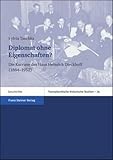
Sylvia Taschka. Diplomat ohne Eigenschaften? Die Karriere des Hans Heinrich Dieckhoff (1884-1952). Transatlantische Historische Studien: Veröffentlichungen des Deutschen Historischen Instituts. Stuttgart: Steiner, 2006. 289 pp. EUR 45.00 (cloth), ISBN 978-3-515-08649-3.
Reviewed by David Thomas Murphy (Department of History and Political Science, Anderson University)
Published on H-German (November, 2009)
Commissioned by Susan R. Boettcher
Moral Milktoast or Principled Patriot? Dilemmas of a Moderate Nationalist Bureaucrat
National Socialism's succession to power in January 1933 presented Germany's professional diplomats with a troubling question: should they continue to pursue their careers in the service of a movement for which many privately felt apprehension and distaste? A few decided in the negative. Friedrich von Prittwitz und Gaffron, German ambassador to the United States since 1927, resigned in March "aus Gründen des persönlichen Anstandes" (p. 132). Rudolf Nadolny, after accepting an appointment to Moscow, quickly followed suit, ending a distinguished thirty-two-year diplomatic career. The vast majority, however, quietly stifled personal misgivings and went on with their careers under the new masters. Among these was the man who became the last Nazi ambassador to the United States, Hans Heinrich Dieckhoff, the subject of this illuminating monograph by Sylvia Taschka.
Dieckhoff is one of those minor but not insignificant figures whose name appears in passing in many venues, but about whom not much has been written, and Taschka's work represents a welcome contribution to our understanding of the continuities and ruptures in the German diplomatic service in the turbulent era of the world wars.[1] A bureaucratic career, and one directed to relations between states, seemed almost predestined from birth for Dieckhoff. His father enjoyed a distinguished career in the Wilhelmine bureaucracy, mostly while living in Alsace, and the young Dieckhoff grew up in the newly acquired border district. Dieckhoff traveled widely with his cultured family, to Italy, France, Switzerland, and other destinations, and later, as a student, he spent semesters in Lausanne, Berlin, and Oxford, acquiring along the way a fluent command of English. A compulsive, life-long writer, Dieckhoff left a draft of a never-published autobiographical memoir, in addition to a wealth of lengthy, chatty, and revealing letters, punctilious travel diaries that he kept religiously from the age of eleven, and many more records, a trove that Taschka skillfully mines for revealing insights into his privately held views.
A deft and ambitious student, Dieckhoff progressed smoothly through the academic cursus honorum intended to culminate in a professional bureaucratic career in the Kaiserreich. He studied law, achieving the doctoral degree at Marburg in 1906, and served his training in a number of posts in the imperial court system--including a brief stay in German Tsingtau--before completing his assessor's exam in 1912. Entering the Foreign Office in December of the same year, he promptly transferred into the diplomatic service where, as a middle-class Roman Catholic, he was something of an outsider in a branch of the bureaucracy dominated by Protestant aristocrats. His first foreign appointment came shortly thereafter, when he was appointed to a post as attaché in the German service at Tangier during the fateful spring and summer of 1914.
Dieckhoff saw combat with the German army in Belgium and Poland, but in 1915 he was recalled from his unit and dispatched to represent German interests in Baghdad, then under threat from advancing Russian armies. Instead, he landed in Istanbul and was able to witness at first hand Germany's official response to the Turkey's genocidal "relocation" of Armenian Christians. This response was divided, hampered by sharp divisions between the head of Germany's delegation, Wolff Graf Metternich, who was sharply critical of Turkish actions, and his advisor Konstantin von Neurath, who wished to tread lightly in dealing with Germany's valued ally. Dieckhoff, reacting with a moral equivocation foreshadowing the posture he would adopt three decades later, was unable, or perhaps unwilling, to decide whose path was the more appropriate, professing instead to find both responses admirable.
When the shipwrecked Kaiserreich went under at war's end, Dieckhoff fought clear of the sociopolitical whirlpool that drew so many Germans into the polar extremes of the Weimar political spectrum. He considered supporting the DDP, but for many reasons (more about which momentarily), chose instead to back the Center Party. Fearing communism and distrusting the socialists, he was equally critical of Weimar's rightists, holding the DVP and DNVP, with some justice, to be the political embodiments of all that led to Germany's disaster between 1914 and 1918. For radicals on the Right, Dieckhoff had absolutely no patience. Of Erich Ludendorff and the proponents of the stab-in-the-back myth, he wrote, tellingly: "Erst haben uns diese Leute durch ihre Provokationen den Krieg eingebrockt, dann haben sie ihn durch mangelhafte Führung verloren und nun stellen sie sich in der Pose des trauernden Patrioten hin. Eine widerwärtige Gesellschaft!" (p. 54). He was even more impatient with the Nazis. While supporting a strong national opposition, as he put it, he abhorred the "Hitler-Unsinn," and "das Geschrei, wie wir es nun, laut und sinnlos, seit Monaten von ganz rechts hören" (pp. 85; 115).
Dieckhoff's diplomatic service during Weimar was varied, including an early stint in Chile, followed in 1922 by a lengthy first appointment in the United States, where he remained until January 1927 and took an active part in the work of the so-called Mixed Claims Commission. Though initially inclined to view the United States as a land without culture, he grew over time to appreciate many aspects of life in America, particularly the rough-and-tumble vigor of its entrepreneurial economic culture. At the same time, he was sensitive to and critical of the widespread racial prejudice, anti-Catholicism, and provincialism of 1920s American society. He was particularly moved by an encounter with a Native American put on display at a suburban Washington farmer's market in the summer of 1923: "Mir tat der Indianer mit seinem Federschmuck in der Seele weh. Vor 200 Jahren beherrschten diese Menschen das ganze Land und jetzt sind sie, in vereinzelten Exemplaren, eine umgaffte Jahrmarktsattraktion!" (p. 90).
Such expressions the author takes, perhaps too charitably, as proof that Dieckhoff possessed "ein äußerst intaktes Moralempfinden für Fragen ethischer Natur" (p. 90). The bulk of Taschka's book, however, which treats Dieckhoff's service of and attitudes toward the Nazis, might lead some readers to less charitable conclusions regarding the ease with which a man of such apparently fine moral apprehension repressed his ethical misgivings when they clashed with his career or service to the state. Despite the misgivings Dieckhoff and many of his colleagues felt after January 1933, and the fact that many of them, including Dieckhoff, explicitly reflected upon the alternative of abandoning the service rather than work for the Nazis, he clung instead to Bülow's oft-cited slogan: "Man läßt sein Land nicht im Stich, weil es eine schlechte Regierung hat."
Just how bad that government would become was perhaps not immediately apparent to nationalists like Dieckhoff, who, as Taschka relates, was deeply moved by the patriotic ceremony of the carefully staged "Day of Potsdam" and Adolf Hitler's so-called "Peace Speech," which followed shortly in the spring of 1933. Despite a clear comprehension of the propagandistic intent of the former, and of the disingenuous diplomatic expediency of the latter, Dieckhoff seems to have persuaded himself that they indicated the possibility of moderation and maturation of the Nazi political Weltanschauung under Hitler.
Appointed to the ambassadorial post in Washington in March of 1937, the charming and cordial Dieckhoff was quickly accepted by many Americans as a sympathetic, liberal German who stood in stark contrast to what they perceived to be the bellicosity of the government he represented. And in some ways this perception was accurate. He worked hard to warn Hitler against aggression toward the Czechs, for example, accurately predicting that it would turn "the whole weight" of the United States against the Germans, and bemoaning the negative impact that the Munich Agreement had on public perceptions of Germany in the United States.[2] He also proved a sober analyst of the realities of American power politics, providing a much more accurate critical analysis of the strength of the isolationists than did other German experts, like military attaché Friedrich von Boetticher.[3]
Even if he was so perceptive in many ways, one is still struck by Diekchoff's apparent blindness toward the brutality and aggression of the regime he served. Part of the reason for this refusal to see may be found in the antisemitism that tinged Dieckhoff's personal writings throughout his career. His decision in 1919 not to join the DDP was made, in part, because he found the Democrats "too Jewish": "Ferner schien mir der semitische Einschlag bei der demokratischen Partei über das erlaubte Maß erheblich hinauszugehen" (p. 52). In the wake of the Kristallnacht pogrom, he lamented the impact of that night's violence on Germany's image in the American press, but not, apparently, the state-orchestrated brutality itself. And, when Americans protested against the German closing of stores owned by Jewish Americans, his response was merely outrage at American "hypocrisy": "Es ist ja grotesk, wegen der etwaigen Ladenschließung von einem halben Dutzend amerikan(ischer) Juden in Deutschland ... ein Geschrei anzustimmen, als ob der Himmel einstürze.... Was wohl die Neger und kalifornischen Japaner, sowie die Katholiken zu dieser verlogenen Heuchelei zu sagen hätten!" (p. 199).
It was not American Jews, however, whom Dieckhoff blamed for the rising hostility between Germany and America in 1939 and 1940, but rather Franklin D. Roosevelt himself, to whom Dieckhoff, like many in Germany, attributed an irrational Germanophobia.[4] Recalled to Germany in the wake of Kristallnacht as a response to America's recall of its own ambassador from Germany, Dieckhoff served during the war briefly as ambassador to Spain. His writings and activities during the war years grew more violently anti-American--he published books like Zur Vorgeschichte des Roosevelt-Krieges (1943), which blamed the war on FDR, and proposed antisemitic propaganda strategies for the future. For a radio broadcast in 1941, he suggested that the moderators point out the following: "Ist nicht der Präsident täglich umgeben von Juden, die ihn aufs engste beraten ... ? Ist Felix Frankfurter nicht ein Jude?" (p. 211).
Detained, interrogated, and briefly imprisoned after the war, Dieckhoff insisted on a clear distinction between what he described as "politics" and "crime," insisting that the majority of diplomatic corps staff were innocent of contribution to the latter. Some who, like Neurath, had served in occupied or annexed territory, might deserve the punishment meted out by the Allied authorities, but most, in Dieckhoff's view, were guilty of little more than serving a defeated regime.
Taken as a whole, Taschka's study constitutes a model academic monograph. It rests upon a thorough evaluation of the relevant primary and secondary sources, it is logically organized and clearly written, and it contributes something new to our understanding of the era. Taschka is sympathetic in her assessment of Dieckhoff, but in the consideration of his career with which she concludes her work she answers the question raised in the title (a reference to Robert Musil's novel, Der Mann ohne Eigenschaften [1931-32]). While flattering himself that he remained an unpolitical servant of the German nation, and not of any specific regime, Dieckhoff's career under the Nazis actually betrayed his own humanistic and liberal values. Taschka's work suggests of Dieckhoff that, as with so many of his time and place, patriotic principle led to moral failure.
Notes
[1]. Dieckhoff’s view of America has been treated in Warren F. Kimball, "Dieckhoff and America: A German's View of German-American Relations, 1937-1941," The Historian 27 (1965): 218-243.
[2]. Dieckhoff, cited in William Shirer, 20th Century Journey, vol. 2, The Nightmare Years (New York: Bantam, 1984), 353.
[3]. See the assessment in Katrin Paehler, Review of Beck, Alfred M., Hitler's Ambivalent Attaché: Lt General Friedrich von Boetticher in America, 1933-1941. H-German, H-Net Reviews. March, 2007, URL: http://www.h-net.org/reviews/showrev.php?id=12978
[4]. See also the discussion of Dieckhoff and FDR in Frederick W. Marks III, Wind over Sand: The Diplomacy of Franklin Roosevelt (Athens: University of Georgia Press, 1988), 209-210.
If there is additional discussion of this review, you may access it through the network, at: https://networks.h-net.org/h-german.
Citation:
David Thomas Murphy. Review of Taschka, Sylvia, Diplomat ohne Eigenschaften? Die Karriere des Hans Heinrich Dieckhoff (1884-1952).
H-German, H-Net Reviews.
November, 2009.
URL: http://www.h-net.org/reviews/showrev.php?id=23840
 | This work is licensed under a Creative Commons Attribution-Noncommercial-No Derivative Works 3.0 United States License. |

