



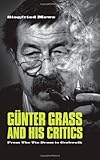
Siegfried Mews. Günter Grass and His Critics: From "The Tin Drum" to "Crabwalk". Studies in German Literature, Linguistics, and Culture: Literary Criticism in Perspective Series. Rochester: Camden House, 2008. viii + 426 pp. $90.00 (cloth), ISBN 978-1-57113-062-4.
Reviewed by David Clarke (Department of European Studies and Modern Languages, University of Bath)
Published on H-German (April, 2009)
Commissioned by Susan R. Boettcher
The Wide Field of Grass Scholarship
Günter Grass surely qualifies as the most consistently controversial of all post-1945 German authors and is arguably also the living German novelist with the most important international reputation. A Nobel laureate and tireless commentator on his country's history who has often sought to intervene in contemporary political debates, Grass writes complex, allusive, frequently generically unclassifiable and often enormous prose works which, as Siegfried Mews's admirable study amply demonstrates, provide grist to any number of critical mills. Mews's book is part of an ongoing series published by Camden House that seeks to provide overviews of critical responses to important authors or literary movements, as well as "to illuminate the nature of literary criticism itself" (p. ii). Volumes have already appeared on Arthur Schnitzler, Theodor Fontane, and Thomas Mann, among others. Apart from Wolfgang Hildesheimer, Grass is the only postwar German figure represented in the series, and it is very appropriate that Grass should be the subject of a study of this kind, given the extensive amount of material that has been produced on the author and his works, by both feuilletonists and academics, in Germany and abroad.
Faced with the perhaps overwhelming volume of the sources available, Mews wisely circumscribes the scope of his project. In his introduction, he makes a case for offering an overview of the public reception of each major prose work in newspaper and magazine reviews, up to and including the autobiographical Beim Häuten der Zwiebel (2006), before moving on to consider, in a selective fashion, the ongoing engagement with each text by academics. Rather than a summary of everything published by academic commentators, Mews sets out to produce "an informed synopsis of pertinent criticism" (p. 6). In this light, the description of critical responses to Grass offered by Mews is selective and evaluative rather than exhaustive, but this evaluation interestingly extends to a highlighting of academic works that, in Mews's view, have not received sufficient attention. At the same time, Mews devotes considerably more space to critical responses that he feels have a valuable and well-founded perspective to offer, so that in some cases a journal article receives as much attention as a monograph, or even more. Mews is careful to differentiate between the points made by individual commentators, and highlights weaknesses as well as strengths. His frustration with other academics who failed to engage with secondary literature available to them at the time of their writing is apparent; such neglect must be particularly frustrating to someone who has had to read so many of the texts his colleagues neglect. Even where other critics fail to refer to each others' arguments, however, Mews is careful to tease out similarities and points of contrast between the perspectives on offer, so that a readable and coherent narrative is maintained. Only very occasionally does Mews dismiss an argument as implausible without explaining his reasons in detail, and it is particularly helpful that he illustrates both his own points and those he approves of in the work of others by a judicious use of short quotations from Grass's prose.
In this way, Mews clearly achieves the first aim of the series in which this volume appears: namely, to provide an overview of critical responses to the author in question. He does so, however, with a very specific market in mind. The book is written in English and the general approach is make the analysis accessible to those who do not read German. To this end, quotations appear in English throughout, either in Mews's own translation in the case of the secondary literature analyzed, or from the published English-language translations of Grass's prose. As the book is already a substantial read, the omission of the original German is perhaps necessary in terms of the space available, but it might have been helpful to scholars and students working with the German to include page references to the most up-to-date German Werkausgabe or the first German edition in the case of more recent texts. The concentration on the English-speaking world is also evident in the choice of reviews and academic analyses of Grass, which takes in only German, British, and U.S. perspectives, with the exception of the chapter on Ein weites Feld (1995), where French reactions are included without an explanation for this change of approach. Nevertheless, this restriction in terms of the countries analyzed is appropriate in terms of the book's intended audience and the need to limit the project in some sensible way. The same can be said for the author's decision to leave aside the reception of Grass's dramas, in particular Die Plebejer proben den Aufstand (1966), his poetry, or even his work as a visual artist. Similarly, Mews does not directly address reactions to controversial speeches and other political interventions by Grass, tending to mention these in passing where their subject matter relates to the major prose publications.
Aside from these minor quibbles, it is clear that this book will be a boon not just to other academics working on Grass, but also to undergraduate and graduate students in the English-speaking world who want to gain a sense of the debate about Grass's work as a whole or about individual texts before concentrating their reading on the secondary literature most relevant to their own work. Mews's text will doubtless become the starting point for graduate students looking to find their own angle on Grass for dissertation projects and may also provide a useful reminder of the perspectives of the key commentators for experienced Grass scholars.
In terms of the second aim of the series, namely to explore the nature of literary criticism, Mews also makes a valuable contribution. Particularly in the first chapter, on Die Blechtrommel (1959), the novel that has attracted and continues to attract by far the largest volume of critical interest of all of Grass's works, Mews demonstrates how changing critical fashions have produced new readings of the novel and provides a kind of potted history of literary studies since the late 1950s in the process. The scope for this sort of analysis is narrower with regard to Grass's other texts, but a key theme running through Mews's analysis of the response of literary journalists in particular is the extent of Grass's feeling of having been misunderstood by those whose job it is to interpret him for the wider public. As an author who, as Mews points out, defines himself "as a democratic socialist and engaged intellectual who deliberately [breaks] with the traditional separation of Geist (intellectual, mind) and Macht (power)" (p. 2), Grass has frequently complained at the (perhaps unsurprising) dominance of political judgments of his work over attempts to come to terms with his aesthetics; the attack on Ein weites Feld by the "pope" of German literature, Marcel Reich-Ranicki, was perhaps the most notorious example of this pattern. As one would expect, this detailed engagement with literary aesthetics has been mostly the province of academic commentators, and it is sobering to note that their insights have not fed back into the discussion of Grass in the feuilletons and the news media more generally.
Mews is also very good on the context of each work's publication, sketching details of relevant political debates and social trends at the time. Although he does not have the space to do this in a comprehensive fashion, enough material is certainly incorporated to point students in particular towards the contexts they will need to understand. Mews also weaves in interesting details relating to the marketing of the individual texts and some hints at the energy Grass himself expends in bringing his work to the attention of a wider audience: his ability (and that of his publishers) to make best-sellers of often demanding and sometimes voluminous literary texts is also intrinsic to the Grass phenomenon.
In summary, then, Mews's book more than achieves the goals it sets itself and provides a valuable work of reference for Grass scholarship. Readers may choose to consume only sections of the book according to their individual needs and may take issue with some of the judgments passed, but these are always even-handed and succinctly put. One can imagine a number of postwar authors whose reception would benefit from a similar treatment (Christa Wolf springs immediately to mind) and it is to be hoped that this series continues in a similar vein with works that rise to a comparable standard.
If there is additional discussion of this review, you may access it through the network, at: https://networks.h-net.org/h-german.
Citation:
David Clarke. Review of Mews, Siegfried, Günter Grass and His Critics: From "The Tin Drum" to "Crabwalk".
H-German, H-Net Reviews.
April, 2009.
URL: http://www.h-net.org/reviews/showrev.php?id=23838
 | This work is licensed under a Creative Commons Attribution-Noncommercial-No Derivative Works 3.0 United States License. |

