

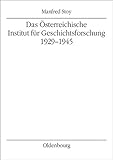
Manfred Stoy. Das Österreichische Institut für Geschichtsforschung 1929-1945. Österreichische Geschichtsforschung, Ergänzungsbände. Munich: Oldenbourg Wissenschaftsverlag, 2007. 423 pp. EUR 49.80 (paper), ISBN 978-3-7029-0551-4.
Reviewed by J. Laurence Hare (Department of History, Emory & Henry College)
Published on H-German (April, 2009)
Commissioned by Susan R. Boettcher
An Austrian Historical Research Institution during the National Socialist Era
It has been more than fifty years since Alphons Lhotsky published the most recent study of the Institute for Austrian Historical Research in Vienna, making Manfred Stoy's work a welcome addition to the literature on the Institute.[1] The previous effort commemorated the hundredth anniversary of the founding of the Institute as a center both for training archivists and for promoting the close study of the sources of Austrian history. For the Institute's sesquicentennial, Stoy has filled an important historical gap in Lhotsky's research by providing an exhaustively researched account of the Institute's activities from the Depression to the end of the Second World War, a period whose sources were unavailable to Lhotsky and spanned a mere eight pages in his work.[2] There is no one better suited to this task than Stoy, who not only studied at the institute, but also served from 1979 to 2003 as its librarian and archivist. Indeed, the finished product, at 423 pages, not only surpasses its predecessor in size, but also often exceeds it in detail and erudition.
Readers will find a strong sense of continuity between Stoy's work and Lhotsky's previous work. Stoy structures his book along many of the same thematic lines, giving attention to the financial state of the Institute, the growth of the library collections, and assessments of the Institute's journal, Mitteilungen des Instituts für Österreichische Geschichte. Stoy also considers such criteria as the institute's course offerings, its international relations, the state of its personnel, and even improvements to its facilities. The biggest departure from Lhotsky's structure, however, is Stoy's decision to combine thematic considerations with a year-by-year narrative. While such an approach has the advantage of allowing him to contend with large amounts of archival sources in an orderly narrative, it is not without its flaws. Readers less familiar with the institute may find Stoy's account a bit tedious in this portion of the book, since chapters on individual years tend to indulge heavily in details, such as long paragraphs on minor building improvements that border on the superfluous, even for an institutional history. Moreover, while a yearly account is suitable for the period before World War II, for which a steady stream of documentation is extant, it is less useful for the years after 1940, when spottier records lead Stoy to admit that "an arrangement of this and also the following chapters is not simple due to the Second World War, because a strictly chronological depiction of events can scarcely be maintained" (p. 261).
To his credit, Stoy combines his year-by-year chapters with comprehensive thematic chapters that outsiders will find especially useful in developing overall impressions of the institute's history. These summaries and reflections serve to bookend accounts of the institute under its directors during the period: Hans Hirsch (1878-1940), whose tenure lasted from 1929 until his death from cancer in 1940, and Otto Brunner (1898-1982), who stepped down at the end of the war. Although Stoy repeatedly disavows an emphasis on these two men, they remain fixed in the foreground of the book's narrative, and Stoy's reflections on their respective roles stand as some of the most important contributions of the book. Indeed, Stoy chooses to begin his account with Hirsch's accession to the directorship of the Institute in 1929. Two prologue chapters detail the infighting that surrounded Hirsch's appointment, which included strife between Hirsch and his mentor, outgoing director Oswald Redlich (1858-1944). Although Hirsch ultimately "outmaneuvered" Redlich in receiving both the directorship and a professorship at the University of Vienna, the costs of the struggle lead Stoy to conclude, "seen as a whole, it was for Hirsch a Pyrrhic victory" (p. 44).
Hirsch's tenure as director indeed proved replete with challenges, as it was marked from the beginning by struggles over the institute's finances and later by increasingly complex relations with institutions at home and abroad during the turmoil of the National Socialist period. As early as 1933, Hirsch found himself facing criticism for his support of colleagues with alleged Nazi ties, including Walther Wache, a former student whom Hirsch had recommended for a position in Rome, and Paul Heigl, who was arrested in 1934 for running a pro-Nazi press. After 1938, of course, the situation reversed itself dramatically, when the Anschluß forced first Hirsch and later Brunner to defend the status of the institute against attempts in Berlin to centralize the training of archivists by creating a new institution in Potsdam. Although Brunner was able to protect the institute with the help of well-placed Austrian scholars such as Hans Srbik and Ludwig Bittner, he was nevertheless unable to prevent its work from suffering under the wartime pressures of limited resources, military service, and the threat of air attacks, which caused only minor damage but major disruptions after 1943.
Dealings between the institute and the Nazi regime have long raised questions about the levels of engagement of its scholars in the activities of the Third Reich. Here, Stoy is able to bring some fresh insights in his study, particularly in the case of Hirsch, whose early death largely spared him from the scholarly attention directed at Brunner, Harold Steinacker, Heinz Zatschek, and other members of the institute. He is, to be sure, no apologist for any of these men, but he does defend Hirsch and, to a lesser extent, Brunner, from some of their worst critics through chapters placing them in the political context of the period. Drawing both on personal letters and interviews with their colleagues, students, and acquaintances, Stoy portrays Hirsch and Brunner as ardent believers in a Großdeutsch view of history who welcomed the Anschluß even as they harbored misgivings about Hitler. He disputes the work of Ursula Wolf and Michael Fahlbusch, who have depicted Hirsch as favorably disposed towards Nazism, arguing that Hirsch was never a candidate for NSDAP membership, and his affiliation with the Südostdeutsche Forschungsgemeinschaft ended before that organization became involved in justifying the German occupation of the Balkans.[3] Rather, Hirsch's personal letters reveal a man with a deep sense of Austrian nationalism whose attitude towards Germany was typical of his generation and whose relationship with the Nazis was one of accommodation rather than open support. This latter assessment fits well within a long-term perspective on Hirsch's directorship, in which we can see his engagement with the Reich at least in part as a product of a decade-long effort to protect the standing of his institution. From Hirsch's letters, it is clear that he opposed the advent of Gleichschaltung in Austrian academia and that he paid only lip service to the display of Nazi symbols. Hirsch's attitudes on the war are less clear, since he died in the summer of 1940, but it is worthy of note that he received a great deal of correspondence from students serving on the front lines who felt at ease sharing their doubts about the conflict.
Hirsch has also come under fire for his leadership of the institute, and in this regard, Stoy takes a moderately critical position. He defends Hirsch, on the one hand, from accusations that he allowed the quality of scholarship to decline during the 1930s, showing that the library actually grew during this period and that the institute's journal remained worthy of praise. On the other hand, Stoy seconds those who suggest that Hirsch was not suited to the task of supporting the institute's networking with institutions abroad, and that his rather reclusive personality similarly placed him at a disadvantage in his dealings with colleagues at the University of Vienna. Indeed, the situation worsened after the Anschluß, when Hirsch became increasingly alienated from his more politicized students and colleagues.
Such assessments are of great value for historians seeking to understand the set of motivations and pressures that colored the work of scholars within the Third Reich. At the same time, they are critical to an honest and nuanced account of the Institute's activities under the shadow of Nazism. Of course, Stoy cannot answer all remaining questions, and in most sections of the book he avoids passing judgment on the sources he relates. Moreover, his decision to end his study with the conclusion of World War II leaves readers wondering how the institute fared in the early postwar era. Yet historians interested in such issues can rely on Stoy's thorough exposition of the sources as an important point of departure. In many ways, this was one of the key purposes of the study, as the Institute's present director, Karl Brunner, points out in his foreword to the book, writing, "with it, we hope to make available a solid basis for further research" (p. 13). At the same time, this style is a testament to the Institute's orientation towards Hilfswissenschaft. Its close scrutiny of textual sources is fitting for a book written by an archivist for archivists, and readers affiliated with the institute will no doubt appreciate the care and honesty with which Stoy chronicles a difficult period in its history.
Notes
[1]. During the period of Stoy's study, the institute was known as the Austrian Institute for Historical Research.
[2]. Alphons Lhotsky, Geschichte des Instituts für Österreichische Geschichtsforschung, 1854-1954 (Graz: Böhlau, 1954), 379-386.
[3]. Ursula Wolf, Litteris et Patriae: Das Janusgesicht der Historie (Stuttgart: Steiner, 1996), 90; and Michael Fahlbusch, Wissenschaft im Dienst der nationalsozialistischen Politik? Die Volksdeutschen Forschungsgemeinschaften von 1931-1945 (Baden-Baden: Nomos, 1999), 254-255.
If there is additional discussion of this review, you may access it through the network, at: https://networks.h-net.org/h-german.
Citation:
J. Laurence Hare. Review of Stoy, Manfred, Das Österreichische Institut für Geschichtsforschung 1929-1945.
H-German, H-Net Reviews.
April, 2009.
URL: http://www.h-net.org/reviews/showrev.php?id=23828
 | This work is licensed under a Creative Commons Attribution-Noncommercial-No Derivative Works 3.0 United States License. |

