



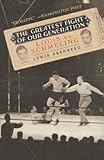
Lewis Erenberg. The Greatest Fight of Our Generation: Louis vs. Schmeling. New York: Oxford University Press, 2007. xii + 274 pp. $15.95 (paper), ISBN 978-0-19-531999-6.
Reviewed by Erik Jensen (Department of History, Miami University)
Published on H-German (March, 2009)
Commissioned by Susan R. Boettcher
Parallel Lives
On June 22, 1938, boxers Joe Louis and Max Schmeling met in a heavyweight title fight in Yankee Stadium, Louis as the defending champion and Schmeling as his only serious challenger. The title of Lewis Erenberg's book has less to do with the action inside the ring, which lasted a mere two minutes and four seconds, during which Louis battered a hapless Schmeling into submission. Instead, the label "Greatest Fight of Our Generation," coined by an American radio announcer as part of the hype leading up to the bout, referred to the profound symbolic resonance of this match-up. This meeting was actually the second between the two boxers, just two years after Schmeling had knocked out the up-and-coming Louis in a stunning upset. Political events during the intervening twenty-four months, however, had set Germany and the United States increasingly at odds, and by 1938 white Americans had turned noticeably hostile toward the German champion and remarkably receptive to having Louis represent them in the ring. Louis had increasingly come to embody the democratic, freedom-loving, and (comparatively) racially tolerant United States, as only the second black heavyweight champion in history. In the opposing corner, the U.S. press had cast Schmeling, whose own political leanings at the time remained somewhat murky, as an emblem of the National Socialist dictatorship and its defining doctrine of extreme racism. Sports have always been laden with larger meanings, and this fight brought the domestic and international tensions of the 1930s to a dramatic head. In Erenberg's words, the second Louis-Schmeling bout "began the challenge to an American national identity firmly rooted in a racial hierarchy of whiteness" (p. 2).
Erenberg's primary interest, as the preceding quotation indicates, lies in charting a shift in public conceptions of national belonging in the United States. He argues that the fight, by positioning an African American boxer as the defender of American values, contributed to the emergence of a civic patriotism that transcended racial and ethnic lines. The book has less to say about how, or if, this fight had any influence on German developments, other than to note that key leaders like Joseph Goebbels saw it as a deep humiliation that needed to disappear from public attention as quickly as possible. Nevertheless, this book should interest many German historians. Lewis Erenberg has produced--in a mere 230 pages of text--a compelling, readable comparative biography of two figures whose own lives closely reflected and, to a small degree, shaped some of the major historical developments in the last century. As such, the book would lend itself well to certain undergraduate-level comparative history courses, especially those with a focus on sports and race.
On this latter point, Erenberg does a nice job of using the lives of his central figures to illustrate the evolving attitudes in Germany and the United States. He points out similarities between the increasingly exclusionary policies of Nazi Germany--which affected many of Schmeling's friends, fellow boxers, and professional associates--and the often identical policies that had been in place in the United States for centuries and whose effects Joe Louis felt personally every single day of his life. With the Nazi-decreed expulsion of Jews, Roma and Sinti, and other "racial undesirables" from German boxing in 1933, Erenberg writes, "German athletics began to follow practices of segregation long established in the United States for the demarcation of African American athletes as separate and unequal" (p. 60). At the same time, Erenberg also points out that the two countries were positioned on opposite trajectories in the 1930s. Just as Germany was redefining many of its hitherto assimilated citizens as now lying outside of the national community, America had begun, tentatively and often grudgingly, to allow its racial and religious outsiders into the national fold.
When it came to the question of "racial mixing," the two countries--and the lives of these two fighters--exhibited both interesting parallels and potentially illuminating differences, something that emerges from the narrative at several points, but that Erenberg would have done well to highlight explicitly. Nazi Germany vehemently attacked the mixing of races and imposed the Nuremberg Laws in 1935 specifically to prevent just that. Schmeling tried at one point to intervene on behalf of the Jewish wife of his neighbor, the sculptor Josef Thorak, but to no effect, and the Thoraks wound up divorcing in order to save Thorak's career as a favored artist of the new regime. The Nazi regime also scorned the United States as a "mongrelized" nation and pointed to Louis as a product of this wanton miscegenation. He was worse than black, Nazi propagandists insisted; he was "mixed." In the United States, though, it was precisely Louis's status as "brown," and not "black," that made him more palatable to many in the white press. Louis himself identified as black, but after his 1938 victory over Schmeling, columnist Dan Parker, for one, emphasized the boxer's Native American ancestry. Parker wrote, "One hundred percent Americans who can't see any merit in an athlete if his skin happens to be of darker pigmentation ... are hereby reminded that some of Joe's ancestors, the Cherokee Indians, were here long before the forebears of most of the so-called 100 per centers" (p. 155). At the same time, of course, America's appreciation of mixed ancestry existed within clear and violently enforced limits, a state of affairs that Louis's life also amply illustrated. From the beginning of his rise in the world of boxing, Louis's managers had carefully groomed him as the antithesis to Jack Johnson--the only previous black heavyweight champion, whose liaisons with white women had enraged the public--and Louis strictly avoided all situations that might leave him even momentarily alone with a white female. The discourse in Germany and the United States that surrounded the figure of Louis would provide a fascinating lens for comparing the highly fraught notion of "racial mixing" in the two countries during the decade leading up to the Second World War. Erenberg does not always connect the dots himself in this book, but his narrative provides the raw material for a potentially interesting and useful classroom discussion.
The Greatest Fight of Our Generation also affords an opportunity to examine how two individuals positioned themselves vis-à-vis nation-states about which they had competing emotions. Throughout the 1930s, and particularly during the war itself, both Schmeling and Louis articulated what one might call an oppositional support of their respective countries, in which they tempered a generally dutiful loyalty with periodic expressions of criticism and even resistance toward injustices committed by those countries. Louis underwent a consciousness-raising over the course of the 1930s, during which he grew increasingly vocal in his criticisms of American racial injustice and of the irony of his own public image as a symbol of American tolerance. On the eve of his 1938 fight, Louis later recalled, "White Americans, even while some of them were lynching black people in the South--were depending on me to K.O. Germany" (p. 138). Louis nevertheless volunteered for the army in 1942, just a month after Pearl Harbor; actively promoted war bonds on behalf of the U.S. military effort; and made a number of tours to raise the morale of American troops. Louis also used his position to protest segregation in the U.S. military, however, and he actively contributed to its integration in a number of ways, such as helping Jackie Robinson to integrate Fort Riley's baseball and football teams; calling on his contacts in the War Department to open up the Officer Candidate School to Robinson and fifteen other African Americans; getting buses on U.S. army bases to integrate; and refusing to speak or fight in front of segregated audiences. On this last point, too, Louis convinced the military to accede to his demands. Given this quite impressive record on civil rights, I find it surprising, therefore, that Erenberg concludes, "[y]et while he sympathized with the freedom struggle, Louis never became a crusader for civil rights" (p. 202).
Schmeling provides an even more compelling example of how an individual balanced his support for the state with his resistance to it. Erenberg very neatly sums up Schmeling's relationship to the Hitler regime: "Throughout the Nazi era he had attempted to walk a tightrope to pursue his individual sporting goals, but he had treaded too close to the fires of Nazism for the allies and too near cosmopolitanism for the Third Reich" (p. 198). Schmeling demonstrated a number of personal acts of resistance, or at least defiance, during the 1930s and the war itself. In addition to the intervention on behalf of Mrs. Thorak, Schmeling maintained a professional relationship with Joe Jacobs, his Jewish manager in the United States, despite Nazi objections. Schmeling also refused an award from the SA, visited American and British POWs during the war, and--most heroically of all--hid the sons of his Jewish tailor during the Kristallnacht pogrom. At the same time, though, Schmeling willingly served the Nazi propaganda machine by, among other things, extensively lobbying the American Olympic Committee to prevent a possible boycott of the 1936 Berlin Olympics; urging Germans to vote in favor of the 1938 Austrian Anschluß; and defending the Nazi regime before the American press, a move that prompted Marlene Dietrich to refuse to meet with her old acquaintance during one of his American tours. These latter actions, along with the American press's ability to frame Schmeling as a Nazi through and through, made the German boxer a key symbol of the enemy for Allied troops during the European campaign. In an odd foreshadowing of the countless "false Hitlers" who were captured on the streets of Berlin just after that city's occupation in 1945, rumors circulated "from Crete to Norway" that various Allied soldiers had killed Schmeling, and many GIs "searched for his remains as proof that they, like Louis, had defeated their symbolic enemy" (p. 174). Despite Schmeling's fraught relationship with the Nazi regime, he, like the nation he had long represented, managed to reinvent himself after the war as reasonably democratic, certainly entrepreneurial, and very America-friendly. Schmeling's postwar career as a leading Coca-Cola bottler in Germany spoke perfectly to the new order and to the ex-boxer's ability to negotiate his place within it. As Schmeling himself so perfectly stated, "My life is that of a German in the 20th century" (p. 199).
Lewis Erenberg has chosen a fascinating subject--or, rather, two fascinating subjects--for his book, since this work is less about that one fight in 1938 and more about the parallel lives associated with it. Und das ist gut so. Erenberg had the unfortunate timing of publishing his book just a year after two previous works had ventured their own interpretations of the Louis-Schmeling rivalry, one by David Margolick and the other by Patrick Myler.[1] Margolick's book, in particular, offers much more extensive coverage of the same general territory that Erenberg covers. Erenberg's relative concision, on the other hand--his book is 120 pages shorter than Margolick's--might lend itself better to a course in which one would likely devote only one week to the subject. Although Erenberg does not explicitly foreground some interesting connections between these two lives and their respective social and political orders, he does emphasize a number of significant parallels, and the narrative affords plenty of opportunities for the reader to draw other connections him- or herself. Erenberg has written an engaging, solidly researched work based on an extensive and close reading of the secondary sources, along with some original and very useful digging in American and German newspaper archives. I must quickly point out two errors in Erenberg's book, though. He regularly misspells the name of Birk Meinhardt, one of the leading historians of boxing in Germany (p. 258, n. 5, 11, and 14); and he refers to Axel Springer as the publisher of the newsweekly Der Spiegel (p. 219). Rudolf Augstein must be spinning in his grave. That said, Lewis Erenberg has done a very fine job of shining another spotlight on the Louis-Schmeling fights and of showing that sports events and athletes play important roles in history, too. And for those who doubt the lingering resonance of this fight in contemporary American culture, just consider a headline in the New York Times that described Barack Obama's election as a "Joe Louis Moment" and the quotation from New York City poll watcher Sarah Gordon, who described Election Day 2008 as even better than June 22, 1938, when Joe Louis beat Max Schmeling.[2]
Notes
[1]. David Margolick, Beyond Glory: Joe Louis vs. Max Schmeling, and a World on the Brink (New York: Knopf, 2005); and Patrick Myler, Ring of Hate: Joe Louis vs. Max Schmeling: The Fight of the Century (New York: Arcade, 2005).
[2]. William C. Rhoden, "Joe Louis Moment," New York Times (November 6, 2008) B13; Jim Dwyer, "For an Older Generation, History, When Once There Was Only a Dream," New York Times (November 5, 2008), A28.
If there is additional discussion of this review, you may access it through the network, at: https://networks.h-net.org/h-german.
Citation:
Erik Jensen. Review of Erenberg, Lewis, The Greatest Fight of Our Generation: Louis vs. Schmeling..
H-German, H-Net Reviews.
March, 2009.
URL: http://www.h-net.org/reviews/showrev.php?id=23827
 | This work is licensed under a Creative Commons Attribution-Noncommercial-No Derivative Works 3.0 United States License. |

