



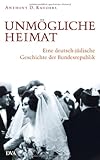
Anthony D. Kauders. Unmögliche Heimat: Eine deutsch-jüdische Geschichte der Bundesrepublik. Munich: Deutsche Verlags-Anstalt, 2007. 302 pp. EUR 22.95 (paper), ISBN 978-3-421-05924-6.
Reviewed by Margy Gerber (Department of German, Russian, East Asian Languages, Bowling Green State University)
Published on H-German (May, 2009)
Commissioned by Susan R. Boettcher
Guilt as Determinant of Jewish Life in the Federal Republic
The Swiss-born, British-educated historian Anthony D. Kauders describes his most recent book on German Jewish issues as the attempt to write "eine Geschichte des schlechten Gewissens" (p. 9). The various Jewish groups in West Germany in the postwar years--German-Jewish survivors, Jewish refugees from eastern Europe, Jewish remigrants--shared a strong sense of guilt for living in the Land der Täter, an "unmögliche Heimat" in their own eyes and in the eyes of world Jewry, who censured them as pariahs. Kauders organizes his German-Jewish history of the Federal Republic around this single issue; he explains many of the characteristics and actions of Jews in West Germany in the first decades after World War II as consequences of this feeling of guilt and the ever-present need to justify not yet having emigrated to the Jewish homeland. The waning of German-Jewish guilt vis-à-vis Israel and the gradual acknowledgement of Germany as Heimat in the 1970s and 1980s, especially by the younger (second) generation, represents the second stage in Kauders's German-Jewish history. In the third and present phase, which began in 1990 with the influx of Jews from the former Soviet Union, guilt for choosing to live in Germany is notable by its absence: the Russian Jews--as a result of their Soviet socialization--have only distant ties to Israel, and the German Jews, now integrated into German society, no longer feel constrained to consider the Israeli response to their actions. For the expert in German Jewish history, only details of the study may be new. However, Kauders's viewing the development of German-Jewish life in the Federal Republic from the point of view of guilt and his focusing on such basic issues as money, the relationship to Israel, and the role of the Jewish community provide new insights. And, for those less versed in the nature of Jewish life in the Federal Republic, it is an excellent source of information, a Jewish space.
Kauders's discussion of Jewish guilt in postwar West Germany is divided into five chapters with the simple titles "Schuld," "Geld," "Israel," "Demokratie," and "Gemeinde." He treats each of these aspects of Jewish life chronologically from 1945 to the end of the 1980s, when guilt ceased to be a determining factor. No matter which topic, the development is the same: in the postwar years, it reflects the painful guilt and basic insecurity of Jewish survivors in a country with which they could not identify and which they viewed as only a temporary place of residency; in the 1960s and 1970s, he notes the gradual putting-down of roots; in the 1980s, he depicts the breakthrough of new self-confidence and self-assertion in German society. Kauders tends to focus on the German- (as opposed to east European-) Jewish communities. The former, located mostly in the north of the Federal Republic--in Düsseldorf, Frankfurt, Dortmund, Cologne, Hamburg, and Berlin--tended to be assimilated and assume a political role vis-à-vis the German state and Israel, while the eastern European Jews, mostly living in the south (Munich, Stuttgart, Heidelberg) and by tradition orthodox, concerned themselves more with religion and Jewish values. The chapter on democracy, for example, deals with the efforts of the Zentralrat der Juden, situated in Düsseldorf, to justify Jews' continuing presence in Germany by assuming the role of guarantor and measure of West German democracy.
A second question lies at the root of the Jewish presence in the Federal Republic for Kauders: not only whether there should be Jewish life in Germany, but whether there can and will be. The final chapter of the book theorizes on the future of Jews in the German diaspora. Kauders argues that the immigration of Jews from the former Soviet Union, in spite of their large numbers (well over 100,000 are registered in Jewish communities, which represents more than a tripling of the pre-1990 number), has not produced the renaissance of religious and cultural Jewish life hoped for by the previously small, moribund German-Jewish community. The secular Russian Jews have little knowledge of Jewish tradition, no particular attachment to the history of Jewish life in Germany, and less subjective ties to the Holocaust. Kauders sees little hope for either a pluralistic Jewish community--decentralized and open to differing Jewish life experiences--or for a traditional Jewish community as a distinct ethnic and cultural minority in a multicultural society. The first model would require a thorough reform of the leadership structure and a relaxation of religious doctrine, which he does not foresee; the second presupposes that Jews in today's Germany see themselves (and want to be seen) as a culturally separate minority, which, given their many cultural differences, their individualism, and mixing with mainstream German society, Kauders again rules out.
In the final pages of his book, Kauders discusses a further model for a Jewish future in Germany and in Europe as a whole: that of "Jewish space(s)." It is based on the assumption that in Germany and most European countries other than France and England--and in contrast to Israel and the United States--there are too few Jews to maintain a vibrant Jewish culture, and that such activity is only possible with the participation of the non-Jewish population. The solution is the creation of Jewish spaces, suffused with a Jewish atmosphere, whether in the form of popular culture or intellectual and religious endeavors or Jewish institutions, all of which are shared by both Jews and non-Jews. Proceeding from postmodern theories of shifting identities and hybridity, the proponents of this notion renounce the idea of a fixed essential Jewishness.
Kauders finds this latter model the most realistic: "Man muss weder einer optimistischen noch einer pessimistischen Fraktion angehören, um der Vision eines jüdischen Raums in absehbarer Zukunft mehr Chancen einzuräumen als der religiös-kulturellen Renaissance des deutschen Judentums" (p. 223). And yet, it is in religious cultural practices that Kauders's hopes for the future of a Jewish community in Germany seem to lie: "Die jüdische Ethnie löst sich zunehmend ... auf, übrig bleibt im günstigsten Fall die Religion" (p. 223). He points to the United States as a model. The multiple forms of Judaism practiced by America's Jews allow, as he writes, the combination of religion, on the one hand, and the individual pursuit of happiness, on the other; the emphasis on religious cultural practice makes Jewish life both visible and separate, and thus keeps both religion and the Jewish ethnos alive. Realizing this Jewish future in Germany would require courage and imagination, and reforms which, in his view, given the tenacity with which the Jewish functionaries cling to religious doctrine, can only come from below. The book ends with this subjective appraisal, which reads like a call for action.
Kauders's study is for the most part balanced and representative. He presents and weighs various standpoints with care, such as the second generation's criticism of the Zentralrat for currying favor with high government officials or possible explanations for the greed of Jewish real estate speculators in Frankfurt. Kauders's bibliography includes the full range of German and Anglo-American research on post-1945 German-Jewish issues; the many references to relevant research and citations from archival documents attest to the seriousness of his undertaking. The book is at the same time highly readable. The style is that of a well-prepared series of university lectures, clearly structured and readily understandable; occasional guideposts and reminders of previously treated material are likewise in keeping with an oral presentation. Several excursuses--on the history of the diaspora, on the concepts of shame and guilt, among others--provide useful background information.
If there is additional discussion of this review, you may access it through the network, at: https://networks.h-net.org/h-german.
Citation:
Margy Gerber. Review of Kauders, Anthony D., Unmögliche Heimat: Eine deutsch-jüdische Geschichte der Bundesrepublik.
H-German, H-Net Reviews.
May, 2009.
URL: http://www.h-net.org/reviews/showrev.php?id=23826
 | This work is licensed under a Creative Commons Attribution-Noncommercial-No Derivative Works 3.0 United States License. |

