



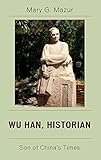
Mary Gale Mazur. Wu Han, Historian: Son of China's Times. Lanham: Lexington Books, 2009. xiii + 515 pp. $100.00 (cloth), ISBN 978-0-7391-2456-7.
Reviewed by Diana Lin (Indiana University Northwest, Dept of History and Philosophy)
Published on H-Asia (May, 2010)
Commissioned by Sumit Guha (The University of Texas at Austin)
A Twentieth-Century Chinese Intellectual
Wu Han, a famous Chinese historian known for his work on the Ming Dynasty (1368-1644) and his play Hairui Dismissed from Office (1961), has frequently been cited as a symbol of the fate of Chinese intellectuals during the Cultural Revolution (1966-76). The denunciation of his play in late 1965 by Mao Tse-Tung, leader of the People's Republic of China, has often been treated as the official beginning of the Cultural Revolution. And Wu’s death in 1969 as a result of persecution also represented the fate of millions of Chinese intellectuals who were tortured in one way or another, and many of whom died, in the Cultural Revolution. Mazur brings out Mao's fickleness, in asking Wu Han to write articles about an honest Ming Dynasty official, Hai Rui, an incorruptible censor who dared to impeach emperor Wan Li (1563-1620) for his corruption, and then using Wu’s articles and play on Hai Rui as evidence against him. The failure of the Great Leap Forward (1958-59), Mao’s attempt to catapult the Chinese economy ahead of Britain’s and the United States,’ had disastrous consequences, including widespread starvation that resulted in the deaths of over twenty-five million people. Aiming to sanction the local officials who falsely reported agricultural or industrial productivity, Mao asked Wu Han to use a theme from ancient Chinese history, Hai Rui’s honesty, to set a good example of cadre behavior during the Great Leap Forward. After writing a series of articles on Hai Rui, serialized in the Communist Party organ People’s Daily in 1959, Wu went on to turn the story of Hai Rui into a play. Because his play emphasized not just Hai Rui’s honesty, but also his dismissal from office due to his honest critique of the emperor, it seemed in Mao's view to draw a parallel with the recent firing of an equally honest Chinese military general, the former defense minister Peng Dehuai, who lost his office after telling Mao in 1959 that the Great Leap Forward had not succeeded. Mao’s decision that Hai Rui Dismissed from Office alluded to his dismissal of Peng led to newspaper articles criticizing Wu by Communist Party propagandists such as Yao Wenyuan, followed by criticism of Wu on a more massive scale, eventually leading to Wu and his wife being sent to the detention school and ultimately incarcerated. That Wu also published in 1965 a revised edition of his biography of the first Ming Dynasty emperor Zhu Yuanzhang, a peasant turned emperor who ordered the ruthless massacre of thousands of his opponents, including all their clan members, accentuated Mao’s belief that Wu was using history to criticize Mao’s autocracy. Wu and his wife died within seven months of each other in 1969 due to abuse and medical neglect.
Mazur’s biography of Wu is a welcome addition to the monographs in English on Chinese establishment intellectuals (intellectuals who worked for the Communist Chinese government), which include a biography of Deng Tuo, who worked in the Beijing municipal government as an administrator in charge of propaganda from 1959 to his death in 1966 (Timothy Cheek, Propaganda and Culture in Mao’s China, Deng Tuo and Intelligentsia, 1997), biographies of Ai Siqi and Li Da, both Marxist theoreticians who promoted the spread of Marxism in China (Joshua Fogel, Ai Ssu-ch'i's contribution to the development of Chinese Marxism, 1987; Nick Knight, Li Da and Marxist philosophy in China, 1996), an earlier, smaller monograph on Wu Han (James Pusey, Wu Han: Attacking the Present through the Past, 1969), and edited volumes such as China's Establishment Intellectuals (1986, edited by Carol Lee Hamrin and Timothy Cheek).
Mazur states in her introduction that in contrast to many writings on Wu, she did not intend to depict him as a hero, but rather as “the actual person who lived” (p. 8). What holds the book together is what she describes as the tension between “autonomous individual life and responsibility to the group in the form of family, profession, party, and nation” (p. 11). Mazur offers a good description of the tension between Wu and his family. Wu was born in Bitter Bamboo Pond Village in Zhejiang Province in 1909. His father passed the lowest level of the imperial examinations in his prefecture, but the imperial examination system was abolished before he could advance to the next level. After China became a republic in 1912, Wu’s father briefly served as a policeman but was soon dismissed and returned to his village. He harbored hopes that his sons would study and become gentry scholars. Wu Han (Chunhan) was an avid reader and a good student who attended a modern middle school in Jinhua, Zhejiang. But his education came to a halt when he finished middle school because his father could no longer support him financially. Wu Han displayed very strong personality and independent thinking even at this stage, when he defied a family-arranged marriage and went on to school, first in Hangzhou, capital of Zhejiang Province, then the China College in Shanghai, and finally Qinghua University in Beijing, where he entered the department of history, specializing in the Ming Dynasty. Wu’s defiance of his father was shown once more in the case of a sister’s arranged marriage--he helped the sister get away from home to school in Hangzhou, and this sister finally married a man of her own choosing. He defied his mother by pursuing a romantic relationship with Yuan Zhen, a student with tuberculosis at Qinghua University, where he had begun teaching, and then marrying her. (Yuan could not have children because of her illness.) Wu’s secret marriage spoke much about the tension in Wu as a filial oldest son who otherwise tried his best to help his family, and as a May 4th youth who wanted his own freedom of love and marriage.
Mazur situates Wu’s story against the background of Chinese history, yet her unwillingness to omit any detail of Wu’s life story contrasts with the lack of an extensive discussion of the complex social and political contexts in which which Wu’s life story unfolded. Background information is supplied, but mostly to illustrate the conditions under which Wu’s life experience took place; there is little discussion of the interactions between Wu Han and his social/political background. Wu’s gradual move toward the left--first he joined the Democratic League, and eventually the Communist Party after the Communist takeover in 1949--is carefully described, yet the main reason given is that Wu was influenced by his Communist-inclined wife. Did Wu have any struggles with accepting Communism at first? How did Wu perceive his role as vice mayor of Beijing, a role he assumed after the Communist takeover in 1949 because he represented the Democratic League, a symbol of the continued “united front” in the new Communist government in Beijing, and his joining the Communist Party, even though the party allowed him to straddle the two political organizations? How did the meaning of the Democratic League change for him, and how did he reconcile his naming names during the anti-rightist movement and his determination to carry out his own Great Leap Forward in his history-writing? There is scantier background information in the narration of Wu’s transformation from vice mayor of Beijing to prisoner of the Communist regime. Mazur covers this story in nine pages (pp. 420-429) and presumably assumes that much does not require explanation (or maybe the editor required cutting), since there has been extensive coverage of the persecution of party elites and intellectuals during the Cultural Revolution. There is also scant discussion of Wu’s reactions to his persecution.
What Mazur loses in a more nuanced analysis of Wu Han and the various struggles he went through in life, however, she gains in providing a composite picture through myriad details of Wu Han’s life. Mazur gives equal weight to Wu’s youthful struggles against his father, his passion and devotion to his girlfriend/wife and his mother and siblings and his scholarship, and his activities in the Democratic League and as vice mayor of Beijing. Instead of dwelling on Wu’s unique attributes as a historian/scholar, Mazur depicts Wu as a human being who was also a scholar/historian. One can say that Mazur has achieved her goal of depicting Wu as he actually lived. Through the many sketches of his life at succeeding stages, gleaned from the observations of others, including his colleagues, relatives, and so on, as well as from Wu’s own writings, Mazur allows us to “see” Wu Han in action, as well as in writing. We “witness” Wu’s life from its beginning at Bitter Bamboo Pond Village; to Hangzhou, Shanghai, and Beijing, where he became a professor of history; to Yunnan, where he worked first at Yunnan University, then the Southwest Associated University; and back to Beijing, when he was made vice mayor and where he would meet his sudden downfall in 1965. The end result of such details or “snapshots” is that Wu’s tragic end is made all the more poignant, and the fickleness of fate in Communist China, depicted with a minimalist method by Mazur in nine pages, is felt all the more keenly by the reader. By bringing out so many aspects of Wu’s humanity, Mazur shows us that Wu in so many ways was a universal, average human being. The torture and fall from grace that he suffered represent the fate of many in the twentieth century.This book is recommended for both public and university libraries, and especially to readers who need a detailed knowledge of modern Chinese intellectual history.
If there is additional discussion of this review, you may access it through the network, at: https://networks.h-net.org/h-asia.
Citation:
Diana Lin. Review of Mazur, Mary Gale, Wu Han, Historian: Son of China's Times.
H-Asia, H-Net Reviews.
May, 2010.
URL: http://www.h-net.org/reviews/showrev.php?id=23807
 | This work is licensed under a Creative Commons Attribution-Noncommercial-No Derivative Works 3.0 United States License. |

