

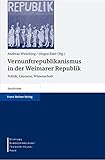
Andreas Wirsching, Jürgen Eder, eds. Vernunftrepublikanismus in der Weimarer Republik: Politik, Literatur, Wissenschaft. Stuttgart: Franz Steiner Verlag, 2008. 330 pp. ISBN 978-3-515-09110-7.
Reviewed by Eric Kurlander (Department of History, Stetson University)
Published on H-German (March, 2009)
Commissioned by Eve M. Duffy (University of North Carolina Chapel Hill)
In Search of a "Rational" Republic
This stimulating essay collection seeks to breathe new life into the concept of Vernunftrepublikanismus, first coined by the liberal monarchist Friedrich Meinecke to represent his "rational" grounds for supporting the Weimar Republic.[1] The editors make two primary claims. First, they argue that we should view Vernunftrepublikanismus not only as an "unspezifisch pragmatische Haltung bürgerlich-liberaler Intellektueller und Politiker," but as a political principle "das erhebliche Parallelen zum intellektuellen Republikanismus der französischen Dritten Republik aufweist" (p. 12). According to Wirsching and Eder, "rational republicanism" encompassed something more than a "functionalist" acceptance of the constitutional status quo (although this did characterize numerous Catholics, Protestants, and political conservatives). It also incorporated a truly "reasoned" endorsement of pluralist democracy and at least partially critical attitude toward the Kaiserreich. Second, the authors contend that Vernunftrepublikanismus, at least in its more functionalist incarnation, was both more common and indelible than the existing historiography suggests.[2]
The fourteen essays are divided into four sections: "Networks and Milieus," "Vernunftrepublikanismus from the Left," "Vernunftrepublikanismus and the Academy (Wissenschaft)," and "The Political Rationality (Vernunft) of the Citizen." The first section begins with an essay by Thomas Hertfelder, who examines the views of Weimar's quintessential Vernunftrepublikaner, the followers of the left liberal publicist and first chairman of the German Democratic Party (DDP), Friedrich Naumann. Rather than parse the differences between "republicans by conviction" and "republicans by responsibility," Hertfelder illustrates the mix of pragmatism, idealism, and skepticism that defined most left liberals' relationship with the republic. Virtually all Democrats accepted the republic on "functionalist" grounds. But most also viewed it idealistically, both in terms of universalist, "Kantian democracy" and the historical embodiment of German national and democratic aspirations that Wilhelm II had never managed to create (pp. 42-44). Still, many Naumannites bemoaned the republic's lack of symbolic power and mass, interest-group politics, eventually turning to a more elitist, quasi-authoritarian conception of the Weimar state. In "Verfassungspatriotismus und Gemeinschaftsideologie: 'Vernunftrepublikanismus' in der deutschen Zentrumspartei," Elke Seefried illustrates a similar ambivalence among Catholics, who vacillated between the idea of a liberal democratic Volksstaat and a conservative, nationalist Volksgemeinschaft. Initially at least, most Catholics were willing to recognize the republican state form so long as it respected the rights of the church. Yet, the Center Party remained incapable of reconciling the differences between its three main constituencies: a "democratically-oriented wing" led by Volksstaatler like Matthias Erzberger; a large "pro-constitutional" center, characterized by Vernunftrepublikaner like Wilhelm Marx; and a significant "conservative-monarchical" minority embodied in Heinrich Brüning's successor and Adolf Hitler's future vice chancellor, Franz von Papen (pp. 60-64). Even more so than the Democrats, the majority of Catholics also distrusted pluralist democracy, preferring a less politically contentious, organicist "(Volks-)gemeinschaft" (p. 73). Thus, as Weimar entered a new phase of crisis in the early 1930s, most Catholics abandoned the republic.
Investigating "Vernunftrepublikanismus in den Spitzenverbänden der deutschen Industrie," Wolfram Pyta shows how ostensibly "conservative" industrial organizations were actually quite willing to operate within a republican framework. Having matured in the dynamic political incubator of Wilhelmine Germany, Weimar's industrial lobbies accepted "ein pluralistisches Verständnis von Gesellschaft" that saw it as the function of democratic institutions "durch geregelte Verfahren die Fülle von Einzelinteressen zu bündeln und in eine entscheidungsfreudige politische Willensbildung zu überführen" (p. 89). Export-oriented industrialists in the Reichsverband Deutschen Industrie (RDI) even endorsed the controversial Young Plan, "plädierten, der Sozialdemokratie die Rückkehr in die Regierung zu ermöglichen" (p. 105), and, failing that, supported Heinrich Brüning's rule by decree as the best antidote to economic collapse and political extremism. Finally, Thomas Meyer takes up the "republicanism of rationality" embraced by liberal Jewish intellectuals and businessmen like Ernst Cassirer, Aby Warburg, Carl Melchior, and Albrecht Mendelssohn-Bartholdy. Unlike their gentile colleagues (a point that Meyer makes only implicitly), the Warburg circle saw the republic as the single "rational" vehicle for reconciling and guaranteeing the pluralist aspects of German politics and society.
Turning from the bourgeois center to the Left, the second section opens with Rüdiger Graf's essay, "Die Politik der reinen Vernunft--das Scheitern des linken Sozialdemokraten Heinrich Ströbel zwischen Utopie und Realpolitik." Exemplifying the tension between utopian (socialist) and rational republicanism, Ströbel bounced around between socialist factions in search of a more "vernünftige[n] Politik" (p. 143). As Weimar democracy became increasingly dominated by "old [bourgeois] elites" in the mid-1920s, however, Ströbel abandoned the path of compromise and withdrew from active politics. According to Jürgen Eder, the left-wing novelist Alfred Döblin followed a somewhat different trajectory. Starting out on the far Left, Döblin gradually moved toward the republican center in order to stave off escalating threats from the anti-democratic Right. It was in the wake of the Great Depression and the NSDAP's first electoral landslide that Döblin published his most famous political work, Wissen und Verändern (1931), which called on "rational" intellectuals of all political tendencies to support the republic as the best alternative to ideological extremism. The communist historian Artur Rosenberg, argues Mario Keßler, made a similar compromise, softening his critique of bourgeois liberalism in order to forge a coalition of "linken Vernunftrepublikanismus" (p. 190).
Addressing the views of the liberal jurists Gerhard Anschütz, Wilhelm Kahl and Alexander Graf zu Dohna, Gusy argues against the utility of "rational republicanism" within the legal profession. As part of a German legal tradition that saw "rationality [Vernunftigkeit]" as an essential criterion of any Rechtswissenschaft, legal theorists could admit no emotional criteria for or against the republic. Indeed, Gusy suggests that the inadequacy of Vernunftrepublikanismus as an interpretative category extends beyond the legal profession. Perhaps, the author concludes, "brauchen wir weniger ein neues Konzept des 'Weimarer Vernunftrepublikaniusmus' in Abgrenzung zu anderen republikanischen Erscheinungsformen, sondern eher ein solches des 'Republikanismus'" (p. 217). Examining "Wissenschaftsverständnis in der protestantischen Theologie," Matthias Wolfes tends to agree. Protestants might rationalize their support for the republic as a function of historical necessity, so long as it made possible the social and cultural reproduction of an "organic Volksgemeinschaft." But this qualified endorsement of republicanism dissipated over the course of the 1920s, becoming progressively less "rational" as political and economic challenges mounted. Thus Wolfes remains skeptical about the utility of a category (Vernunftrepublikanismus) that "weist aus sich selbst auf den Bezug zu alternativen politischen Optionen hin, und hierin ist qualitativ von Parteizuschreibungen ('Sozialdemokrat') unterschieden" (p. 229). Although the concept "um eine korporative Beschreibung handelt, darf im Blick auf konkrete Gruppen politischer Akteure keine Kollektivgesinnung unterstellt werden. Diese Schwierigkeit scheint mir unüberwindlich, und sie ist es meiner Ansicht nach, die die Verwendung des Begriffes so diffizil oder eben prekär macht" (p. 229). In "Naturwissenschaft und demokratische Praxis: Albert Einstein--Fritz Haber--Max Planck," Margit Szöllösi-Janze addresses the views of three scientists who maintained their emotional distance from the republic, but nonetheless supported its foreign policy and opposed "authoritarian" tendencies within the academy. Still, all three "liberal" scientists maintained a typically elitist, anti-pluralist attitude toward the republic, a stance that explains their tacit ambivalence regarding its descent into authoritarianism.
The last section opens with a revealing essay by Horst Möller on Weimar's three most famous Vernunftrepublikaner, "Friedrich Meinecke, Gustav Stresemann und Thomas Mann––drei Wege in die Weimarer Republik." All three liberals, Möller contends, reconciled themselves to republicanism through the galvanizing experience of the First World War. All three combined idealistic and pragmatic grounds for embracing democracy, although Mann tended to view it mostly as an ideal-type, Meinecke as a product of historical evolution, and Stresemann as a vehicle for peaceful revisionism. For Mann and many other liberal intellectuals "war es erst Hitlers Reich, dass ihn seinen Extremismus zur politischen Eindeutigkeit gezwungen hat" (p. 274). Sascha Kiefer next recounts the ultimately unsuccessful attempts of one liberal democratic editor, Willy Haas, to create a healthy republican public sphere through the creation of an politically "neutral" cultural journal. The modest and largely liberal readership of Die Literarische Welt nevertheless fragmented and dissipated over time, much like the republic it was supposed to represent. In "Die Republik, eine 'Notlösung'? Die preußische Kultusminister Carl Heinrich Becker im Dienste des Weimarer Staates (1918-1933)," Béatrice Bonniot traces the career of another liberal who tried to hold the center together. Like Meinecke, Becker viewed the republic as a natural product of German political development, the best of all available state forms. Similarly to Mann, however, Becker never warmed to the openly partisan nature of Weimar democracy, preferring a more "unpolitical" government of experts. The collection concludes with Sylke Kirschnick's interesting article, "Republikanismus aus Alternativlosigkeit: Zum Demokratiedenken Gabriele Tergits," a relatively obscure, explicitly illiberal intellectual whose "rational republicanism" was founded almost exclusively on the lack of viable alternatives.
This article provides a fitting conclusion to a book, which, for all the richness of its contributions, tends to reinforce the prevailing view that Vernunftrepublikanismus constituted a pragmatic response to real political and economic circumstances. The authors do make a compelling case that a reasoned acceptance of and perhaps even measured loyalty toward the new state pervaded all political and social strata. These essays also illustrate the notoriously fluid, historically contingent nature of Weimar republicanism, which vacillated back and forth along the spectrum of Herzens-, Vernunft- and Anti-Republikanismus. But, following the contributions of Gusy and Wolfes, it is not altogether obvious that the concept of "rational republicanism" per se yields a more precise understanding of the republic or republicans. We are left, after all, with the impression that most Germans were "rational republicans." Just as political pragmatism, patriotism, and economic self-interest played significant roles in motivating Germans to support the republic before 1929, the same factors caused many to distance themselves from liberal democracy thereafter. Perhaps an explicit comparison of Weimar with the French Third Republic, as the editors suggest in the introduction, would highlight the particular aspects of German republicanism. A greater focus on the views of women, Jews, and national minorities might have been fruitful as well.[3] Even if one remains skeptical about reviving Vernunftrepublikanismus as a category of historical analysis, however, this volume does much to suggest that German republicans were no less "rational" than any other.
Notes
[1]. See for example, Harm Klueting, "'Vernunftrepublikanismus' und 'Vertrauensdiktatur': Friedrich Meinecke in der Weimarer Republik," in Historische Zeitschrift 242 (1986): 69-98.
[2]. Walter Laqueur, Weimar: A Cultural History, 1918-1933 (New York: Capricorn, 1974); Peter Gay, Weimar Culture: The Outsider as Insider (New York: Harper & Row, 1970); and Henry Turner, Stresemann and the Politics of the Weimar Republic (Princeton: Princeton, 1963).
[3]. See, for example, recent work emphasizing the ethnopolitical cleavages within Weimar republicanism. Steffen Bruendel, Volksgemeinschaft oder Volksstaat: Die "Ideen von 1914" und die Neuordnung Deutschlands im Ersten Weltkrieg (Berlin: Akademie Verlag, 2003); Thomas Göthel, Demokratie und Volkstum: Die Politik gegenüber den nationalen Minderheiten in der Weimarer Republik (Cologne: SH-Verlag, 2002); and Eric Kurlander, The Price of Exclusion: Ethnicity, National Identity, and the Decline of German Liberalism (New York and Oxford: Berghahn, 2006).
If there is additional discussion of this review, you may access it through the network, at: https://networks.h-net.org/h-german.
Citation:
Eric Kurlander. Review of Wirsching, Andreas; Eder, Jürgen, eds., Vernunftrepublikanismus in der Weimarer Republik: Politik, Literatur, Wissenschaft.
H-German, H-Net Reviews.
March, 2009.
URL: http://www.h-net.org/reviews/showrev.php?id=23804
 | This work is licensed under a Creative Commons Attribution-Noncommercial-No Derivative Works 3.0 United States License. |

