

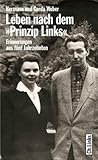
Hermann Weber, Gerda Weber. Leben nach dem "Prinzip Links": Erinnerungen aus fünf Jahrzehnten. Berlin: Christoph Links Verlag, 2006. 450 pp. ISBN 978-3-86153-405-1.
Reviewed by Bernd Schaefer (Woodrow Wilson International Center)
Published on H-German (February, 2009)
Commissioned by Susan R. Boettcher
Memoir of a Critical "Left" Historian
Hermann Weber, known since the 1980s as (West) Germany's "Nestor der deutschen Kommunismusforschung," was born in 1928 in Mannheim into a poor communist family, soon to be persecuted under the Nazis. He joined the re-emerging KPD in 1945 and entered SED party college between 1947 and 1949, during the heyday of the early Cold War, in order to be trained as a future communist youth cadre leader in West Germany. In a previous book, now the first part of his memoirs, he described the years of his fascination and gradual disillusion with communism, and the experiences that led to a slow but complete break with both Stalinist ideology and the German parties that represented it. In order to understand Weber's particular biography, the volume under review here must be read in conjunction with the earlier one, now unfortunately out of print.[1]
The second volume benefits greatly from increased access to GDR documentation of Weber's personality and writings. Weber was able to unearth many nuggets in various East German archives after 1990. He is a sober, honest, very personal, sometimes dour chronicler of his life, but he undoubtedly has stories to tell. Both volumes also contain autobiographical passages by his wife, Gerda, whom he met at SED party college. Coming from an East German communist family, she briefly advanced to higher party positions than Hermann when she held the chairwomanship of the Democratic Women's Association (DFD) in the FRG, one of the GDR mass organizations that was temporarily legal in West Germany during the 1950s. Hermann and Gerda grew disillusioned with Stalinism together and jointly orchestrated their breaks with the SED and KPD. Gerda Weber, however, soon left politics and became the family breadwinner during the 1950s in a still-tight West German economy. Later, she assisted Hermann's journalistic and academic career and helped him with his writings.
The account of the Webers's break with communism and the light it sheds on the FRG in the 1950s are among the most fascinating parts of the book. Hermann pondered leaving the KPD since his demotion from the status of party journalist after he failed to give sufficiently prominent coverage to Stalin's telegram to the May 1950 East Berlin "Deutschlandtreffen" of the Free German Youth (FDJ). Yet, in that year his wife received party permission to leave the GDR and join him in the FRG, and they needed aid from the KPD to help them settle in. Just when they jointly began to think about leaving the party, West Germany banned the FDJ (1951). They considered it immoral to abandon communism at that point and postponed this step to 1953--when they both were suddenly arrested by the West German police for communist activity and served month-long prison terms. Released without charges or bail, they remained under threat of indictment until 1958. By then they had long broken with communism; indeed, both were expelled from the KPD in 1954. In addition to the vivid descriptions of social, financial, and political problems that such renegades faced in the FRG from both communists and anti-communists, Weber's glimpses into leftist circles more or less associated with SPD and the trade unions are quite fascinating. For Hermann Weber, who for a while became a devoted anti-Stalinist "democratic Leftist" in the spirit of a "third way" of "neither East nor West," these organizations figure as an important but not yet fully recognized West German "pre-1968" Left.
Weber describes in detail his journalistic and academic career, which finally led to a chair in political science at the University of Mannheim, where he later founded the Arbeitsbereich DDR-Geschichte, the major hub of historical research on the GDR in West Germany. Drawing on his extensive knowledge of the history of the communist movement in Germany since 1919 and his personal acquaintances with many witnesses and activists, Weber became the foremost academic expert in this area. Banned from traveling to the GDR since his "treacherous" acts of the early 1950s, he fought constant battles with official East German historiography. In the GDR, he was officially ignored, but his publications were poached and secret academic theses on his works were even assigned. Based on his access to archives after 1990, Weber can present many telling and grotesque stories in this regard, the most interesting concerning the reception of his fact-based publications, Ulbricht fälscht Geschichte (1964), as well as the reactions to his 1969 unearthing of the original transcript of the 1918/19 convention that founded the KPD, and 'Weiße Flecken' in der Geschichte (1989). In the latter, he was able to prove that more former members of the KPD politburo lost their lives due to Josef Stalin than to Adolf Hitler.
All this publishing activity gave Weber the status of a constantly vilified lightning rod in GDR party historiography. In the FRG, he remained a committed Social Democrat and member of the SPD Historical Commission, also gaining respect among conservatives. When parts of the SPD drifted slightly towards the SED in the late 1980s, the West German party excluded Weber from the historic meeting between SPD Historical Commission and GDR Academy of Sciences in Bonn in 1987. This opportunistic move was corrected when Weber was included in the SPD's return delegation to East Berlin in early 1989.
Besides his massive publication record, one of Weber's lasting legacies is the archival access scholars enjoy to the records of SED and GDR mass organizations today. During his two stints as an expert adviser to the Bundestag Enquete Commissions on the GDR in the 1990s, he used his prestige to help create the Stiftung Parteien und Massenorganisationen in the Bundesarchiv (the so-called "SAPMO-BA"). While he was also engaged in the push for the opening of Russia's Comintern archives, his uncompromising advocacy for archival openness was unsuccessful in its attempts to soften the rule that keeps West German federal records sealed for thirty years.
Unlike some academic German opportunists from both West and East, when he came to write the history of the GDR after its unforeseen demise, Weber maintained the lines he had followed in his life and career. He continued to portray and analyze the self-defeating and internecine struggles of the communist movement in Germany during the twentieth century, but he never subscribed to rejuvenated theories of "totalitarianism" or indulged in what has become cheap GDR-bashing. Today, Weber receives almost universal respect for his work from his academic peers. Yet, in their intra-German fights over resources and public domination of historical interpretation, most of them sadly do not take enough cues from his historicist passion.
Note
[1]. Hermann Weber und Gerda Weber, Damals als ich Wunderlich hieß: Vom Parteihochschüler zum kritischen Sozialisten (Berlin: Aufbau, 2002).
If there is additional discussion of this review, you may access it through the network, at: https://networks.h-net.org/h-german.
Citation:
Bernd Schaefer. Review of Weber, Hermann; Weber, Gerda, Leben nach dem "Prinzip Links": Erinnerungen aus fünf Jahrzehnten.
H-German, H-Net Reviews.
February, 2009.
URL: http://www.h-net.org/reviews/showrev.php?id=23783
 | This work is licensed under a Creative Commons Attribution-Noncommercial-No Derivative Works 3.0 United States License. |

