

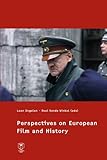
Leen Engelen, Roel Vande Winkel, eds. Perspectives on European Film and History. Gent: Academia Press, 2007. 279 pp. ISBN 978-90-382-1082-7.
Reviewed by Heike Polster (Department of Foreign Languages, University of Memphis)
Published on H-German (March, 2009)
Commissioned by Susan R. Boettcher
Doing History on Celluloid: Intertextual Approaches to European Historical Films
This collection brings together ten case studies of historical films from various European national contexts. In general, scholars who are interested in film writing, intertextual approaches to film, and the debates on historical films would benefit from reading this essay collection. The compilation's arrangement, however, is somewhat odd: Robert A. Rosenstone's epilogue, "The Promise of History on Film," outlines the theoretical perspective necessary to frame the ten distinct approaches in a conflating manner. He develops the term "historiophoty" to exemplify the role that "the visual media play in helping us to confront and understand our individual and collective past" (p. 260). Thus, the concept and the questions it raises would have been more adequately posed as an entry into the discussion. After all, the concept of "historiophoty" can be used to contextualize the key question this edition addresses: namely, the problem of finding the common ground behind the broad variety of disciplines and angles presented in the interdisciplinary work on film that the essays in this study represent.
The particular strength of Perspectives on European Film and History lies precisely in this diversity. It attempts to put lesser-known historical films on our radar, while mapping out the respective historical contexts of the films and their content. The film discussions repeatedly focus on the topics of historical change, historical personae, and the preservation of traditional images, as well as on renewed debates about the significance of particular cultural icons within the context of a nation and its history. The authors frequently touch on both traditional and innovative tactics of historical filmmaking. While some of the articles amount to little more than re-narrations of films and their historical background, some of them contribute to a catalog of intriguing questions: in what manner, they ask, do historical films contest history? And how, using Rosenstone's words, "do they interrogate the meta-narratives that structure historical knowledge, or smaller historical truths, received notions, conventional images?" (p. 122).
In connection with Leen Engelen's essay, "No Way to Do History? Towards an Intertextual Model for the Analysis of Historical Films," a number of the articles successfully borrow from his theoretical model of intertextuality in order to frame their film analyses. Engelen's refreshing approach rests on a redefinition of "genre": no longer "the central structuring element of the relations between text and context" (p. 25), genre is now understood as an intertextual system of "orientations, expectations and conventions that circulate between industry, text, and audience" (p. 23). Engelen thus captures the critical potential of genre, and defines historiography in general as intertext--an expansive and inclusive model.
The individual contributions examine historical personae and the political, social, and cultural contexts of their existence. Uli Jung’s "'A truly fatherlandish epic'? Karl Grune’s Waterloo (1928)" eloquently considers the question as to what extent the film's German director's visual strategies blend with the "patriotic ('fatherlandish') tendencies so clearly present in many German historical films of the interwar era" (p. 133). James Chapman's "The World Turned Upside Down: Cromwell (1970), Winstanley (1975), To Kill a King (2003) and the British Historical Film" focuses on the debates around the economic and cultural viability of British national cinema. He argues that these particular films conform to a popular view of the civil wars. After investigating the director’s tactics, Chapman concludes that revolutionary interpretations of history are not popular in movies. As many historical films depict how people make history, the relationship between an individual and the world he lives in is of critical importance. Pascal Vandelanoitte's "An Icon of Change: Andrei Rublev (1966) as a Historical Film about the Birth of Russia" lays out the historical context of the icon painter Rublev’s life, and links psychological observations about the crisis of an individual to broader social changes in medieval Russia. Brett Bowles's "Luc Besson’s The Messenger (1999): Remaking Joan of Arc for the New Millenium" investigates a number of films that helped shape the legend of Joan of Arc. Bowles dissects the various representations of this icon of French national identity, and lays out how Besson's film suspends her agency as "a national saviour" (p. 59). He successfully outlines which historical purposes the representations follow, and uses critiques of Besson's movie in order to determine the real significance Joan of Arc in French national identity. Willem Hesling's "Artist Legends and the Historical Film: Alexander Korda’s Rembrandt (1936)" contributes greatly to a better understanding of the nature and genesis of the heterogeneous intertextual structure of historical films that he calls "artist biopics." He examines the relationship within this historical subgenre between the tradition of the legendary artist story and the official art-historical discourse.
Some of the individual contributions focus more on the reception of historical films. Amy Sargeant's "Vera Drake (2004): The Comfort of Strangers, the Discomfort of Strangeness" lays out the key aspects of the film that led to its critical success. Liesbet Depauw's "Reframing the Past to Change the Future. Reflections on Herbert Wilcox's Dawn (1928) as a Historical Documentary and War Film" includes a discourse analysis of film reviews, which she uses to critique common genre expectations of historical films. Jasmijn Van Gorp's chapter, "The Time Which Is Yet to Come: Understanding My Friend Ivan Lapshin (1983-1985)" investigates the film's intended reading and contrasts it with its public and critical reception.
One article in particular resonates superbly with Engelen's intertextual approach. It is perhaps not surprising that this edition's most coherent and thought-out contributions were delivered by the editors themselves. Roel Vande Winkel's contribution, "Hitler's Downfall, a Film from Germany (Der Untergang, 2004)," looks at the film as a cultural phenomenon. Vande Winkel focuses on Downfall's particular way of "doing history." The author builds an earnest vocabulary for addressing "the new standards in the art of committing history to celluloid" (p. 184). Furthermore, Vande Winkel makes a series of solid arguments for the filmmaker's occasional deviations from the actual, historically accurate, course of events. The article, to be sure, has grown out of maturing debates on the visual representation of far-reaching historical events. The exemplary element in this article, however, lies in the author's presentation of the film's self-reflexive commentary. In Downfall, the actual woman whose brief acquaintance with Hitler is caught on film provides this commentary. By positing Traudl Junge as a narrator reflecting on her past--and the voiced realization that she was, when she started working as Hitler's secretary, the same age as Sophie Scholl when she was executed--director Bernd Eichinger managed to picture the woman's coming to terms with the past "without totally absolving herself from any guilt" (p. 195). Vande Winkel reads this technique as a representation of Germany's Vergangenheitsbewältigung. Despite the inherent difficulty of humanizing Adolf Hitler without trivializing his brutal actions, a problem the film is forced to confront, Vande Winkel explains that its singular achievement lies in its simultaneous generation and representation of a new phase of reflection and inquiry in Germany's troubled relationship with its past.
More generally, Vande Winkel's thoughtful study vocalizes one of the main concerns in the discussion about the relationship between film and history. He asks: "Is it necessary, or for that matter even feasible, for historical films to have the ambition of visualising literally the complex processes that have led a culturally developed nation to the horrors of Nazism? Is it intellectually appropriate to demand such a task of a medium that, when striving to reach a broad audience, must play by the rules of mainstream cinema?" (p. 213). As Bruno De Wever points out in "Prologue: Historical Film as Palimpsest," research into historical films ought to be conducted with "respect to both the conventions and idiosyncrasies of the film medium" as well as a high degree of care "for the rules of engagement at stake in academic historiography" (p. 5). Therefore, like all historical films, the study of historical films, and even historiography itself, become a "palimpsest of mounted meanings, facts, images, experiences, memories, records, fantasies, structures, traditions, ideologies and stories" (p. 10). The particular achievement of this collection of essays lies in its stress on the strategies for understanding this palimpsest. The perspectives traced by this book focus on the relationship of the films' spectators to history and to the past represented in the film, thus making it clear that "it is impossible to write about history (articles, books, film scripts) without interpreting it, to make historical films without interpreting the events and the people presented" (pp. 203-204).
If there is additional discussion of this review, you may access it through the network, at: https://networks.h-net.org/h-german.
Citation:
Heike Polster. Review of Engelen, Leen; Vande Winkel, Roel; eds., Perspectives on European Film and History.
H-German, H-Net Reviews.
March, 2009.
URL: http://www.h-net.org/reviews/showrev.php?id=23747
 | This work is licensed under a Creative Commons Attribution-Noncommercial-No Derivative Works 3.0 United States License. |

