

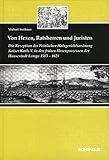
Michael Ströhmer. Von Hexen, Ratsherren und Juristen: Die Rezeption der Peinlichen Halsgerichtsordnung Kaiser Karls V. in den frühen Hexenprozessen der Hansestadt Lemgo 1583-1621. Paderborn: Bonifatius Buchverlag, 2003. 339 pp. EUR 35.80 (broschiert), ISBN 978-3-89710-225-5.
Reviewed by Jonathan Durrant (Department of Humanities, University of Glamorgan)
Published on H-German (June, 2009)
Commissioned by Susan R. Boettcher
The "Constitutio Criminalis Carolina" and Witch Trials
As Michael Ströhmer observes, the Constitutio Criminalis Carolina of 1532, like many other law codes and legal manuals, has elicited only cursory interest from witchcraft scholars (p. 13). Many earlier historians saw it as having a profound influence on the practice of witch persecution; more recently, its status has diminished as case studies have shown that other local or theological practices took precedence or that enforcers of the Carolina habitually manipulated its contents to fit their own needs. In either case, reference is usually only made to the articles dealing with magic and related practices without much contextualization beyond a note citing the Bambergensis of 1507 as the code's template. Ströhmer's work, which will provide new perspectives on this issue, swims against the tide of much witchcraft historiography (which also tends to the social or cultural) and offers a legalistic study of the Carolina that he hopes will bridge the gap between witchcraft and legal historians.
Ströhmer's monograph is divided into two sections. The first presents a macroanalysis of the Carolina covering the origins of its prescriptions in cases of magic (Articles 21, 44, 52, and 109), an interpretation of the articles' contents, and a discussion of their reception among early modern scholars generally at the height of the witch persecutions (the 1580s to the 1630s). The second section offers a case study of the Carolina as it was put into practice in the Hanseatic city of Lemgo between 1583 and 1621.
To anyone who is accustomed to dismissing automatically the importance of the Carolina, the macroanalysis is revealing. The origins of the articles concerning witchcraft are set in their scholastic and canonical contexts and Ströhmer is at pains, through a detailed analysis of each relevant article, to stress both the influence of the Bambergensis and the differences between the two law codes. These differences show a softening of approach as the imperial code evolved out of the local Franconian one and suggest that the influence of the latter was not as straightforward as is often suggested. This subtle evolution in the code's articles concerning magic reveals a general humanist skepticism about witchcraft prosecutions (if not the fact of witchcraft). The skeptical undertone of the Carolina's text is neatly thrown into relief as Ströhmer rehearses the ways in which the code should have been applied in witchcraft cases. The limitations on the use of torture, or on leading questions and the suspect's testimony elicited from these, for example, are explained in more detail than one usually finds in witchcraft histories and demonstrate that the strict application of the code might well have prevented witch persecution on any scale.
While the humanist ambience and relationships between key figures are recreated adequately enough to be suggestive of their significance, Ströhmer avoids the problem that he cannot show many direct links between the thinkers he refers to and the actual changes to the contents of the articles as they were redrafted. One is left wondering whether other factors--imperial politics or practical obstacles--might not have had an equal or greater role to play in this process.
In an attempt to make clearer the general reception of the Carolina at the height of the witch persecutions, Ströhmer pitches the commentary of Johann Georg Godelmann (representative of those skeptical of rigorous witch prosecution) against that of Hermann Goehausen (representative of those who held "orthodox" witch theories). I have a reservation about the term "orthodox" as a descriptor for witch theories. A whole host of theologians, jurists and judges--medieval scholars, inquisitors in early modern Spain, city councilors in Rothenburg ob der Tauber, and both believers and skeptics in, say, England--held theories that did not correspond to those of Goehausen or Heinrich Institoris. Which of the competing theories could one say were "orthodox"? This lack of subtlety reflects Ströhmer's limited reading in witchcraft historiography; Norman Cohn, Stuart Clark in Thinking With Demons (1997), Wolfgang Behringer in Hexenverfolgung in Bayern (1988), and the editors of the recent German translation of the Malleus Maleficarum (Der Hexenhammer, 2000) have all addressed a broader range of the complexities of early modern demonology and judicial practice than Ströhmer has done in the book in question.
The comparison of the views espoused by Godelmann and Goehausen does, however, highlight the range of interpretations that jurists could come to regarding the prescriptions of the Carolina. For the Lutheran Godelmann, the crime of magic was to be dealt with according to the prescriptions laid out in the imperial code and was therefore no different from any other crime. For the Catholic Goehausen, who relied less on the text of the code and more on other witch theories, the crime was certainly an exceptional one, to which prescriptions about torture, questions, and evidence did not apply. The discussion thus adds depth to our understanding of how witchcraft became a crimen exceptum in some jurisdictions. It was not merely that some witch-hunting advocates held firm to the advice given in the Malleus Maleficarum, but that the law could also be interpreted in a flexible way.
This flexibility is demonstrated in the case study for which the macroanalysis provides the context. Much has been written on the witch trials in the county of Lippe, in which the town of Lemgo was located; that fact is justification enough for using it as a case study, and Ströhmer's work should be read in conjunction with this literature. What Ströhmer is able to show is the range of individuals who became involved in the witch trials in Lemgo and the extent to which they did so. This information is important to the case study, because Ströhmer is able to go further and show which members of the justiciary were able to manipulate the Carolina, despite formally accepting it in the revisions to the local Stadtbuch in 1584, and ignore its precepts about dubious confessions, the use of unreliable witnesses, and the provision of sound defense procedures. Like Goehausen, the Lemgo councillors, particularly those of its senate, were able to divorce the criminal acts legislated against in the Carolina from the provisions about legal practice and treat witchcraft as an exceptional crime demanding extraordinary judicial processes. References to the individual trials prosecuted under the Lemgo authorities' jurisdiction reinforce the points Ströhmer wishes to make about the distance between the intentions of the imperial code's authors and the aims of local magistrates.
To anyone well-versed in witchcraft historiography, the fact that witch persecution could not usually proceed without exceptional evidence is not news. What Ströhmer has been able to do, however, is show that the ways in which jurists and judges came to their interpretations and applications of the law were not straightforward. It was never as simple as rejecting the Carolina or merely paying lip-service to its provisions. The imperial code, however skeptical in tone, could also be used as an authority in the service of the witch-hunters.
If there is additional discussion of this review, you may access it through the network, at: https://networks.h-net.org/h-german.
Citation:
Jonathan Durrant. Review of Ströhmer, Michael, Von Hexen, Ratsherren und Juristen: Die Rezeption der Peinlichen Halsgerichtsordnung Kaiser Karls V. in den frühen Hexenprozessen der Hansestadt Lemgo 1583-1621.
H-German, H-Net Reviews.
June, 2009.
URL: http://www.h-net.org/reviews/showrev.php?id=23743
 | This work is licensed under a Creative Commons Attribution-Noncommercial-No Derivative Works 3.0 United States License. |

