

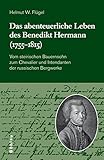
Helmut W. Flügel. Das abenteuerliche Leben des Benedikt Hermann (1755-1815): vom steirischen Bauernsohn zum Chevalier und Intendanten der russischen Bergwerke. Vienna: Böhlau, 2006. 334 pp. ISBN 978-3-205-77424-2.
Reviewed by Warren Alexander Dym (Department of History, Bucknell University)
Published on H-German (January, 2009)
Commissioned by Susan R. Boettcher
An Austrian Metallurgist in Russia
Helmut Flügel has written the present work to recover the life of Benedikt Hermann, who rose from humble origins in Austria to become the highest official in the Russian mining administration. The result, more a commemorative piece than empirical history or biography, exposes a chapter in earth science and mining history largely neglected in the English and German literature.
The eighteenth century marked the beginning of large-scale mining and metallurgy in Russia. Peter the Great's government founded the industrial town of Ekaterinburg in the Ural Mountains in 1723, and both Catherine the Great and Alexander I continued to develop the region as the heart of Russian industry and gateway to Siberia. Hermann's career is a good example of how Russia imported foreign technology and knowledge toward this end. His story is not as unique as Flügel implies--well before Hermann, famous metallurgical chemists moved between Freiberg and the Russian Academy of Sciences--though Hermann did rise quite high in the Russian administration (privy counselor, director of steel works at Ekaterinburg, then chief of all mining in 1807) and left a distinctive body of written material. These texts include a series of travelogues addressed to his friend in Austria, Xaver Sartori, discussing minerals and metallurgy in the Urals (selections of which Flügel appends to his text); numerous publications on metallurgical technologies, ores, and minerals; a large monograph on mining and metallurgy in the Urals; and a short text on the origin of rocks and minerals. Flügel provides some historical analysis of these materials, but he mostly charts the life of his subject and points the direction for future research. A complete account of Hermann will certainly require scouring the Russian archives.
Historians of the trades may be interested in one defining event in Hermann's life. Flügel appends Hermann's 1772 description of a particular method for smelting iron into steel that he observed among Carinthian and Styrian metal smiths. Before Abraham Darby's coking technique had spread through the continent, blacksmiths still experimented with various means of heating iron by coal. Hermann could thank progressive social ideas for his opportunity to hear university lectures in Vienna, meet men of learning and culture, and assume high-status positions in Russia, but by publishing this trade secret, he exposed either naiveté about the role of the Austrian state in its mining and metallurgical operations, or presumption that he could circumvent it. Joseph II's government began a formal action against Hermann, which was the immediate cause for his migration to St. Petersburg, where the tsar employed him to develop this very technique. Flügel asserts that Hermann suffered from some sort of personality complex that compelled him to flee in times of stress, but the notion is not substantiated.
Of interest to historians of geology may be Hermann's Über die Entstehung der Gebirge und ihre Gegenwärtig Beschaffenheit (1797). The author, who had outlined his thoughts on the origin of rocks in a 1789 text, claimed to have priority over Abraham Werner's more famous theory on the sedimentation of rocks and minerals (Neue Theorie von der Entstehung der Gänge mit Anwendung auf den Bergbau [1791]). Flügel does not compare these texts in any depth or discover any response to Hermann's claim, but it might be instructive to question the extent to which a self-taught mineralogist of low social origins such as Hermann could participate in the scientific debates of his day. Hermann ultimately became an honorary member of numerous scientific societies in Russia and abroad, but strong indications suggest that his academic work did not find an audience in the West. Flügel shows that Hermann addressed major issues that more famous contemporaries--the Comte de Buffon, Werner, Christoph Traugott Delius, and Georg Ernst Stahl-- handled otherwise, and Flügel refers frequently to Hermann's famous successor and fellow traveler through Russia, Alexander von Humboldt, but the reader is left to wonder what Hermann's real legacy was in the history of science. Flügel wonders in his conclusion whether Hermann was a scientist. By doing so, he suggests another important avenue for future research, since the question ought to follow the more historically meaningful inquiry as to what Wissenschaft was in Hermann's time and place.
For some readers, Das Abenteurliche Leben might encourage historians to develop the case of Hermann and others like him to expand our understanding of technology and knowledge transfer between Russia and the West during the Enlightenment.
If there is additional discussion of this review, you may access it through the network, at: https://networks.h-net.org/h-german.
Citation:
Warren Alexander Dym. Review of Flügel, Helmut W., Das abenteuerliche Leben des Benedikt Hermann (1755-1815): vom steirischen Bauernsohn zum Chevalier und Intendanten der russischen Bergwerke.
H-German, H-Net Reviews.
January, 2009.
URL: http://www.h-net.org/reviews/showrev.php?id=23739
 | This work is licensed under a Creative Commons Attribution-Noncommercial-No Derivative Works 3.0 United States License. |

