



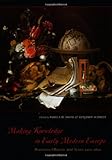
Pamela H. Smith, Benjamin Schmidt, eds. Making Knowledge in Early Modern Europe: Practices, Objects, and Texts, 1400 - 1800. Chicago: University of Chicago Press, 2007. ix + 360 pp. $68.00 (cloth), ISBN 978-0-226-76328-6; $28.00 (paper), ISBN 978-0-226-76329-3.
Reviewed by Michael J. Sauter
Published on H-German (February, 2009)
Commissioned by Susan R. Boettcher
Made in Early Modern Europe
This useful collection of articles highlights new trends in the study of how early modern Europeans produced knowledge. The individual chapters are generally well written and edited, although the publisher's use of endnotes rather than footnotes will be irritating for the serious reader. Still, this text is recommended for both specialists and non-specialists alike because of both the breadth of the contributions and the key lesson that it teaches: namely, that knowledge can be the result of a bewildering and surprising variety of processes. As the editors note in their introduction, "Debates on making and consuming information have tended to privilege certain instruments of knowledge--books and bookishness, for example, in the earlier period and scientific instruments in a slightly later period--and this has narrowed our perspective on the enormous range of ways in which making knowledge has taken place and continues apace" (p. 4). Accordingly, this compilation brings together contributions from fourteen historians, all of whom work in widely divergent fields within the discipline--from history of religion, to history of science, to history of art, and beyond--in order to give the reader a sense of the myriad and sometimes unexpected ways in which early modern Europeans produced knowledge.
The first section, "Making Knowledge from the Margins," includes contributions by Chandra Mukerji, Linda Seidel, Simon Werret, and Londa Schiebinger. The section's title captures the main theme aptly. In each case the author is interested in discovering how marginalized people and/or places contributed to the production of knowledge in early modern Europe. Mukerji's and Schiebinger's chapters are particularly significant in this respect. In "Women Engineers and the Culture of the Pyrenees: Indigenous Knowledge and Engineering in Seventeenth-Century France," Mukerji explains how the great Canal du Midi could never have been built in the seventeenth century without the contributions of Pyrenean women. In contrast to an older literature, which held that the canal's designer, Pierre-Paul Riquet (1609-80), was a solitary genius who braved the slings and arrows of outrageous fortune in his struggle to finish the canal, Mukerji shows how women brought both physical and mental resources to the project without which the work could never have been completed. On the one hand, much of the labor hired to do the digging and terracing was female. On the other, Pyrenean women were traditionally the region's waterworkers, which meant that the women hired came with often sophisticated knowledge of how to build canals, dikes, and pools. Mukerji's work suggests that the large projects that states became capable of financing as state power grew in the seventeenth century must be understood as cooperative enterprises with multiple contributors, rather than as products of a solitary genius's vision.
Schiebinger's chapter, "Naming and Knowing: The Global Politics of Eighteenth-Century Botanical Nomenclatures," reverses our perspective and shows, through a study of botanical naming practices, how Europe suppressed extra-European local knowledges in its desire to know the world. Thanks largely to the machinations of the botanist Carl Linnaeus (1707-78), the system of botanical nomenclature prized names produced by Europeans for local plants and cast aside indigenous names for those same plants. This insight is, in and of itself, not startlingly new. The particular virtue of Schiebinger's chapter lies, however, in her attempts to show that Linnaeus had competition from other European botanists, such as Georges-Louis Leclerc, Comte Buffon (1707-88) and Michel Adanson (1727-1806), both of whom argued for the use of local names in their own systems. In short, although the process of naming was deeply implicated in European imperialism, Schiebinger points out that the entire development was also deeply contingent and could have gone in another (more inclusive) direction that used the names of local flora and fauna. More importantly, this alternate path was a product of early modern Europe's own scholarly traditions, which is to say that although Linnaeus's naming practices were imperial in scope and intent, not all of European science can be tarred with the same brush.
The second section, "Practices of Reading and Writing," includes chapters by Herman Pleij, Rudolf Dekker, Arianne Baggerman, Lori Anne Ferrell, and Scott Black. The main theme that unites all of these pieces is the insistence on seeing books not as mere containers for knowledge but as part of a web of practices within which knowledge was constituted. Books were thus not simply books, but also tools, whose particular use was determined by the social and cultural environment that surrounded them. Along these lines, the contributions of Dekker and Black are of particular note. In "Watches, Diary Writing, and the Search for Self-Knowledge in the Seventeenth Century," Dekker makes excellent use of the diary of Constantijn Huygens (1596-1687), the brother of the noted Dutch scientist, Christiaan Huygens (1629-85). Weaving a complex tale that includes Dutch urban culture, the rise of science in the seventeenth-century Netherlands, and the increasing spread of time awareness, Dekker shows how the pursuit of self-knowledge in early modern Europe was intimately linked to the search for natural knowledge. Put simply, the same clocks that were necessary for navigation and astronomy soon became central to the practice of creating journals of all types, particularly journals that documented the passage of one's inner life. Hence, for Dekker, making a record of worldly occurrences became fundamental to Dutch culture of the period, even where the self was concerned, and this culture of record emerged, to no small degree, along with the rise of science.
Tracing a similar trajectory from knowledge to culture, Scott Black's contribution, "Boyle's Essay: Genre and the Making of Early Modern Knowledge," expressly connects the rise of a new scientific method in the seventeenth century with a fundamental shift in the literary form of scientific writing. Black argues that the shift in literary form may be traced back to the invention by Robert Boyle (1627-81) of the scientific essay. Black argues that the shift to the essay as the means for reporting scientific knowledge was part of an express attempt by Boyle to define scientists as well as science. Put another way, the use of the essay as the primary form for distributing scientific knowledge emerged from Boyle's desire to make science more gentlemanly. Building on Steven Shapin's work, Black connects the use of the essay to the rise of experimental science.[1] If the experiment was, as Shapin has argued, meant to contribute to the cultivation of politeness, then the reporting of experiments within a particular genre--Boyle's essay--was part of the same project, for in choosing to write in a particular way, Boyle sought not only to define how his readers ought to behave but also to limit his readership to gentlemen--that is, those who were deemed capable of understanding him. In this instance, the means to spread scientific knowledge served simultaneously as a means of exclusion. If we take Dekker's and Black's contributions together, their chapters suggest that historians need to pay much more attention to the ways that science was encoded in print and to see that very encoding as, at once, representative and constitutive of larger social and cultural processes.
The book's third section, "The Reform of Knowledge," serves as coda to the previous two by highlighting the significance of institutional contexts to the production of knowledge. This section includes contributions from Claudia Swan, Ole Peter Grell, Carina L. Johnson, Jonathan Sheehan, and André Wakefield. Only the contributions of Johnson and Sheehan will be mentioned here. In "Stone Gods and Counter-Reformation Knowledges," Carina Johnson argues that Counter-Reformation Europe used reports of idolatrous practices among indigenous peoples in the New World as means for justifying the Catholic use of idols against Protestant--and particularly Calvinist--criticism. Through an analysis of the Counter-Reformation debates in the Catholic courts of Vienna and Munich, as well as those sponsored by the Holy See in Rome, Johnson shows how the otherness of the New World served as a crucial point of differentiation for Catholicism. Reeling from Calvinist criticisms of the Catholic use of idolatry, the Catholic Church, in turn, used the idol worship of New World peoples as a critical backstop for the justification of its own practices. New World idols could be identified clearly as the work of the Devil, and this process of definition and exclusion allowed Old World idols to be justified as legitimate elements in Catholic religious practice.
Where Johnson concentrates on Catholics, James Sheehan looks at Protestants. In "Temple and Tabernacle: The Place of Religion in Early Modern England," Sheehan holds that the anthropology of religion emerged in the early modern world because of confessional commitments and not in spite of them. Sheehan pinpoints the emergence of an anthropology of religion in Protestant discussions about the "place" of the Temple of Solomon that raged during the sixteenth and seventeenth centuries. These discussions were part of an attempt to distinguish Protestant theology from the traditions of the Catholic Church. Sheehan sees the various attempts to "locate" the temple as a precursor to the basic anthropological insight that all religions need places that separate the holy from the profane. This insight allowed early modern Protestants to compare Christian traditions to those of other religions--thus reducing the uniqueness of Christianity--while still allowing them to cleave to the belief that their own religion was true. This shift toward comparison as an element of religious study was, however, not the product of secular pressures, but of pressures produced by research and debate within the religious realm. The key to the emergence of a "scientific" study of religion did not come from science at all, but from theologians themselves.[2]
A short review may hardly do justice to the diversity and originality of the many contributions to this volume. In general, all the contributions make for stimulating reading and serve as useful introductions to current debates and problems. That does not mean, however, that this book is perfect, and even the better chapters include problematic points. For instance, Johnson's chapter fails to place the Counter-Reformation interest in the New World in the context of the continual threats from the Ottoman Empire. Sheehan's chapter could have considered the Protestant discussion of place against the backdrop of a long Christian tradition of sacralizing pagan spaces that began in the late Roman Empire and continued through the Middle Ages. Finally, Mukerji's chapter overdraws the contrast between the lone genius interpretation of canal-builder Riquet and the cooperative approach that she prefers. But these are merely quibbles. None of them should dissuade anyone from consulting this timely, informative volume.
Notes
[1]. As in Steven Shapin, A Social History of Truth: Civility and Science in Seventeenth-Century England (Chicago: University of Chicago Press, 1994).
[2]. Sheehan's argument is structurally similar to the arguments made in Dirk Fleischer, Zwischen Tradition und Fortschritt: Der Strukturwandel der protestantischen Kirchengeschichtsschreibung im deutschsprachigen Diskurs der Aufklärung, 2 vols. (Waltrop: Harmut Spenner, 2006).
If there is additional discussion of this review, you may access it through the network, at: https://networks.h-net.org/h-german.
Citation:
Michael J. Sauter. Review of Smith, Pamela H.; Schmidt, Benjamin, eds., Making Knowledge in Early Modern Europe: Practices, Objects, and Texts, 1400 - 1800.
H-German, H-Net Reviews.
February, 2009.
URL: http://www.h-net.org/reviews/showrev.php?id=23734
 | This work is licensed under a Creative Commons Attribution-Noncommercial-No Derivative Works 3.0 United States License. |

