



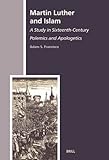
Adam S. Francisco. Martin Luther and Islam: A Study in Sixteenth-Century Polemics and Apologetics. The History of Christian-Muslim Relations. Leiden: Brill, 2007. 260 pp. $169.00 (cloth), ISBN 978-90-04-16043-9.
Reviewed by Kersten Horn (Department of Anthropology and Languages, University of Missouri-St. Louis)
Published on H-German (July, 2009)
Commissioned by Susan R. Boettcher
Martin Luther's Response to Islam as Christian Apologetics
The intersection of internal divisions in the wake of the Reformation and external pressures from the Ottoman military operations in southeastern and central Europe makes sixteenth-century Germany a particularly complex and captivating terrain for academic scholarship. The "Turkish threat," then the predominant European reception of the Ottoman Empire's military expansion on the continent, unsurprisingly also found its way into the contemporary confessional conflict.[1] An examination of Carl Göllner's bibliography suggests that in the genre of turcica, the most widely published author in the German-speaking areas of Europe was Martin Luther.[2] Indeed, as the pivotal figure of the German Reformation and the most prolific representative of German thought on the Turks during this period, Luther would be impossible to ignore on the subject. Nevertheless, Adam S. Francisco's contribution to the scholarly corpus is, to my knowledge, the first monograph devoted exclusively to Luther's response to Islam. The goal of the work is to draw attention to what the author considers the more theological and apologetic aspects of Luther's writings on the Turks, which, he argues, have been downplayed as incidental to the "Turkish threat," Luther's dispute with Rome, and his pastoral concerns. The book is divided into two main sections. The first comprises four chapters that provide a context for the analysis to follow. They include a summary of European responses to Islam from the Middle Ages up until 1546 (the year of Luther's death), an overview of the different approaches Luther took in engaging with Islam, and an analysis that explores the extent of Luther's knowledge of Islam. The second part, "Martin Luther's Engagement with Islam, 1529-1546," dedicates one chapter each to a close reading of four of Luther's major texts on the Turks, Vom kriege widder die Türcken (1529), Eine Heerpredigt widder den Türcken (1529), Verlegung des Alcoran (1542), and finally, the Praefatio Alcoranum (1543) along with his sermon for the fourth Sunday after Epiphany 1546. It should be noted up front that Francisco's study falls primarily into the discipline of theology rather than history or literary studies, a distinction that may go some way toward accounting for the difficulties that historians or literature scholars may find in the work.
Two of the chapters stand out as especially useful. Chapter 4 provides a survey of Luther's knowledge of Islam as well as a discussion of the sources, as far as discernible, from which he gained it. It may thus prove helpful as a starting point for further research on the place and usage of Islam and the Turks in Luther's thought. Among the analytical chapters, chapter 5 is notable for its explication of Luther's Vom kriege. Francisco shows that Luther's case against the Turks here is based on his doctrine of the three estates (church, state, and household) and makes for worthwhile reading.
Nevertheless, in a few regards, the book may puzzle or vex the reader--and these are matters that the author should have been given the opportunity to rectify before publication by having them pointed out during the editing process. For example, in a number of instances, the reader is faced with the question of whether a given statement is a paraphrase of a primary source or instead reflects Francisco's own assessment. This uncertainty is caused chiefly by the sometimes ambiguous manner in which paraphrases are made and footnotes are placed in the text. Absent or erroneous citations sometimes compound the problem. In several instances, readers may be left with the impression that they are reading the paraphrase of a primary source when in fact Francisco is providing his own interpretations and suppositions (some of which are not necessarily borne out by the original text).[3]
In addition, the first three chapters in particular include a number of assertions that cause the reader to wish for further elaboration and more discussion. Time-honored commonplaces though they may be, their critical examination would have been justified in a study of this scope. For example, the assertion that in the Middle Ages, "Islam was viewed as an archenemy of Christianity" and was "perceived to be an alien and vicious civilization" (p. 9) leaves open the question of what might have accounted for this perception and to what degree such a view was uniform among Europeans. When we read on the same page that contemporary travel literature detailed life among the Turks and under Islam "in an effort to raise the level of awareness of the foreign culture and religion," a footnote elaborating on this point or citing secondary sources to support this assessment might have explained how the author arrived at this conclusion about the writers' motives. Finally, in chapter 3, after having been consistently informed that Europeans perceived the Turks as a formidable threat, the reader learns that certain traits among the Turks and their government were apparently widely admired in Europe, even prompting some to wish they lived under Turkish control. Setting aside the matter that the truth of this claim also requires critical examination, the reader is offered no explanation for the contradiction that seems inherent in a desire to live under the rule of a people of whom Europeans supposedly possessed a mortal fear.[4] The whole matter is simply dismissed via the assertion that "[r]ealistically, given that the Turks were feared and despised by most, there probably were not many people in western Europe who expressed a desire to become subjects of the Turks. The possibility of the Ottomans breaking into the German Empire without a fight was thus not much of a concern" (p. 87). While such a claim may appear reasonable on its face, its veracity should be supported by evidence rather than taken on faith alone.
Similarly, when "[t]he threat that the Turks posed to Christian Europe" is described as "unprecedented" (p. 64), the reader might desire a discussion of who exactly felt threatened and how they characterized the nature of this threat. Was the threat, in this instance, seen as territorial, political, physical, religious? Did everyone feel imperiled, or some groups more than others? To what degree was the contemporary perception or representation of a threat as gleaned from the primary sources consistent with historical fact? This matter is not minor, for popular perceptions did not always correspond to historical reality. Absence, in a scholarly analysis, of a clear distinction between the "Turkish threat" as a topos in medieval and early modern European discourse as evidenced in the primary sources, and the historical phenomenon of Ottoman military expansion and responses to it may call into question its reliability and, in consequence, diminish its usefulness.[5]
Such interpretations, moreover, run the risk of taking primary sources too much at face value. At times, Francisco takes assertions made by authors of his primary sources as sufficient proof of their veracity.[6] It is one thing to attempt to provide the modern reader with a sense of how a matter was experienced--or at least portrayed--by its contemporaries. When the author declares, however, that "the threat that the Turks posed to Christian Europe ... was unprecedented" (p. 64) and that the Siege of Vienna was the occasion when "western civilization was at its greatest peril during Luther's lifetime" (p. 233), then he inappropriately internalizes, at least to a degree, elements of the early modern discourse regarding the Ottomans.
One last matter to be highlighted here is the dearth of what many would consider sufficient evidence to support some of the central claims made in the study. For example, Francisco explains that the motivation for Luther's theological and apologetic engagement with Islam stemmed from his "fear of Christian apostasy and conversion" to Islam (p. 90). This "fear" of apostasy is asserted a number of times throughout the book; however, scant evidence is offered to support this characterization of Luther's sentiment towards Christian conversion to Islam.[7] To be sure, the conversion of Christian captives to Islam was a point of concern for Luther even before reading reports to that effect in Georgius de Hungaria's Tractatus (1481).[8] The very idea that Christians might turn away from their faith to that of the Turks certainly would have been denounced by any God-fearing Christian of the time. Moreover, it is true that throughout his writings, Luther describes with characteristic bluntness the threat he saw in the Turks, the shortcomings he imputed to their religion, and the consequences he expected to result from Turkish rule or captivity. In doing so, Luther's prose is nevertheless deliberate and rhetorically purposeful. Instead of analyzing the rhetorical quality of much of this discourse, however, Francisco diagnoses strong anxieties in Luther, but without presenting a compelling case. Although he claims that the "intense concern" over possible Christian conversions has been noted by other scholars, an examination of the sources cited reveals that they do no such thing (p. 85).[9] In several passages, the author asserts that reports of Christian apostasy or the thought thereof variously "aroused a deep-seated fear" in Luther (p. 85), "caused Luther a great deal of concern" (p. 88), or that "Luther's fears of Christian conversion to Islam were not unfounded" (p. 90). The only piece of evidence provided in support of this claim is a quote from Luther's preface to his edition of the Tractatus that "[t]here is danger that many of our people will become Turks" (p. 88). Reading this passage as evidence of a feeling of fear, however, is open to the objection that noting the "danger" of something is hardly the same as declaring one's fear of it. The word may simply indicate the possibility of an outcome deemed undesirable by the speaker. Moreover, Francisco does not offer a discussion of why Luther's response to the prospect of Christian conversions to Islam would have been "fear." What did he fear could result from these conversions? Did he fear for the converts' souls? Did he fear divine punishment? Did he fear that the Roman church would simply be replaced by the Turkish religion, making his reformatory efforts for naught? Unfortunately, by not investigating this aspect of his claim, Francisco passes up on the opportunity to further his case.
Does Francisco ultimately succeed in supporting his contention that the more theological and apologetic aspects of Luther's writings on the Turks have been unjustly downplayed? For the most part, he does, even if he neglects certain passages in Vom kriege in favor of others that can be construed as more theological and apologetic in nature. Narrowing the focus in such a fashion does not sufficiently take into account the extent to which Luther's discussion of the Turks here was embedded in an anti-papal and anti-Catholic critique. Throughout the text Luther points out similarities that he detects between the Roman church and the Turks' religion. His examination of Islam as he understands it serves to clarify his position on the use of military force against the Ottomans and to defend his doctrine of the two kingdoms, which had led him to denounce calls by Pope Leo X for a crusade against the Turks. Similarly, Francisco's reading of the Heerpredigt in chapter 5 misses the context that for part of his refutation of Islam to make sense, the Turks must be understood as a stand-in for the Roman church, just as in the preface to his edition of the Tractatus, which he was working on around the same time. The Turks are, however, much more clearly the primary target of the texts discussed in chapters 7 and 8. Nevertheless, the position that Luther's interest in Islam was not incidental to the "Turkish threat" and Luther's dispute with Rome seems difficult to maintain. Even Francisco's own argument that Luther's desire to formulate theological attacks on the Turks' religion was motivated by his "fear" of Christian apostasy (an assessment that appears unfounded) and that the attacks were aimed at discouraging Christian conversions to Islam suggests as much. After all, those conversions were said to take place among Christians living in areas that had most recently come under Ottoman control. Moreover, Luther's dispute with the Roman church is crucial to his reception of the Turks because of the similarities he saw between the two.[10] It seems, however, that all of this argumentation is in any case not irreconcilable with the recognition of Luther's importance as an apologetic author on Islam, for which Francisco argues in his book.
Notes
[1]. I use the word "Turk" and its lexical derivatives in the context of the medieval and early modern European discourse on the Ottomans while "Ottoman" and its derivatives refer to the Ottomans as the object of historical analysis.
[2]. Carl Göllner, Turcica: Die Europäischen Türkendrucke des XVI. Jahrhunderts, 3 vols. (Bucharest: Editura Academiei, 1961), vols. 1-2.
[3]. As one of several examples, see Francisco's discussion of Georgius de Hungaria's Tractatus on p. 27. A look at the Tractatus reveals that most of the characterizations of Turkish and Christian behavior in this passage are in fact Francisco's own. The reader's misperception is exacerbated by the unconventional placement of the footnote numbers in the text. In this instance, the only footnote reference for the first two-thirds of the page turns out to be the citation for the preceding sentence only. Even readers thoroughly familiar with the Tractatus may be at a loss to establish which passages or pages Francisco is referring to, given that the text does not correspond in an easily discernable fashion to the content of the Tractatus and that no citations are provided. Cf. Georgius de Hungaria, Tractatus de moribus, condictionibus et nequicia turcorum: Traktat über die Sitten, die Lebensverhältnisse und die Arglist der Türken, edited, translated, and annotated by Reinhard Klockow (Köln: Böhlau, 1993).
[4]. Winfried Schulze, while unable to provide sources that would document with greater reliability that such a desire existed, shows at least that the possibility that some of the peasantry proximate to territories under Ottoman control would switch allegiance was a matter of real concern to some of the local German nobility and clergy (Winfried Schulze, Reich und Türkengefahr [Munich: Beck, 1978], 58-59).
[5]. Note that this does not negate the possibility of a subjective reality of the "Turkish threat" and the consequences of such a perception. For more extensive discussions of the matter see especially Almut Höfert, Den Feind beschreiben: "Türkengefahr" und europäisches Wissen über das Osmanische Reich 1450-1600 (Frankfurt: Campus, 2003), 51-55; and Michael Klein, Geschichtsdenken und Ständekritik in Apokalyptischer Perspektive: Martin Luthers Meinungs- und Wissensbildung zur "Türkenfrage" auf dem Hintergrund der Osmanischen Expansion und im Kontext der reformatorischen Bewegung (Dissertation, FernUniversität Hagen, 2004), 17.
[6]. For example, the author bases his characterization of Robert of Ketton's intentions in translating the Qur'an on Robert's own assertion of his motives (p. 12). A little further on, he calls attention to the humility of Riccoldo di Montecroce's self-description as "the least of the Dominicans" (without referencing the source, the opening line of Riccoldo's Liber peregrinationis [c. 1300]), contrasting it with "contemporary scholarly opinion" of him in a 1924 theological study as "the greatest Dominican missionary of the thirteenth century" (pp. 12-13). Francisco also misses here that Riccoldo's self-description simply reflects a medieval literary convention, the humility formula. A final example is the description of Guillaume Postel's Alcorani seu legis mahometi ... liber as a work "based solely upon Arabic sources," an assessment that in turn is supported solely by a quote of Postel's claim to that effect (p. 53).
[7]. Francisco's discussion of Georgius's Tractatus runs into the same problem when he remarks that "[a]longside the physical threat Christians faced Georgius also explained the greater danger--the threat of Christian apostasty [sic]--as well," calling the latter "his greatest concern" (p. 27). He sees this claim evidenced by the fact that Georgius "included a lengthy analysis of what he thought were the motivating factors behind Christian conversion to Islam" (ibid.). This assertion can be questioned in two regards: first, the narrator himself, Georgius, does not give any indication that he considers Christian conversions to Islam a greater threat than the physical abuses of war and captivity that he reports. This is Francisco's evaluation of the magnitude of these threats alone. (Francisco also does not discuss why Georgius would have held the view he imputes to him.) Georgius's laudatory account of Turkish life and his contrasting complaints concerning Christian conduct are important elements in his rhetorical strategy. The impact of his refutation of the Turkish religion on the reader is greatly enhanced by the fact that it comes after Georgius has lauded the Turks and lamented Christian behavior at length (Klockow makes a similar case; see Tractatus, p. 33). It therefore does not necessarily follow that Georgius's discussion of the reasons for Christian conversions indicate that the latter were also his "greatest concern."
[8]. Francisco's chronology appears slightly out of order in this regard when he attributes Luther's reference to the conversion of captured Christians in Vom kriege to his familiarity with Georgius's text. As Klockow has argued convincingly in his authoritative edition of the Tractatus, it is unlikely that Luther read Georgius until after he had written Vom kriege (Tractatus, 58).
[9]. See Egil Grislis, "Luther and the Turks," The Muslim World 64 (1974): 180-193, 275-291; Kenneth M. Setton, "Lutheranism and the Turkish Peril," Balkan Studies 3 (1962): 133-168. Grislis notes only Luther's comment that he finds unsurprising that Christians living under Turkish occupation abandon their faith, noting that he would prefer death over such a life ("Luther," pp. 280-281). Setton merely makes mention of Luther's remark that poor people might prefer Turkish rule rather than exploitative and corrupt Christian princes ("Lutheranism," pp. 160-161).
[10]. Francisco acknowledges as much when he writes that Luther resolved to wield the pen to attack Islam after realizing that it "simply reintroduced a new, albeit superior to Rome's, religion of works righteousness" (p. 128).
If there is additional discussion of this review, you may access it through the network, at: https://networks.h-net.org/h-german.
Citation:
Kersten Horn. Review of Francisco, Adam S., Martin Luther and Islam: A Study in Sixteenth-Century Polemics and Apologetics.
H-German, H-Net Reviews.
July, 2009.
URL: http://www.h-net.org/reviews/showrev.php?id=23733
 | This work is licensed under a Creative Commons Attribution-Noncommercial-No Derivative Works 3.0 United States License. |

