



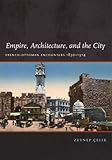
Zeynep Çelik. Empire, Architecture, and the City: French-Ottoman Encounters, 1830-1914. Seattle: University of Washington Press, 2008. 337 pp. Illustrations. $60.00 (cloth), ISBN 978-0-295-98779-8.
Reviewed by Sheila Crane (Department of Architectural History, University of Virginia)
Published on H-Urban (August, 2009)
Commissioned by Alexander Vari (Marywood University)
Cities at the Edges of Empire: Retracing French and Ottoman Infrastructure and Architectural Ambitions in the Nineteenth Century
Although Ali Riza Pasha is a relatively minor character in Zeynep Çelik's Empire, Architecture, and the City, his life story vividly demonstrates the dynamic connections between Ottoman and French empires that are the subject of this ambitious and fascinating book. Born in Algiers, Ali Riza Pasha fled with his family to Istanbul following the French occupation of the city in 1830. Later educated in France, he was twice appointed by Sultan Abdülaziz to be the governor of Trablusgarb (renamed Tripoli after Italy took control of the city in the early twentieth century), where he initiated a vast project to modernize the city's infrastructure with the help of French engineers brought in from Algeria. Whereas histories of colonial architecture and urbanism have long cleaved to the same nationalist divisions that were significant motors for imperial expansion in the nineteenth century, Ali Riza Pasha's story reveals the blind spots inherent in such an approach. By excavating previously unexamined links between French colonial cities in Algeria and Tunisia on the one hand and provincial Arab cities within the Ottoman Empire on the other, Çelik's book opens new ground in our understanding of architectural and urban transformations during what Eric Hobsbawm famously called "the age of Empire" (The Age of Empire, 1875–1914 [1987]).
Empire, Architecture, and the City offers a wide-ranging account of new infrastructural projects and monumental public spaces that were constructed in French colonial cities in the Maghrib and in leading Middle Eastern cities under Ottoman rule, from 1830, when the French invaded Algeria, to 1914, on the eve of World War I. The book thus brings this critical period of French colonial expansion in the mid-nineteenth century into dialogue with the results of Tanzimat reforms to Ottoman rule first adopted in 1839 in order to demonstrate the degree to which the concerted reshaping of cities were central to both efforts. Each chapter examines these transformations at a different scale, moving from transnational networks of telegraph lines and railroads, to large-scale interventions in existing cities, the design of new public squares, the architecture of major monuments, and the official events staged in these sites. The topography traversed is likewise ambitious, including substantive discussion of Algiers, Constantine, Bône (now Annaba), Tlemcen, Tunis, Sfax, Bizerte, Aleppo, Beirut, Damascus, Haifa, Jaffa, Mosul, and Baghdad. Bringing together existing studies of these sites with new archival documentation and carefully selected visual materials, Çelik traces how French and Ottoman authorities mobilized infrastructure, urban space, buildings, and public ceremony to represent and enforce imperial power. Considerable emphasis is placed on the impulse toward regularity, monumentality, and visual distinction that these urban transformations shared. At the same time, the author takes pains to underscore the divergent motivations that prompted these changes and the remarkably varied architectural forms that resulted.
In Çelik's hands, cities emerge as dynamic constructions, simultaneously experienced as important nodes within emergent global networks, as monumental architectural assemblages, and as performative stages. One of the real benefits of the book's structuring logic is that the reader returns at various points to the same sites, but each time is asked to consider them at a new scale and from a different perspective. In this way, the book's unfolding narrative heightens our appreciation of the multiple layers of meaning that were inscribed over time into these cities. The Hijaz Railroad, a sprawling network of regional lines that were to converge on Mecca, is one such captivating thread that weaves its way through the book. While the first chapter examines the process of its construction, with particular attention to its monumental bridges and the design of train stations, subsequent chapters consider memorial structures and inaugural celebrations that marked the completion of key segments. Even though it was not completed as planned, the Hijaz Railroad figures here as a critical motor for the expansion, modernization, and reconsolidation of the Ottoman Empire and a project that had palpable effects on transnational movements and local landscapes alike. In this way, Çelik thoughtfully reveals the political and cultural power of infrastructure, which was used to forge a new sense of imperial belonging and pan-Islamic identity across the Ottoman Empire.
The visual materials reproduced in the book alone make it an invaluable resource. Çelik's book adopts an approach common to several recent studies that consider the built environment in tandem with the visual culture of empire.[1] Given the book's stated interest in tracing how imperial power was consolidated and represented through emergent communication technologies, it was surprising to find relatively little attention given to the compositional strategies and circuits of distribution of the postcards and photographs included as illustrations. The production and circulation of these images, which serve as crucial source material throughout the book, would seem to merit more sustained analysis than the relatively brief treatment of these concerns in the introduction and epilogue. Nevertheless, the book makes thoughtful and creative use of its remarkable visual apparatus, particularly in the layered annotations given to the numerous full-color maps and plans (although, as with most books of its kind, the reader does have to repeatedly refer back to the color plates).
Empire, Architecture, and the City takes its place within a flourishing field of urban and architectural studies that has examined how built landscapes have been shaped by colonization. In turn, Çelik's study is founded on the broadly shared understanding that the histories of modernity and of imperialism are intimately interwoven. The book's most innovative methodological contribution is the comparative, cross-cultural perspective it adopts, a choice that marks a welcome and significant departure from existing studies of architecture and empire. In this regard, Çelik builds on a surprisingly limited number of studies that have challenged the conventional national or regional topographies through which histories of imperialism have long been traced. The majority of these are anthologies of investigations by various scholars largely focused on singular imperial traditions or relatively bounded localities.[2] By contrast, Çelik's comparative approach allows her to reveal the close intellectual affinities between French and Ottoman authorities. In this sense, her project tests recent work by Ottoman historians who have described the Tanzimat reforms as "borrowed colonialism," in order to consider how such dynamics operated in the urban realm.[3] At the same time, however, Çelik takes care to underscore the differences that separated French and Ottoman strategies, from the organization of their colonial or provincial administrations, to the status and treatment of women, and the influence of religious belief on imperial ideology.
Çelik's cross-cultural perspective is grounded in her own previous research across the Mediterranean region examining the cities of Algiers and Istanbul as well as Islamic architectural structures featured in nineteenth-century world's fairs.[4] While building on these influential studies, Empire, Architecture, and the City stakes out significantly expanded terrain, not only in its geographic breadth but also in the projects it investigates. For example, new documentation drawn from the archives of the French army (Service Historique de la Défense) lends fresh texture to Çelik's account of urban transformations in Algiers under Napoleon III, a moment that received less detailed examination in her earlier work on the city. An impressive model of comparative research, Çelik's study avidly mines primary sources in French and Turkish, mainly drawn from collections in Istanbul and various archives in France. Significant differences in available documentation of French and Ottoman imperial projects posed a considerable challenge, but one that is discussed in the introduction and creatively responded to in the chapters that follow, particularly by drawing on information from the Ottoman salnames, or almanacs for the provinces.
In addition to its comparative approach, Empire, Architecture, and the City offers a second and equally important challenge to existing urban histories of colonialism. By shifting the focus from the metropolitan center to the periphery, Çelik takes on board the lessons of postcolonial theory contesting the absolute oppositions embedded in the foundational mappings center and periphery, East and West. As a result, the book effectively decenters our understanding of empire, even as it provides vivid accounts of cities whose histories are largely unknown outside the audience of specialists in those areas. Here, Çelik takes her cue from the work of Jens Hanssen (The Empire in the City: Arab Provincial Capitals in the Late Ottoman Empire [2002]) and others who have trained their attention on the history of provincial Arab cities within the Ottoman Empire. By pairing this investigation with that of French colonial cities in the Maghrib, Çelik's study aims to "reconsider the bilateral axis of east-west and north-south" in favor of a multidimensional communication pattern (p. 5). Certainly, the process of translating planning schemes and architectural ideas from metropolitan capital to the peripheries is shown here to have produced considerable variations. Nevertheless, even as the book argues against a familiar story of one-way European influence, Paris retains its position as the authoritative capital of the nineteenth century. Even urban interventions in Algiers that predated those famously undertaken in Paris under Napoleon III are referred to as "a Haussmannian operation before Haussmann" (p. 73). If we take chronology seriously here, might these urban experiments in Algiers offer productive fodder for further rethinking circuits of influence and origin? Rather than positing Paris as ultimate source, Çelik's account might have more directly engaged recent critiques of the familiar notion that modernity first originated in Europe and was subsequently disseminated around the world.[5]
One of the book's greatest insights is to recognize that new public spaces in the French colonies and the Ottoman provinces consolidated new representations of empire while nevertheless allowing for local variation. In both French and Ottoman contexts, stylistic differences in architecture were encouraged as a means of accommodating and even overtly emphasizing regional and ethnic differences. Here, Çelik draws on an established body of scholarship, including her own, that has emphasized the important shift in colonial policy under Napoleon III from assimilation to association as an explanation for a shift in architecture from "the style of the conqueror" to the neo-Moorish buildings first analyzed by François Béguin.[6] During this same period, the Ottoman Empire embraced a vision of modernity marked by an even greater stylistic multiplicity. In the book's epilogue, Çelik describes Ottoman imperial ideology as "a position reflecting the cosmopolitan culture of the empire" and one that encouraged "integrated heterogeneity" (p. 272). The epilogue raises critical questions about how racial ideology and cultural difference were formulated in French and Ottoman contexts, particularly as these ideas helped to shape educational policy. While this history is a fascinating one, the observations offered in this final section of the book move almost entirely away from direct consideration of the built environment, a choice that leaves the reader wondering precisely how Çelik understands the relationship between architecture and racial ideology.
Occasionally, Çelik seems to overstate her case about the enlightened attitudes of Ottoman authorities and their magnanimous motivations. Near the end of the first chapter, for example, she asserts that whereas new railroads and communications networks established by the French in North Africa aimed to facilitate colonial expansion and more efficient extraction of natural resources, similar projects under the Ottoman Empire in the latter half of the nineteenth century were created for the benefit of their provincial subjects. This conclusion, however, fails to acknowledge the occasionally violent opposition to the Hijaz Railroad by Bedouins, whose livelihood was largely dependent on serving the needs of pilgrims making their way to Mecca by other means, discussed earlier in the chapter. In fact, this episode offered a rare glimpse of active resistance to such grandiose imperial schemes, since Çelik's study of empire building from above focuses explicitly on the official perspectives of state authorities and elite officials, a choice acknowledged from the very outset. These brief traces of how modernization efforts were received by local residents, however, open up productive terrain for further exploration. Future studies might also expand on the foundation Çelik provides to compare urban transformations in the French colonies and in Ottoman provinces with those undertaken during this same period in provincial cities within France and Anatolia.
A timely study that provides significant insights into pressing debates about modernity and imperialism, Empire, Architecture, and the City should enjoy a broad audience within and well beyond the fields of urban and architectural history. Çelik's book offers a refreshing counterpoint to the prevailing monographic focus on individual cities of much recent urban history, particularly studies focused on imperial and colonial situations. While this book is certainly essential reading for scholars of the French and Ottoman empires, it has much to teach all historians of the modern period interested in better understanding the far-reaching and still on-going consequences of nineteenth-century imperialism.
Notes
[1]. Recent examples of this tendency include William J. Glover, Making Lahore Modern: Constructing and Imagining a Colonial City (Minneapolis: University of Minnesota Press, 2008); Steven Nelson, From Cameroon to Paris: Mousgoum Architecture In and Out of Africa (Chicago: University of Chicago Press, 2007); Brian L. McLaren, Architecture and Tourism in Italian Colonial Libya: An Ambivalent Modernism (Seattle: University of Washington Press, 2006); and Swati Chattopadhyay, Representing Calcutta: Modernity, Nationalism, and the Colonial Uncanny (London: Routledge, 2005).
[2]. See Marc Pabois and Bernard Toulier, eds., Architecture coloniale et patrimoine: Expériences européennes (Paris: Somogy-Institut National du Patrimoine, 2006); Leila Tarazi Fawaz and C. A. Bayly, eds., Modernity and Culture: From the Mediterranean to the Indian Ocean (New York: Columbia University Press, 2002); and Julia Clancy-Smith, ed., Domesticating the Empire: Race, Gender, and Family Life in French and Dutch Colonialism (Charlottesville: University of Virginia Press, 1998).
[3]. Selim Deringil, "'They Live in a State of Nomadism and Savagery': The Late Ottoman Empire and the Post-Colonial Debate," Comparative Studies in Society and History 45, no. 2 (2003): 312.
[4]. Zeynep Çelik, Urban Forms and Colonial Confrontations: Algiers under French Rule (Berkeley: University of California Press, 1997); Displaying the Orient: Architecture of Islam at the Nineteenth-Century World's Fairs (Berkeley: University of California Press, 1992); and The Remaking of Istanbul: Portrait of an Ottoman City in the Nineteenth Century (Berkeley: University of California Press, 1986).
[5]. See Ikem Okoye, "Unmapped Trajectories: Early Sculpture and Architecture of a 'Nigerian' Modernity," in Exiles, Diasporas, and Strangers, ed. Kobena Mercer (Cambridge: MIT Press, 2008), 28-44; Anthony King, Spaces of Global Cultures: Architecture, Urbanism, Identity (London: Routledge, 2004); and Vikramaditya Prakash, Chandigarh's Le Corbusier: The Struggle for Modernity in Postcolonial India (Seattle: University of Washington Press, 2002).
[6]. François Béguin, Arabisances, décor architectural et trace urbain en Afrique du Nord, 1830-1950 (Paris: Dunod, 1983), 11. Çelik also draws on more recent work, especially Nabila Ouselebir, Les usages du patrimoine: Monuments, musées et politique coloniale en Algérie (1830-1930) (Paris: Éditions de la Maison des Sciences de l'Homme, 2004).
If there is additional discussion of this review, you may access it through the network, at: https://networks.h-net.org/h-urban.
Citation:
Sheila Crane. Review of Çelik, Zeynep, Empire, Architecture, and the City: French-Ottoman Encounters, 1830-1914.
H-Urban, H-Net Reviews.
August, 2009.
URL: http://www.h-net.org/reviews/showrev.php?id=23699
 | This work is licensed under a Creative Commons Attribution-Noncommercial-No Derivative Works 3.0 United States License. |

