



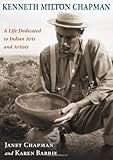
Janet Chapman, Karen Barrie. Kenneth Milton Chapman: A Life Dedicated to Indian Arts and Artists. Albuquerque: University of New Mexico Press, 2008. Illustrations. xiv + 370 pp. $34.95 (cloth), ISBN 978-0-8263-4424-3.
Reviewed by Carter Jones Meyer (Ramapo College of New Jersey)
Published on H-NewMexico (October, 2009)
Commissioned by Tomas Jaehn (Special Collections/Center for Southwest Research)
Championing Southwestern Indian Art in the Early Twentieth Century: The Life of Kenneth Milton Chapman
The early twentieth century served up tremendous challenges for American Indians. Many of them could be traced to the federal government's assimilation policy, which, after passage of the notorious Dawes Act in 1887, provided for the dismantling of tribal cultures and the enforced incorporation of Indians into American society, often with disastrous results. Pueblo Indians of the Southwest, in particular, struggled to maintain their traditional way of life against this assault, but they also dealt with impoverished economies and the demands of a nascent tourist industry in the Southwest that prized natives as exotic "others" and their pottery as commercial "curios." Kenneth Milton Chapman, a quiet, unassuming midwestern artist and staff member at the Museum of New Mexico, found himself increasingly caught up in this struggle to preserve a way of life for Pueblo Indians. His fateful decision in the 1920s to take a stand on their behalf, largely by encouraging traditional pottery making methods and styles, and becoming, in time, a major advocate for the preservation of Indian arts, provides the foundation and focus of Janet Chapman and Karen Barrie's informative biography of this leading, if unsung, authority on Pueblo arts and culture. Kenneth Milton Chapman also provides an important lens on the Santa Fe society in which Chapman lived and worked, particularly during the cultural ferment of the 1920s and 1930s, when Santa Fe became not only the institutional hub for Southwestern archaeology and the study of Pueblo arts and culture, but also the center of an unprecedented outpouring of regional artistic expression. Chapman helped shape this era of ferment, and his biography--the first of its kind to consider this major figure--provides valuable insights into his many contributions, both to the field of Indian arts and to the institutional development of Santa Fe itself.
"Chap," as he was fondly known by nearly everyone with whom he worked, did not set out to become an authority on Pueblo arts and culture, but fate seemed to be his guide when he met Frank Springer and Edgar Hewett soon after he settled in Las Vegas, New Mexico, in 1899. Springer was a powerful lawyer in the territory and president, at the time, of the famed Maxwell Land Grant Company. His influence on New Mexico's development was widespread and indelible. Hewett, an educator and aspiring archaeologist, had recently assumed the presidency of Las Vegas Normal School, thanks to Springer's sponsorship. Springer had met him through a shared interest in archaeology, and must have thought that Hewett's organizational abilities and charisma would be a boon to the fledgling school. Each of these men would become a decisive influence on Chapman's professional development. "In Springer," the authors contend, "Chap found a champion of his art and a fatherlike warmth and affection. In Hewett he discovered the path to a lifetime career in the study of Indian art" (p. 38).
Hewett offered Chapman a position teaching art classes at the school; shortly afterward, Springer invited him to illustrate a book on fossils that he had written, based on his extensive collections and a lifelong passion for paleontology. These positions set the stage for numerous new career opportunities. With the guidance of these two men, who recognized Chapman's great skills, strong work ethic, and steadfast integrity, the young artist found himself at the epicenter of a particularly vibrant time in Santa Fe history. Hewett went on to become a full-time archaeologist, inviting Chapman to participate in fieldwork being conducted on prehistoric Puebloan settlements in the Pajarito region near Santa Fe. Then, in 1906, Hewett became the first director of the School of American Archaeology (later known as the School of American Research) and shortly thereafter assumed leadership of the newly created Museum of New Mexico, an educational adjunct of the school. Springer had been a prime mover in bringing these intertwined institutions to Santa Fe, and he continued to be a steadfast supporter, both of Hewett and Chapman, whom Hewett hired as his assistant at the museum.
Serving as a staff member at the Museum of New Mexico during its formative years had its benefits, as the authors point out. Chapman was given new opportunities to develop his artistic skills and to work closely with the growing number of artists, primarily Anglo and Indian, that the museum sponsored and that helped establish Santa Fe's reputation as a major art center in the United States. Also at this time he developed a consuming interest in Pueblo pottery, first from the potsherds unearthed during the school's summer field excavations, but then later by working closely with contemporary potters, including Julian and Maria Martinez of San Ildefonso Pueblo, creators of the famed black-on-black pottery. He found the traditional design elements of Pueblo pottery particularly fascinating, and began to document them, with the intention of helping contemporary potters to recreate them, and therefore produce pottery of a higher quality, and a higher income producing price, than the cheap "curios" then flooding the tourist market. As he later wrote, "I tried ... to arouse the pride of the younger women in the good old designs of their own Pueblo and urged them to study and use them." When the women complained that none of the old pottery remained, having been worn out or sold to the "Americanos," Chapman hit on an idea that would come to define his career: "It was then that I saw the immediate need of giving the potters of each Pueblo a chance to study their own decorative art, so that it might be revived in their hands if they really wished to use it" (epigraph).
Chapman went on to play a major role in the Pueblo pottery revival of the 1920s, a courageous position to take when the federal government's assimilation policy still held sway and many Americans assumed Indians were a "vanished" race. But times were changing, and a new era of tolerance, based on cultural pluralism, had begun to take hold, most clearly seen in John Collier's Indian New Deal of the 1930s. Chapman was at the forefront of this transformation, overseeing the creation of Indian Market in 1922 (known then as the Indian Fair, held in conjunction with Santa Fe Fiesta) to encourage production of high quality traditional pottery, and, in 1924, becoming a founding member with other prominent Santa Feans of the Indian Arts Fund, which pooled resources to purchase and preserve fine examples of traditional Southwestern Indian arts.
The authors, who are members of Chapman's extended family, and who have been able to draw from previously unpublished family papers in addition to Chapman's letters and memoirs, tell this story of his rise to prominence in the world of Indian arts with skill and insight. Readers will be impressed by the extent of his contributions, not only to the preservation of Indian arts but also to the building of prominent cultural institutions in Santa Fe, chief among them the School of American Research (now School of Advanced Research) and Museum of New Mexico, as well as the Laboratory of Anthropology, where he served as a founding staff member. The authors provide a particularly comprehensive account of the political maneuverings that eventuated in the founding of the laboratory.
One may wonder, given Chapman's many contributions to Indian arts and the development of Santa Fe, why he has not received more credit for his work, but this biography makes clear that he was more often than not overshadowed by calculating self-promoters like Hewett. Hewett looms large in the book, perhaps overly so, because the authors have relied heavily on Chapman's fragmented memoirs, written with a tinge of bitterness and resentment later in his life to set the record straight regarding his often stormy relationship with the museum director. This means that the development of Santa Fe's cultural institutions, which relied on a broader community of scholars, artists, and museum professionals, is frequently reduced in this book to a struggle between two: the quiet, long suffering Chapman and the manipulative, often reckless, and egotistical Hewett, who seemed always to take credit for Chapman's work. The authors might have trimmed down this personal drama to examine more fully the broader transformation in the preservation of Indian arts and cultures then taking place, and Chapman's indisputable role in moving it along. As part of this larger story, the book would have benefited from the incorporation of more Indian perspectives on the Pueblo pottery revival of the 1920s and a more critical assessment of the paternalism that continued to haunt Chapman's work, even as he passionately advocated for the preservation of Indian arts. These criticisms aside, Chapman and Barrie have succeeded in writing an important, much-needed biography of Kenneth Chapman that will provide scholars and the general public with a rich new perspective not only on the preservation of early twentieth-century Indian arts but also on the development of Santa Fe in one of its most vibrant and exciting eras.
If there is additional discussion of this review, you may access it through the network, at: https://networks.h-net.org/h-newmexico.
Citation:
Carter Jones Meyer. Review of Chapman, Janet; Barrie, Karen, Kenneth Milton Chapman: A Life Dedicated to Indian Arts and Artists.
H-NewMexico, H-Net Reviews.
October, 2009.
URL: http://www.h-net.org/reviews/showrev.php?id=23596
 | This work is licensed under a Creative Commons Attribution-Noncommercial-No Derivative Works 3.0 United States License. |

