



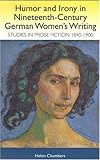
Helen Chambers. Humor and Irony in Nineteenth-Century German Women's Writing: Studies in Prose Fiction, 1840-1900. Rochester: Camden House, 2007. 222 pp. $75.00 (cloth), ISBN 978-1-57113-304-5.
Reviewed by Carol Strauss Sotiropoulos
Published on H-German (January, 2009)
Commissioned by Eve M. Duffy (University of North Carolina Chapel Hill)
A Feast for the Funnybone
For scholars and students of nineteenth-century German and Austrian women’s writings, this volume is a "must have." For those new to the field, Chambers provides sufficient information on the nine writers discussed, as well as on the theoretical foundations of humor and irony, to render the work accessible.The backgrounds of the writers treated range from the aristocracy to the working class and their works were received positively by literary critics in their day. Their work is presented in near chronological sequence, but more importantly, the chapter layout guides the reader toward specific applications of humor and irony. In each of four chapters we meet two writers whose intent and strategy bear commonality: Annette von Droste-Hülshoff and Ida Hahn-Hahn, Ottilie Wildermuth and Helene Böhlau, Ada Christen and Clara Viebig, Isolde Kurz and Ricarda Huch. For example, the chapter on Christen and Viebig steers us to "Laughter and Pain in the World of Work," that on Kurz and Huch to "The Humor of Skeptical Idealism." Maria von Ebner-Eschenbach alone is accorded an entire chapter due to her singular use of satire and physical comedy.
Chambers’s introduction succinctly educates the reader on a number of fronts. First, important literary historical errors and gaps that demand redress include a corrective to dispel the widely accepted belief that the Weimar Republic was the first great period for humorous women's writing in German. Further, beyond the historical assignation of women's writings to "low" literature, patriarchal mentality on women’s nature excluded women from the rational and therefore male domain of humor. Critics and literary scholars failed to apply theoretical constructs of humor and irony to these writers' works, thus effectively dismissing them from the humor and irony canon. Curiously, at the turn of the twentieth century the humor/irony perspective was addressed by two critics of German women's writings, yet subsequently overlooked by later critics. More curious, perhaps, theoretical discussions of humor, irony, and satire in German literature make almost no mention of women's writings at all. Moving beyond the gaps, Chambers provides historical and current theoretical approaches to humor and irony and contextualizes uses of humor both within and in opposition to the realist and naturalist movements. Although through the chapters Chambers draws on some traditional theoretical constructs of humor when pertinent, she clearly advises the reader that her aim is not to codify the "humorous," "comic," and "ironic" in the works treated, but rather to show how discursive techniques and narrative stances work to effect particular readerly responses, including increased awareness of the dark side of the human condition.
In addition to examining several works by each writer in depth, Chambers details each writer's body of works; thus the volume functions doubly as a survey for reference purposes. Thankfully there is no expectation that readers would be familiar with each of the works discussed and concise plot summaries are provided. The flow from summary to analysis is smooth and Chambers's lively and elegant style never allows the reader's attention to flag. Occasional appearances of terminology that might be unfamiliar to those working outside of narrative theory are contextualized sufficiently for easy understanding. Further, a summary at the conclusion of each chapter cogently underscores the main points of analyses.
Pertinent biographical information that provides the reader historical and personal insights also marks the evolution of each writer's place, or in some cases burial, in literary history. With respect to the latter, Chambers's resurrection of these writers will assuredly invite scholarly interest and discussion. A case in point is Wildermuth: viewed as accepting a female subordinate position, she was left for dead in the post-1970 feminist project to unearth women writers. A side note here regarding the biographical information: one cannot help but be moved by the near unimaginable challenging conditions under which those who most needed financial support were composing, while raising large families with neither household assistance nor personal space. For those writers who have attracted a body of criticism, Chambers contests the stance of prior critics who failed to perceive irony at work. In the case of Hahn-Hahn, for example, earlier critics took her disorienting narrative shifts at face value. Instead, Chambers argues, such shifts function as an effective ironic literary device, the ambiguity created deliberately to prod the reader into questioning the ostensibly authoritative narrative voice.
A red thread coursing through the chapters is that of humor as a device for raising awareness about gender inequity (though no single writer's use of humor is limited to this alone). A remark in the discussion of Hahn-Hahn pertains to several others as well: that in the "frequently ironic airing of gender issues ... she points out inconsistencies and absurdities in conventional views and unquestioned assumptions" (p. 45). Aside from the many instances of irony and humor as discursive strategies for exposing the double standard and oppressive male conduct, other distinguishing facets of women writers' use of humor are brought to the fore. In the sphere of character types, children, adolescents, and female eccentrics are strongly represented across the works of several writers. Chambers's suggestion that such characters most effectively challenge societal norms is compelling. With respect to setting, depictions of village and small-town life bring the dynamics underlying social constraints, gendered interclass relations, and the marriage market into sharp and comical relief. Though universals may abound regarding village life, the regional peculiarities inhabiting the works of von Droste-Hülshoff (Westfalia), Wildermuth (Marbach), Böhlau (Weimar), von Ebner-Eschenback (rural Austria), and Kurz (Swabia) both inform and delight. Fantastic settings mark the works of a few writers who turn from the realist mode to fairy tales and the supernatural to create worlds whose humorous incongruity to the real world exposes male egocentricity or inverts conventional patterns of gender relations and sexual power.
Weak spots in the volume pertain only to the picayune matter of editing lapses, particularly in the last chapter. The decision to put quotations solely in German assumes a German-proficient audience and thus limits accessibility for some who work in nineteenth-century women’s writings from a transnational perspective. A list of the treated works that have been translated would be useful to faculty who teach German or world literature in translation. Certainly it is hoped that this study will serve as inducement to expand the project of translating these writers’ works. And for the intended German-proficient audience that may be unfamiliar with many of these works, this valuable study serves as inspiration to obtain and read them, and to then revisit Chambers’s analyses.
If there is additional discussion of this review, you may access it through the network, at: https://networks.h-net.org/h-german.
Citation:
Carol Strauss Sotiropoulos. Review of Chambers, Helen, Humor and Irony in Nineteenth-Century German Women's Writing: Studies in Prose Fiction, 1840-1900.
H-German, H-Net Reviews.
January, 2009.
URL: http://www.h-net.org/reviews/showrev.php?id=23562
 | This work is licensed under a Creative Commons Attribution-Noncommercial-No Derivative Works 3.0 United States License. |

