

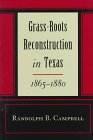
Randolph B. Campbell. Grass-Roots Reconstruction in Texas, 1865-1880. Baton Rouge: Louisiana State University Press, 1997. x + 280 pp. $35.00 (cloth), ISBN 978-0-8071-2194-8.
Reviewed by Walter D. Kamphoefner (Texas A&M University, currently Senior Fulbright Lecturer, University of Osnabrueck, Germany)
Published on H-Pol (September, 1998)
Reconstruction as Seen from the County Courthouse
As the title implies, this valuable study examines Reconstruction in Texas from ground level, tracing political, and to a lesser extent social and economic, changes in six widely diverse counties scattered across the state.
Even non-Texans will recognize the administrative seats of most of these counties: Dallas, Waco, Corpus Christi, Beaumont, Marshall (near the northeast corner of the state) and Columbus (midway on the main route between Houston and San Antonio). Herein lies my only reservation about the book, the issue of representativeness. Campbell concedes that these counties "cannot be presented as 'typical' of the state or any of its regions" (p. 4), but in fact they provide a reasonable cross-section of the state in many respects. Blacks made up anywhere from two-thirds to just 8 percent of the population in the case studies. Included are counties with a significant presence of the leading white ethnic minorities: Hispanics, Germans, and (Cajun) French. In their political stance, however, none of the six counties voted more than 36 percent against secession, even though one-quarter of the state's participating voters opposed it, and 25 of the 100-odd organized counties in Texas turned in opposing votes ranging from 40 percent upwards. Had Fayette and Denton counties been substituted for Colorado and Dallas, the sample would have been more representative of the statewide secession vote. Though the author nowhere explains his selection criterion, one suspects that besides geography, source availability came into play. This would explain the heavier representation of cities and towns than was characteristic of the state as a whole, and also a stronger presence of Freedmen's Bureau agents. Moreover, it is probably not coincidence that the six counties under study include the homes of both "Radical" Governor Edward Davis and his "Redeemer" successor Richard Coke. Whatever peculiarities the larger towns introduced into the study, they are largely compensated by the detailed view offered by long runs of newspapers from all six localities. Nor does it appear that the presence of Freedmen's Bureau sub-agents assured better treatment of blacks--only that their mistreatment was better documented than elsewhere. Still, the author would have done himself and his readers a favor by discussing his selection criteria and including a table with a number of "indicator" variables for the six studied counties set against quartile or quintile values for all the counties of the state.
This being said, Campbell (after sketching the outlines of the Reconstruction process at state level) does a masterful job of asking large questions in small places, offering a very detailed and nuanced portrait of how Reconstruction unfolded in each of his six counties. Following basically a standard format, he sets the stage by outlining the social and economic geography of the county, its involvement in slavery and plantation agriculture, and its stance on secession and war. With a strong political emphasis, he examines how much change in personnel and policy resulted during the transitions from war to Presidential Reconstruction to Congressional "radical" Reconstruction and the "Redemption" that ended radical control. Each chapter concludes with an assessment of the persistence of the antebellum economic elite through 1880 and of the degree of black progress as measured by occupation, property holding, family structure and educational opportunities of children. The study profits greatly from the author's extensive work in individual-level source material, including but not restricted to the manuscript census. Hitherto obscure local political actors, black as well as white, are consistently characterized with respect to relevant variables such as social and geographic origins, time of arrival in Texas and the locality, exposure to the institution of slavery, military service and political stance during the Civil War. And yet, while such background factors proved influential, none of them operated mechanistically. Campbell often highlights ironic details which illustrate this point. For example, in 1869 a carpetbagger and former Union army officer ran for Congress from Dallas County--as a Democrat and without incurring the least bit of local resentment.
At first glance, it might seem that this study does little more than confirm neo-Revisionist interpretations of Reconstruction that have reigned since Kenneth Stamp's seminal study. There could be no talk of Carpetbagger or black domination at any stage of Reconstruction in Texas--natives of the south, Republican as well as Democrat, dominated the political process throughout. Federal troops were not long on the scene, and stretched thin while they were present. Reconstruction in Texas was expensive, but for legitimate reasons, prominent among them an ambitious educational program. Factionalism plagued Texas Republicans at both the county and state levels, helping to hasten their demise. The end of Reconstruction resembled less the slamming of a door than a slow downward spiral which had not yet hit bottom when the book leaves off. The legacy of slavery did less to undermine the black family than did urban life.
But in the concluding chapter (which may provide all the detail many non-Texans desire), Campbell also stresses the diversity of the Reconstruction experience in this large and diverse state. For example, while most of the investigated counties had a significant contingent of Unionists, they varied in origins from county to county and thus were not natural political allies. The degree of change wrought by Presidential or Congressional Reconstruction depended greatly upon how recalcitrant a given county had shown itself in the aftermath of war. Three of the six counties saw few officials replaced by military appointees. Two of the six counties immediately elected conservatives in 1869, but the Republican majority in the others drew on different elements from county to county. The process of "redemption" in these four counties varied in both timing and method. Some counties remained heavily polarized in their politics, while in others Reconstruction issues appeared to play a minor role and local candidates of a variety of backgrounds gained office. For all the local diversity, "Reconstruction .... hurt whites far less than is often claimed and benefited at least one generation of blacks a good deal more than is often recognized" (p. 231).
One hopes that Campbell's study finds wide emulation in other areas of the south, though it may turn out that the Texas experience was rather singular. The rest of the south had virtually no Mexicans, and much less of a German or other foreign element in its population, so that home grown Unionists had fewer potential allies, and Reconstruction was much more of a drama in simple black and white.
Copyright (c) 1998 by H-Net, all rights reserved. This work may be copied for non-profit educational use if proper credit is given to the author and the list. For other permission, please contact H-Net@h-net.msu.edu.
If there is additional discussion of this review, you may access it through the network, at: https://networks.h-net.org/h-pol.
Citation:
Walter D. Kamphoefner. Review of Campbell, Randolph B., Grass-Roots Reconstruction in Texas, 1865-1880.
H-Pol, H-Net Reviews.
September, 1998.
URL: http://www.h-net.org/reviews/showrev.php?id=2356
Copyright © 1998 by H-Net, all rights reserved. H-Net permits the redistribution and reprinting of this work for nonprofit, educational purposes, with full and accurate attribution to the author, web location, date of publication, originating list, and H-Net: Humanities & Social Sciences Online. For any other proposed use, contact the Reviews editorial staff at hbooks@mail.h-net.org.

