



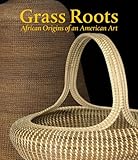
Dale Rosengarten, Theodore Rosengarten, eds. Enid Schildkrout. Grass Roots: African Origins of an American Art. Long Island City: Museum for African Art, 2008. Illustrations. 269 pp. $35.00 (paper), ISBN 978-0-945802-51-8.
Reviewed by Kristine Frank Elias
Published on H-AfrArts (April, 2010)
Commissioned by Jean M. Borgatti (Clark Univeristy)
Roots: Context and Complexity
Grass Roots: African Origins of an American Art coedited by Dale Rosengarten, Theodore Rosengarten, and Enid Schildkrout is a companion publication for an exhibition of the same name organized by the Museum for African Art in New York City in cooperation with the Avery Research Center for African American History and Culture at the College of Charleston and the McKissick Museum at the University of South Carolina. Along with the authors, researchers from a number of disciplines contribute to the text, including Peter H. Wood, Judith A. Carney, Jessica B. Harris, Sandra Klopper, John Michael Vlach, Fath Davis Ruffins, and J. Lorand Matory. Together these essays provide a rich historical and cultural context for the coiled baskets of the South Carolina Lowcountry on display.
As the title suggests, several essays in the book focus on Africa as the potential site of origin for Lowcountry coiled baskets. To scholars of the African diaspora, this search for African sources is a familiar one. However, the path taken in Grass Roots is refreshing for its recognition of the complexity of such a search for origins. In the first pages of the introduction, Theodore Rosengarten outlines the challenges of establishing a direct lineage to Africa based on formal qualities alone. He raises an issue that we as art historians must keep in focus: “Nothing and no one in Africa stand still,” making formal comparisons problematic (p. 13). However, the book “emphasizes the indisputable African contribution to Lowcountry basketry but opens the door to the possibility of other influences as well” (p. 14). This statement serves to frame the essays that follow, which, drawing on a variety of disciplinary perspectives, examine the evidence for the cultural continuities that are at the center of the study.
The main text is a collection of ten loosely connected chapters providing multiple perspectives on basket making and the cultural history of the Lowcountry region (with one additional chapter that focuses on southern Africa). Although formal analysis and comparison of the Lowcountry and African baskets is discussed, attention is focused on changes in basket making over time and how economic, social, political, and cultural pressures play a role in change. Indeed a number of chapters provide a variety of historical and environmental contexts for basket making in the Lowcountry that one might not expect to see in an art exhibition catalog. For example, Wood, a historian, discusses transferrable skills slaves could have used to their advantage, like canoe building and fishing, while Carney, a geographer, raises questions of agricultural connections between rice cultivation in Africa and the Lowcountry. Overall, we gain an understanding of the basket country as a culturally complex world, instead of a one-dimensional, timeless place of baskets.
Critical chapters on basketry are those authored by Schildkrout and Dale Rosengarten, Dale Rosengarten, and Klopper. In the first chapter, “African Origins: Ancestors and Analogues,” Schildkrout and Rosengarten argue for a comparison of Lowcountry and African baskets based on technique and materials; at the same time, the authors point out that tracing origins through formal similarities is “intriguing” but difficult (p. 22). Schildkrout and Rosengarten tighten the connection through a discussion of the production environment--in West Africa, rice production was an integral part of the culture; on a plantation, the slaves and baskets were means of production. There is strong evidence of an economic demand for slaves with experience in rice cultivation, and it is reasonable to conclude that individuals with this experience brought with them knowledge and expertise that might be used advantageously. The multiple factors contributing to the development of basket-making techniques and production underscore that there are no straight lines from past to present in material culture. Overall, we are left with a clear sense of the complex history and a greater appreciation for the art form and basket makers themselves.
The chapters written by Dale Rosengarten herself highlight a deep understanding of Lowcountry people and baskets. While her work is objective, it reflects the empathy, integrity, and respect of a scholar intimate with her subject. It is clear that she understands not only the history but also the present circumstances of Lowcountry communities and the role basket making plays in the lives of contemporary people from a source of income to a source of pride. She shows how economic, social, cultural, and environmental change is omnipresent in the community and reflected in the art of basketry. For example, in chapter 6--“Missions and Markets: Sea Island Basketry and the Sweetgrass Revolution”--she recounts how the sweetgrass basket makers of Mt. Pleasant “seized opportunities offered by retail merchants and a budding tourist trade to increase their output and expand their repertory” (p. 128). Her perspective helps us understand Lowcountry baskets as a living tradition in a complex cultural and economic environment.
Klopper provides the only look at African basketry in chapter 7, entitled “Necessity and Invention: The Art of Coiled Basketry in Southern Africa,” which includes several beautiful additions to the catalog. While Klopper proposes possible connections between southern African and South Carolinian baskets, the primary contribution of her essay is its position as a comparative case study. The basket-making traditions of southern Africa are reviewed in cultural contexts that echo what other essays explore in relation to the Lowcountry. Klopper examines some key influences on basket-making traditions, such as missionary activities, economic pressures, and the accessibility of raw materials; these factors are relevant to the Lowcountry case as well. An interesting comparison can be made between the influence of the Penn School established in the early 1900s on St. Helena Island outlined by Dale Rosengarten and the Vukani Association founded in southern Africa by Swedish missionaries Kjell and Bertha Löfroth in the late 1960s described by Klopper. Although Klopper does not make this connection overtly, the reader can easily see the similarities between how the Penn School and Vukani Association influenced basket making in the Lowcountry and southern Africa respectively.
Although the book demonstrates both a breadth and depth of knowledge, it is neither dense nor theoretical, making it accessible to the general reader. As an exhibition catalog, it is replete with beautiful photographs of the baskets as well as historical documents, maps, various art works, and photographs of the people and regions discussed. However, the book would have benefited from more complete descriptions of the catalog images, for they are not always discussed specifically in the accompanying essays. Despite this flaw, the book presents a textured reading that weaves together historical, cultural, and economic context and a perspective on how the coiled baskets have become cultural symbols. Woven into the overall discussion of context and change is the discussion of how meaning is formed. Specifically, the idea of African origins is addressed. It is clear that the idea of African origins has a life of its own, nurtured by cultural stakeholders and resulting in community pride and restored heritage, with baskets as the material symbol.
If there is additional discussion of this review, you may access it through the network, at: https://networks.h-net.org/h-afrarts.
Citation:
Kristine Frank Elias. Review of Rosengarten, Dale; Theodore Rosengarten; Enid Schildkrout, eds., Grass Roots: African Origins of an American Art.
H-AfrArts, H-Net Reviews.
April, 2010.
URL: http://www.h-net.org/reviews/showrev.php?id=23534
 | This work is licensed under a Creative Commons Attribution-Noncommercial-No Derivative Works 3.0 United States License. |

