



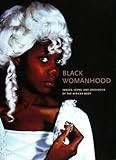
Barbara Thompson, ed. Black Womanhood: Images, Icons, and Ideologies of the African Body. Seattle: University of Washington Press, 2008. 374 pp. $75.00 (cloth), ISBN 978-0-295-98770-5; $50.00 (paper), ISBN 978-0-295-98771-2.
Reviewed by Lisa Gail Collins
Published on H-AfrArts (November, 2011)
Commissioned by Jean M. Borgatti (Clark Univeristy)
Icons and Interventions
"Black Womanhood: Images, Icons, and Ideologies of the African Body," a timely, large-scale exhibition, opened at Dartmouth College’s Hood Museum of Art in 2008 and then traveled to Wellesley College’s Davis Museum and the San Diego Museum of Art.
Ambitiously conceived by curator Barbara Thompson, a scholar of traditional and contemporary African art, “Black Womanhood” explores representations of the black female body in visual art and material culture across social location, time, and place. Organized in three parts, the expansive exhibition and accompanying catalog investigate images and icons of black womanhood--and the ideologies, politics, and practices that undergird them--from three different, intersecting vantage points defined as “the traditional African, the colonial, and the contemporary global” (p. 21).
The three-part structure and the over one hundred historical and contemporary images and objects on display--including sculptures, photographs, textiles, paintings, prints, postcards, ceramics, and installations--allow viewers to see how past and present creators, both male and female, have represented the black female body in various African, European, and American contexts and locales. “Black Womanhood” provides viewers with a unique opportunity to experience a wide range of perspectives on key issues such as agency, beauty, sexuality, and maternity through a wide array of art forms. In addition, with its nine scholarly essays and over two hundred high-quality images, the exhibition catalog further enables readers to study intently how the black female body and, by extension, black womanhood, have been variously experienced, viewed, and interpreted across the transatlantic.
Over forty traditional African representations of the female body are featured in “Part I: Iconic Ideologies of Womanhood: African Cultural Perspectives.” Nineteenth- and twentieth-century masks, figurative sculptures, terra cotta vessels, staffs, and clothing largely created by unidentified artists from across the African continent are on view in this first object-oriented section.
Complementing this rich display, three Africanists explore gendered practices and politics that inform the ideas and experiences of womanhood in various societies in part 1 of the accompanying catalog. Exhibition curator Barbara Thompson leads with a thoughtful overview of the place the female body has held--and continues to hold--in African art and society. Religion scholar Ifi Amadiume follows with an examination of struggles between “African traditions and Christo-centric modernity” over women’s bodies, including how Igbo-speaking women, through culture and creativity, have negotiated these struggles (p. 66). Then curator Enid Schildkrout, a trained anthropologist, shows how popular iconic images of Mangbetu women developed out of an active, elaborate, and unequal exchange among African and European parties within the colonial context.
“Part II: Colonizing Black Women: The Western Imaginary” features about fifty images of African women’s bodies; the majority are early twentieth-century picture postcards that strikingly betray anxieties about female sexuality on the part of creators and consumers. Concerning these popular picture postcards, curator Christraud Geary, a trained anthropologist, discusses the narratives about Africans and Africa produced and reinforced by the “hundreds of thousands” of them that circulated around the globe in conjunction with colonial rule (p. 143). Traveling west of the Atlantic Ocean, Kimberly Wallace-Sanders, editor of Skin Deep, Spirit Strong: The Black Female Body in American Culture (2002), investigates the “black mammy” figure in U.S. visual and material culture and charts how this icon--introduced by slavery’s defenders--came to serve as an “ultimate representation of maternal devotion” within the American popular imagination (p. 163).
Works by twenty-four contemporary African and African-descended artists who have carefully chosen to engage the black female body in their art are the focus of “Part III: Meaning and Identity: Personal Journeys into Black Womanhood.” Maria Magdalena Campos-Pons, Sokari Douglas Camp, Lalla Essaydi, Senzeni Marasela, Zanele Muholi, Wangechi Mutu, Magdalene Odundo, Fazal Sheikh, Malick Sidibé, Penny Siopis, Maud Sulter, and Carrie Mae Weems are some of the female and male artists whose works are included. Photography is central to this vast and vibrant final section; sculpture, painting, book art, ceramics, textiles, collage, and new media installation are also powerfully on view.
Essays by Deborah Willis and Carla Williams, co-authors of a related project, The Black Female Body: A Photographic History (2002), accompany this final section. Cultural historian and photographer Deborah Willis opens the archive of photographs of black women created during the New Negro Movement, the first fully “self-conscious and race-conscious” African American cultural movement in the United States (p. 233). She shows how the Jazz Age photographs of black women can be divided into two categories: “mass-produced images that reinforced widely held stereotypes” (p. 228), and “photographs that visually realized the dreams and desires of their individual communities and captured a spirit of transformation” (p. 228). Focused on the latter, Willis shares portraits that grace treasured family albums. Writer and photographer Carla Williams shares her research on Maudelle Bass and Florence Allen, two California-based African American women who worked as artist’s models beginning in the 1930s. Sharing her work to reconstruct the models’ twentieth-century biographies and creative collaborations, Williams reveals how these two women, both dancers, prefigured the recent interest in self-portraiture by black women artists. Then literary scholar Ayo Abiétou Coly charts the sexualized and racialized ideologies that “enabled the mobility” of Sarah (Saartje) Baartman and Josephine Baker within the French nation and imagination (p. 262). She considers what relationship, if any, the provocative French Cameroon-born popular writer and media interest Calixthe Beyala has to this colonial history. Barbara Thompson closes the volume with “Decolonizing Black Bodies: Personal Journeys in the Contemporary Voice,” an essay devoted to visual analysis of the contemporary works that engage the black female body. Drawing from exchanges with the artists, she explores the personal, cultural, social, and historical issues that animate their aesthetic choices.
For its generative juxtaposition of historical and contemporary images and objects from various African, European, and American contexts and locales, thoughtful inclusiveness, and scholarly depth and insight, the exhibition and catalog serve as a visual and intellectual gift to all who question the images and icons of black womanhood.
If there is additional discussion of this review, you may access it through the network, at: https://networks.h-net.org/h-afrarts.
Citation:
Lisa Gail Collins. Review of Thompson, Barbara, ed., Black Womanhood: Images, Icons, and Ideologies of the African Body.
H-AfrArts, H-Net Reviews.
November, 2011.
URL: http://www.h-net.org/reviews/showrev.php?id=23485
 | This work is licensed under a Creative Commons Attribution-Noncommercial-No Derivative Works 3.0 United States License. |

