



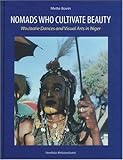
Mette Bovin. Nomads Who Cultivate Beauty: Wodaabe Dances and Visual Arts in Niger. Uppsala: Nordic Africa Institute, 2001. Illustrations. 128 pp. $32.95 (cloth), ISBN 978-91-7106-467-7.
Reviewed by Cynthia Becker
Published on H-AfrArts (March, 2010)
Commissioned by Jean M. Borgatti (Clark Univeristy)
Wodaabe Men Cultivate Beauty But Do Wodaabe Women Also Strive to Be Beautiful?
Obsessively vain, exotic, strange, and foreign--these are words frequently used by Europeans and Americans to describe the Wodaabe, a group of pastoral nomads who are part of the Fulani. In her 2001 book, Nomads Who Cultivate Beauty, Mette Bovin confronts these stereotypes. She notes that although many may believe that the tall thin Wodaabe men--who paint their faces yellow, widen their eyes, and quiver their black painted lips during annual dance performances--resemble "homosexuals or transvestites," Wodaabe men are, in fact, dressing "for the sake of young girls" (p. 41).
Bovin, a Danish anthropologist and filmmaker, bases her analysis of Wodaabe performance aesthetics on her experiences living with the Wodaabe in eastern Niger between 1968 and 2000. The book contains ten chapters, sixty-four drawings, and an appendix of seventy-one color and black-and-white photographs taken by the author. In addition to dismissing stereotypes, her book asks why the Wodaabe, especially men, "use enormous amounts of time, energy and money to become pretty, handsome, beautiful, 'exotic,' attractive, elegant, refined, and symmetrical in poor surroundings" (p. 9). Bovin argues that the colorful Wodaabe performances in the desolate desert environment of eastern Niger are strategic acts of cultural resistance against the marginalization of their minority ethnic group that allow them to distinguish themselves from settled Muslims. Gender also plays a crucial role, since, according to Bovin, the emphasis on male dress is done to please women and encourage women to marry within their extended families. At the same time, Bovin divides the Wodaabe world into gendered dichotomies and asserts that Wodaabe men represent culture, order, and purity while women represent nature, disorder, and impurity. This is not to suggest that Bovin dismisses female roles within Wodaabe society, but her concentration is clearly on men who cultivate beauty through their styles of dress and performance.
In addition to her concentration on Wodaabe male dress, Bovin seeks to identify what exactly is Wodaabe about Wodaabe art and life. She discusses carved calabashes and bedposts, body painting, jewelry, and tattoos, asserting that "art is as much part of everyday life for the Wodaabe as finding grass and water for the animals" (p. 15). Indeed, there is a consistency of style across artistic media with the patterns engraved on calabash bowls, tattooed on faces, and embroidered on clothing resembling each other. The Wodaabe consider patterns that demonstrate symmetry around a central axis to be beautiful. In addition to expressing aesthetic pleasure, these patterns also assert ethnic identity and are believed to cure certain illnesses.
One of the most intriguing aspects of Bovin's book is the interpersonal relationships she developed with specific individuals. This is evident in the photographs, figures, and their associated captions, which contain an extraordinary amount of detailed information. In her captions, Bovin identifies each individual by name; she also identifies the carver of each calabash, explaining when it was carved and why.
This long-term relationship with the Wodaabe means that she effectively captures the dynamism of Wodaabe life and demonstrates how their aesthetics have responded to change over the last thirty years. She describes the influence of Indian films, such European goods as safety pins and wristwatches, such environmental factors as drought, and interaction with sedentary Muslim farmers on Wodaabe aesthetics. She also addresses how the inclusion of Wodaabe images in such popular magazines as National Geographic and in the numerous films made by Bovin and others (listed at the back of her book) have influenced how others see the Wodaabe, and, more important, how the Wodaabe see themselves. While Westerners may be guilty of exoticizing the Wodaabe, other ethnic groups within Niger criticize Wodaabe dance performances, dress styles, and the relaxed relationship between men and women as religiously inappropriate and promiscuous. Since the 1980s, Wodaabe men have been abandoning their indigo clothing and leather loincloths for white gowns and/or turbans when they go to town "in order not to be called 'primitive pagans'" (p. 34).
The Wodaabe have been engaged in contact and exchange with various groups in the Sahara and Sahel, such as the Tuareg, the Hausa, and other Fulani groups. Bovin, however, fails to historicize artistic connections between various groups in this multiethnic and diverse region of Niger. Throughout the book, Bovin's account of Wodaabe aesthetics tends to be overly simplistic and raises more questions than it answers. For example, how has contact with sedentary Muslim farmers, such as the Kanuri and the Hausa, contributed to Wodaabe aesthetics? Bovin briefly addresses the influence of Islam on male dress but does not raise the question of how it has affected female dress. If Wodaabe aesthetics serve as a strategy to assert their nomadic identity, what happens when Wodaabe settle? How does this influence the role and status of women, since women build nomadic camps and furnish them with objects that they make? Bovin writes that women "expend somewhat less time, energy and money on their bodily appearance" than men, but women spend a great deal of time "embroidering clothes for themselves and their favourite men" (p. 17). Bovin does discuss embroidery patterns, but she does not take her analysis of women's artistic production any further.
Bovin's chapter on dance performances (chapter 5) successfully outlines the different types of Wodaabe dances. It contains a fascinating account of the yaake dance and explains that male dancers strive to imitate the grace and elegance associated with the long-legged white cattle egret, attempting to harness the power of the bird. The chapter is almost entirely devoted to men, and, when Bovin writes about women, they appear to play a peripheral role. For example, Bovin writes that during yaake performances, women "stand in a crowd at a distance. They look shy, but they are in fact active and important spectators. Women judge and choose among the men!" Bovin continues to state that women "choose not the "Miss Wodaabe" but the "Mr. Wodaabe" of the year!" (p. 47). In fact, the "names of male beauty contest winners are remembered for several generations" (p. 68). Although she mentions that women are actively involved as judges, her emphasis on the male ideal fails to consider female agency and does not give these female carvers, embroiderers, tattoo artists, and "beauty pageant" judges a voice.
Nor does Bovin analyze the relationship between Tuareg and Wodaabe aesthetics, which would have been intriguing given their similar nomadic histories. Although Bovin mentions that Tuareg blacksmiths made the brass anklets once commonly worn by Wodaabe women, she does not discuss the leather bags used by Wodaabe men, which resemble those of the Tuareg. An examination of this relationship would have allowed her to complicate male aesthetics. For example, in chapter 2, "The Importance of Beauty," Bovin lists the ideal characteristics of a young male dancer: a tall slim figure, a "red" or light-complexion, an aquiline nose, a narrow face, thin lips, big eyes, and white teeth. Moreover, he should be well dressed, charming, and intelligent. However, her conclusions raise many unanswered questions: Why is "red" skin the ideal as opposed to what she calls "black" skin? Why do the Wodaabe prefer thin fine lips and a long narrow nose? Is this due to historical contact with and the influence of Arabs or light-complexioned Tuareg?
Nomads Who Cultivate Beauty would have been enhanced by a more thorough discussion of the role of female creativity in Wodaabe society and the artistic and historical connections between the Wodaabe and other ethnic groups in Niger. However, Bovin's book is clearly a labor of love based on more than thirty years of personal relationships, and she includes fascinating details concerning Wodaabe art and culture not available to most researchers. The length of her time in the field and the amount of primary material that she provides to the reader is to be admired.
If there is additional discussion of this review, you may access it through the network, at: https://networks.h-net.org/h-afrarts.
Citation:
Cynthia Becker. Review of Bovin, Mette, Nomads Who Cultivate Beauty: Wodaabe Dances and Visual Arts in Niger.
H-AfrArts, H-Net Reviews.
March, 2010.
URL: http://www.h-net.org/reviews/showrev.php?id=23482
 | This work is licensed under a Creative Commons Attribution-Noncommercial-No Derivative Works 3.0 United States License. |

