



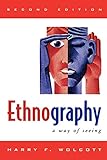
Harry F. Wolcott. Ethnography: A Way of Seeing. Lanham: Altamira Press, 2008. xiii + 338 pp. $75.00 (cloth), ISBN 978-0-7591-1168-4; $29.95 (paper), ISBN 978-0-7591-1169-1.
Reviewed by Joseph Nevadomsky
Published on H-AfrArts (December, 2008)
Commissioned by Jean M. Borgatti (Clark Univeristy)
Ethnographic Experiencing, Enquiring, and Examining
Every university department of anthropology of any repute must offer at least one theory course for undergraduates, and a course on methodology must complement it. It is impossible to divorce the Siamese twins of field methods and ethnographic theory. The study of human societies demands this union. From Bronislaw Kasper Malinowski and Margaret Mead in the first half of the twentieth century, ethnographic theory and practice is confirmed, empirically and analytically. It is anthropology’s orthodoxy, and also its "modus operandi."
As a seasoned anthropologist, as the author of ethnographic studies in educational anthropology (e.g., The Man in the Principal’s Office [1973] and A Kwakiutl Village School [1989]), and as one who has traversed most anthropological paradigms (The Art of Fieldwork [2005]), Harry F. Wolcott is positioned to map out how theoretical orientations are employed in anthropological practices. This casual yet informed synthesis, written in an engaging style, is what sets Wolcott’s book apart from the humdrum of texts that discuss methods formally, often in a staccato, bland, and abstracted tone, usually detached from application except to highlight the method by tacking on a case study. By contrast, Wolcott’s excursion is a wonderful raft ride through the flows, eddies, and rapids of anthropological experience that is always theoretically informed. His neat blending of method and theory--from structural functionalism to the symbolic, interpretive, and cognitive--provide a tour guide’s “way of seeing” along the route.
That “way of seeing” is both the theory and the practice, and the compelling interweaving that is the supposed consequence: the ethnographic monograph. But how is this to be accomplished? How are we to get around the basic American methodological recipe approach and lists, or the typical British approach of chin up? Will you figure it out once you get to the field? How does an apprentice anthropologist stitch theory and practice together to alleviate the anxieties of actual witnessing or the necessary construction of a segmented research proposal? More important, how does a student stitch together classroom theory and fieldwork techniques prior to actual witnessing?
Chapter headings, such as “Does It Matter Whether or Not It’s Ethnography,” "Ethnography as a Piece of Cake,” or “Culture and Ethnography under Siege,” whet the appetite and guide the apprentice. Perhaps the best way to grasp the contents is to note that the author’s intention is to use some of the classic ethnographic texts as “ripples on a pond” and to show how each ripple is an expansion of earlier research. He demonstrates how ethnography is as much a way of conceptualizing as it is a way of configuring. His ultimate goal is to show what makes research discernibly ethnographic, and how ethnography has remained a staple of anthropological research, regardless of paradigm.
This book should serve as a companion piece for every theory course text in anthropology. It can even, in a pinch, serve as a sole theory text where those who have eaten their theoretical oats and absorbed their methodological grits can employ Wolcott’s book to demonstrate how theory pans out in practice, and conversely, how actual engagement informs theoretical orientations. The cut-off point for Wolcott’s excursion into experiencing, enquiring, and examining is postmodernism. Neither his style of exposition nor his ethnographic expertise is up to that task. But then, for many anthropologists, postmodernism has less to do with ethnographic fieldwork and more to do with critical thinking, exegesis, and textual criticism. The real doing of ethnography remains the same, however framed, and this second revised and updated edition (the first was published in 1999) is an unabashed endorsement of the craft of ethnography and the ways to do it.
If there is additional discussion of this review, you may access it through the network, at: https://networks.h-net.org/h-afrarts.
Citation:
Joseph Nevadomsky. Review of Wolcott, Harry F., Ethnography: A Way of Seeing.
H-AfrArts, H-Net Reviews.
December, 2008.
URL: http://www.h-net.org/reviews/showrev.php?id=23475
 | This work is licensed under a Creative Commons Attribution-Noncommercial-No Derivative Works 3.0 United States License. |

