



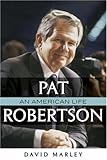
David John Marley. Pat Robertson: An American Life. Lanham: Rowman and Littlefield Publishers, 2007. x + 312 pp. $26.95 (cloth), ISBN 978-0-7425-5295-1.
Reviewed by C. Alvin Hughes (Department of History and Philosophy, Austin Peay State University)
Published on H-Pentecostalism (January, 2009)
Commissioned by Gene Mills (Florida State University)
Pat Robertson's American Life Story
David John Marley presents an interesting and balanced coverage of the life of Pat Robertson when compared to what has been published in the past. On the one side, The Auto-Biography of Pat Robertson: Shout It from the Housetop! (1995) with Jamie Buckingham is a laudatory account of Robertson’s life as a successful religious man who followed the voice of God to invoke spiritual miracles and economic success. The book portrays Robertson as a man who consults with God before he takes action on any idea, whether it is a business decision, a personal walk, or adventure on behalf of others. On the other side, Robert Boston’s The Most Dangerous Man in America: Pat Robertson and the Rise of the Christian Coalition (1996) shows a man obsessed with power and the desire to be influential in American affairs, and a man willing to use his wealth and the donations of millions of innocent supporters of The 700 Club to back anyone as a means to gain access to the developing world's natural resources to be used for the development of a Christian-controlled America. Marley has produced a fascinating study of a very powerful man and a dangerous man, in the sense that Robertson believes God needs his help to implement God's plan for the earth; Robertson volunteered to be God’s helper and narrowed God’s plan to mean for Christians to be in charge in America and the world.
Marley’s Pat Robertson: An American Life is the story of one man’s use of religion, politics, business, education, and the communications industry to implement his vision of a world governed by Christians. Robertson’s aim is to train Christian professionals and place them in strategic institutions, agencies, and governmental positions so they can make decisions to change the course of history to his Christian vision, and to combat and destroy the liberal agenda, which he believes will lead the nation toward socialism and the destruction of Christian values. Robertson’s disappointing experiences over the years supporting conservative politicians led him to the conclusion that his agenda could not be achieved in a supporting role. He decided that he must get Christians in political offices and not just have them sitting on the sidelines.
Robertson has been in the public eye for decades, and there are no shortages of published sources available to the author. Marley used personal interviews of a few of Robertson’s major associates as well as interviews with Robertson. Marley also cited extensively many of Robertson's published writings, including his journal, Pat Robertson Perspective, his autobiography, and dozens of works attributed to Robertson, especially the two works published in the early 1990s, The New Millennium: 10 Trends That Will Impact You and Your Family by the Year 2000 (1990) and The New World Order (1991), along with an earlier book, The Secret Kingdom (1982). Marley claims to be the first author to have access to Robertson’s presidential campaign papers, which were essential to telling that portion of the story. The author has successfully presented a full story of Robertson’s life from his birth in the 1930s to his triumphant life in the 1990s. It is a fascinating tale and an eye-opener for those who watch The 700 Club and may not agree with the description of Robertson as an arrogant highbrow southern gentleman who hobbles very low opinions about most groups in America, especially the liberal Left and its ethnic supporters. Marley states in the preface that Robertson was not a terrorist, which may be true; however, later in the text, the author presents information which showed that Robertson politically and financially supported state terrorists in South Africa, the Republic of the Congo, and child soldiers in Liberia and Sierra Leone to protect his investments in diamonds in those countries. Robertson’s efforts to support the apartheid government in South Africa, reactionary regimes in Africa, and the Contras in Central America are the most surprising parts of the book.
Marley applied a thematic approach in Pat Robertson with each chapter emphasizing a major project that engaged Robertson’s attention. The first three chapters cover Robertson’s early life and his struggle to find his purpose. Marley retells the story without explanation of Robertson’s volunteering to become a minister even before he became a Christian and then seeking out the charismatic-pentecostal-evangelical form of Christianity rather than the more conservative form befitting his station as a southern gentleman. This form of Christianity was traditionally nonpolitical but conservative on certain social issues, like the role of women, homosexuality, and abortion rights, and practiced the word of knowledge to predict future events or to pronounce God’s wrath for sinful behavior. Other chapters describe how Robertson, with a word from the Lord, turned forty dollars into a multimillion dollar TV ministry, established Regent University and the Christian Coalition, and drifted into conservative Republican politics even though God told him not to get involved in politics. Marley argues that while other televangelists were involved in personal immoral scandals, Robertson’s failure was his misuse of other people’s money, God’s money, to sustain his business ventures and Operation Blessing, which supported the needy throughout the world in disasters.
Pat Robertson is a valuable study for anyone interested in the ability of one person to make a difference, the role of the Christian Right in American politics and culture, the use of financial support to protect business interests abroad, and the development of the Christian Right as an extension of the Republican Party in the 1980s. The greatest political lesson learned from Robertson’s work with the Christian Coalition was how to bypass the traditional leadership of groups on the Left and the Right to gain the support of the masses; the strategy both Ronald Reagan and Barack Obama as candidates for the presidency used effectively to rally people to their call for a new beginning.
If there is additional discussion of this review, you may access it through the network, at: https://networks.h-net.org/h-pentecostalism.
Citation:
C. Alvin Hughes. Review of Marley, David John, Pat Robertson: An American Life.
H-Pentecostalism, H-Net Reviews.
January, 2009.
URL: http://www.h-net.org/reviews/showrev.php?id=23407
 | This work is licensed under a Creative Commons Attribution-Noncommercial-No Derivative Works 3.0 United States License. |

