



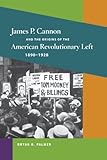
Bryan D. Palmer. James P. Cannon and the Origins of the American Revolutionary Left, 1890-1928. Urbana: University of Illinois Press, 2007. 576 pp. $50.00 (cloth), ISBN 978-0-252-03109-0.
Reviewed by Deborah Marinski
Published on H-SHGAPE (December, 2008)
Commissioned by James Ivy
An American Radical
Bryan D. Palmer writes an interesting and informational piece on the history of American working-class radicalism in the late nineteenth and early twentieth centuries in his work, James P. Cannon and the Origins of the American Revolutionary Left. Palmer uses rich details about Cannon's life to identify the beginning and evolution of an American leftist movement through the problems the faction faced from within its own ranks, the American social and political pressures from outside the movement, the struggle to legally politicize the party, and the impact of international affairs on the American Left from the Bolshevik Revolution in 1917 through the process of Stalinization in the 1920s. Through his balanced and explicit descriptions of the working-class revolutionary Cannon and the rise of American communism, Palmer composes a fair and thorough examination of a topic that is often pushed aside and misunderstood.
In his introduction, Palmer clearly places his book within the historiographical context by establishing it as a study of a native American radical movement and the influences of foreign communists on that movement. Palmer highlights three points that separate his book from previous works. First, he places a homegrown radical, Cannon, at the center of the development of an American Left, while at the same time recognizing the importance of international theory and practice on Cannon and the American Left. In doing so, Palmer transitions the different approaches to the historiography of radicalism that either emphasize foreign influence or the complete Americanization of communism. Palmer transcends Theodore Draper's interpretation that American communism was bred by the Soviets as well as those social historians of the 1980s and 1990s who neglect the influence of foreign involvement in the American Left.
Second, Palmer's emphasis on the early twentieth century, specifically the 1920s, brings the study of radicalism back to its formation. Much of radical historiography glosses over or neglects the importance of the 1920s by concentrating more on the social and political pressures demonstrated by the Palmer Raids and the Red Scare of the 1920s and later 1950s, and less on the actual internal structure and survival of the communist movement through Cannon's adaptations.
Finally, Palmer's reliance on Cannon stresses the importance of the working class in the formation of the American Left. According to Palmer, Cannon is different than other revolutionaries, even those considered working-class revolutionaries, like William Z. Foster, because of his childhood experiences in the laboring class, which molded his radical ideals and led to action; his struggle to "Americanize communism" by bringing together various foreign and native-born interests into one common working-class party instead of isolating foreign factions; and his acceptance of Trotskyism in the face of increasing Stalinization (p. 18). Cannon recognized the force and power of the working class, but he also recognized the social, labor, and ethnic tensions that threatened the unification and action of that class. Palmer argues that Cannon recognized differences and tried to bridge those labor divisions to create a powerful party of change in the Worker's Party.
Palmer unquestionably shows the development of an American working-class revolutionary Left through Cannon's life. Palmer begins his study with Cannon's childhood in Rosedale, Kansas, and the influence of his English-born of Irish descent, working-class, Socialist parents. During his early life, Cannon faced the trials of a working-class existence, watching his parents struggle, losing his mother at a young age, working in packinghouses, and yearning for an education. Although he lacked a formal education, Cannon was able to teach himself through reading the works of various individuals, the most prominent being Eugene Debs. Cannon became a member of the Socialist Party in 1908; however, he did not consider himself a revolutionary until his membership in the Industrial Workers of the World (IWW). Cannon wrote, "'When I joined the IWW, my life was decided'" (p. 52). According to Palmer, it was during his participation in the IWW and traveling as a labor activist that Cannon matured into a working-class revolutionary. This history of pure activism and fighting with and for the working class stayed with Cannon throughout his career in radicalism.
The Russian Revolution in 1917 was a major turning point for Cannon. Palmer writes, "The Russian Revolution remained forever embedded in his consciousness as an event that awakened awareness of the need to situate and develop the American Revolution within its global context, a direct political action that lived in its concrete accomplishments as well as in its wide-reaching implications for the theory of the revolutionary movement" (p. 91). Cannon consistently looked to the Russian Revolution as an example and as justification for a working-class revolutionary movement in the United States, one of "mass action and revolutionary recruitment" (p. 134). For Cannon, the idea of "mass action and revolutionary recruitment" came from several sources: working-class involvement, political participation, trade union militancy, education of workers, a unified "party of class-conscious workers, bound by the discipline of a democratic-centralist body," and a medium of publication (p. 136). As a founder and leading figure of the Worker's Party, Cannon held firm to these principles to "legalize and Americanize communism" and found international support against the underground movement during one of his several trips to Moscow to participate in the Comintern (Communist International) (p. 152). The 1920s witnessed a continuous struggle between Cannon and other communist factions and individuals, including the Goose convention, John Pepper, Charles E. Ruthenberg, and Jay Lovestone, as well as changes within the Comintern that transformed Cannon.
It was the conflicting theoretical and practical responses of key revolutionary figures and the involvement of the Comintern in American communism that led to Cannon's slow evolution from "loyal Comintern soldier" into a devout Trotskyist (p. 206). Cannon disagreed with the bureaucratization and Stalinization ("socialism in one country") of the Comintern and came to embrace Trotskyism, which emphasized a return to international revolution. Cannon continued to emphasize political participation, trade union militancy, working-class participation and class consciousness, mass movements, and "Americanizing" communism. One important way that Cannon achieved these aims was through the International Labor Defense (ILD). The ILD was "dedicated to leading protests aimed at freeing all class-war prisoners," and the organization "challenged anti-labor legislation and the arbitrary use of court injunctions against workers; provided legal aid to those facing trial and sentencing; educated the labor movement and the wider public about the extent of class persecution in the United States; was committed to united-front cooperation and building solidarity of all defense forces, national and international; struck repeated blows against racist brutality and lynching; and continued the Comintern-inspired project of exposing the nature of white terror in other capitalist countries" (pp. 269-270). According to Palmer, "the ILD was Cannon's, and potentially the party's, bridge back to a politics of mass activity" in the wake of the disorganized and conflict-ridden 1920s (p. 271). Unfortunately for Cannon, because he embraced Trotskyism and maintained his principles of mass action, he was forced out of the Communist Party in 1928. This may be the ending of the book, but it was not the end of Cannon. Cannon continued to fight for Trotskyism within the United States for the next thirty years.
In this book, Palmer's stylistic and contextual strengths are many with only a few weaknesses. Palmer's straightforward statements in the introduction that establish his purpose, main arguments, and place within the radical historiography are repeatedly proven throughout the rest of the book's well-written twelve chapters. Palmer's organization and writing style facilitate easy flow from one subject to the next and one chapter to the next. However, in a book with such intense and valuable information, endnotes in the middle of sentences detract from the course of the reading. The reader has to reread several sentences and paragraphs when an endnote or multiple endnotes pop up within a sentence. The style would be better served if all endnotes were placed at the end of sentences.
When writing on working-class radicalism and communism in the United States, the number of names and organizations is daunting. Palmer falls into the trap of mentioning foreign and domestic individuals, parties, associations, movements, ideologies and theories, and dates, making it difficult for the reader to get through the surplus of information and keep everyone, every principle, and every action in its correct place. It is hard for any author, especially on this topic, to get out of this trap, but one way that Palmer makes up for this weakness is by constantly reiterating important points about people, groups, practices, and ideas. He does not simply repeat his points over and over, which is a stylistic and contextual negative, but chooses the best spots to refresh the reader's memory as the story moves forward. Illustrations are also included, which helps to put faces to names. Palmer does an excellent job of keeping such a mass amount of information as straightforward as possible and more important, interesting.
The number and variety of primary sources is impressive. Palmer includes sources throughout his main text about and composed by Cannon and other leading figures, such as personal and published writings, letters, and interviews. There are also a large number of references to newspapers, the published organs of organization, and files from Russia. The arguments and details of the work are based on Palmer's extensive primary research, but he also includes a wide range of secondary books and articles as well as illustrations. Unfortunately, Palmer does not provide a bibliography. While the endnotes are extensive and informational, a standard bibliography is more accessible and comprehensive.
Finally, when reading over the chapter titles and subtopics, the reader is immediately drawn in by catchy phrases, for example, "Geese in Flight" (chapter 6) and "Pepper Spray" (chapter 7). Also, several subtopic headings spark the reader's interest, including "Blind Spot: 'Women's Work'" and "Race and Revolution" both in chapter 8, and "Antoinette Konikow: Boston's Red Birth-Control Advocate and Pioneer Left Oppositionist" in chapter 11. Palmer acknowledges that his book lacks a great deal of discussion of women and African Americans within the 1920s leftist movement; however, the fact that he does at least mention the involvement of two groups often neglected with respect tothis topic is significant to working-class, radical, and social history. Palmer's inclusion of women (he devotes much discussion to the various women in Cannon's life and how they influenced him, both romantically and professionally) and of African American men and women throughout his text opens the door for more scholarly work on these important segments of society.
Palmer has composed an elegant book that draws readers in with engaging chapter headings and does not disappoint, providing them with an immense amount of intriguing information about Cannon and the American revolutionary Left. Palmer's writing is engaging and hard to put down; you can feel his passion for his subject.
If there is additional discussion of this review, you may access it through the network, at: https://networks.h-net.org/h-shgape.
Citation:
Deborah Marinski. Review of Palmer, Bryan D., James P. Cannon and the Origins of the American Revolutionary Left, 1890-1928.
H-SHGAPE, H-Net Reviews.
December, 2008.
URL: http://www.h-net.org/reviews/showrev.php?id=23386
 | This work is licensed under a Creative Commons Attribution-Noncommercial-No Derivative Works 3.0 United States License. |

