



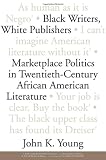
John K. Young. Black Writers, White Publishers: Marketplace Politics in Twentieth-Century African American Literature. Jackson: University Press of Mississippi, 2006. 240 pp. $40.00 (cloth), ISBN 978-1-57806-846-3.
Reviewed by Noah Mass
Published on H-Southern-Lit (December, 2008)
Commissioned by Lisa Hinrichsen (University of Arkansas)
Selling Race in Hardcover and Paperback
In 1975, Ralph Ellison had a rather embarrassing interaction with Ishmael Reed, on the occasion of Reed’s appearance at the American Academy of Arts and Letters awards ceremony. After spotting Reed, who was being celebrated at the ceremony, Ellison shouted at him: “Ishmael Reed! You’re nothing but a gangster and a con artist!”[1] We might be led to believe that Ellison’s calling out of Reed was related to Ellison’s conservative dislike of those whom he thought of condescendingly as “crude black nationalists.” However, Ellison’s remark, especially the “con artist” part, is not one we should dismiss too readily. Ellison was unprofessional in his name-calling (to put it mildly), but isn’t it understandable that he would be struck by the seeming paradox of a writer like Reed, who was well known for his engagement with the Black Arts Movement, receiving a prize from a “white” establishment organization like the Academy? If Reed wasn’t conning anybody, then just what was the relationship between Reed’s work and a white mainstream readership?
It is a complicated question, and John K. Young helps us to work towards an answer in Black Writers, White Publishers: Marketplace Politics in Twentieth-Century African American Literature. Young asks us to recognize that when we encounter texts by writers of color like Reed as well as Ellison, our readings of those texts must be engaged with their contingent editorial origins. Paying attention to the editorial and publishing histories of works by black authors who worked within an historically white-dominated publishing industry will help us to come to terms with the commodification of race, and a focus on textual origins and textual variants might help us to work through the tensions surrounding racial performance in a white marketplace.
To that end, Young examines works by five canonical twentieth-century African American authors: Nella Larsen, Reed, Gwendolyn Brooks, Toni Morrison, and Ellison. He asks us to read some of those works through the lens of editorial theory, in particular as that theory has been popularized by scholars such as Jerome McGann, George Bornstein, and D. C. Greetham. McGann, in particular, asks us to acknowledge “the textual condition” of a work: the contingent and unstable balance of meanings that a work’s publication and marketing presence contribute to. Young argues that, through a focus on the “artifacts” of a work--“first editions, colophons, book jackets, title and copyright pages, drafts and manuscripts, advertisements” (p. 23)--we can come to understand “both the complex negotiations required to produce African American texts through a predominantly white publishing industry and the material marks of these negotiations” (p. 5). But Young is not attempting to “recover” the version of a text that was closest to its African American author’s original intentions before the manuscript became mangled by the interfering hands of a powerful white editor. Rather, he wants to illustrate that, for black authors, publishing was always a complex act of negotiation--a confrontation with white power structures as well as a collaboration with them.
Young begins his study with an analysis of a work for which he has little editorial information. His reading of Larsen’s Passing (1929) in the opening chapter, “Passing (On) Textual History,” focuses on that novel’s last paragraph; the paragraph appeared in the first and second editions of the work but was dropped from later editions, for reasons that remain unclear. The final line in most editions, “Then everything went dark,” follows the ambiguous scene in which Irene may have pushed her passing-for-white sister, Clare, out a window to her death. But the alternate ending, in which the possibility emerges that Clare’s demise will be ruled “death by misadventure,” alters our reading of Irene’s (and Clare’s husband John’s) ultimate fate. For Young, the alternate endings are not merely publishing footnotes, but central elements to any interpretation of the novel, for “to ignore this textual crux risks short-circuiting the careful narrative dynamics that do change significantly, depending on which paragraph holds the privileged final position” (p. 52). Were we to highlight, rather than diminish, this novel’s “unstable” textual history, Young contends, we would be asking students and fellow scholars to recognize “the work’s basic character as materially unstable,” and so “raise a host of questions about the seemingly straightforward process of reading a book” (p. 57).
Young is here using Passing less as an example of the relationship between black authors and their publishers--as he acknowledges, the lack of archival evidence about just who decided to omit the final paragraph leaves us unable to make any conclusions about the variance among editions--and as more of an overture of sorts to a larger argument about “editorial ethics.” As we have no choice but to acknowledge both endings of Passing, Young contends, we must affirm the ambiguity of the conclusion: “the most ethical editorial strategy would be the preservation of our lack of knowledge” (p. 56).
This first analysis, then, is really an introduction to Young’s methodology, but the real work of Black Writers comes in chapter 2, “Black Page, White Copyright,” where Young considers the publishing history of Ishmael Reed’s Mumbo Jumbo (1971). As in the Larsen chapter, Young is concerned with a textual variant among editions--in this case, a black-colored copyright page included in first printings of the novel, but absent in paperback editions thereafter. Young reminds us that, when Reed was publishing Mumbo Jumbo in 1971 through Doubleday, a white-owned mainstream publisher, small black-owned presses such as Broadside, Third World, Jihad, and others were emerging as small-scale, and less profit-oriented, alternatives for African American authors. Reed recognized the financial benefits of reaching a wider, and possibly whiter, audience than these small presses could achieve, and in Young’s reading, the black copyright page epitomizes the “uneasy negotiations” that Reed made with “the white commodification of black texts” (p. 90). The black page “replaces the normal--and normative--whiteness of the standard page with a black field for the book’s expression of itself as literary property” (p. 69), and in this way “adds race to the capitalist literary equation, using the color often associated with obscurity to illustrate ironically the operating assumptions of textual ownership on which the white page depends” (p. 87).
But Young does not want us to ascribe to this page some “subversive” gesture of Reed’s against the “white power” of his own publishing house. Mumbo Jumbo is a novel that is itself replete with self-conscious overtures to the representation of African American cultures for different racial audiences. A “postmodern mystery,” the novel tells the story of an “anti-plague,” called Jes Grew, whose spread is being investigated by “astrodetective” PaPa LaBas, and the story is told to us through a collection of textual, narrative, photographic, and visual devices. In the course of the text, Jes Grew “appears as either stable or fluid, controllable by editors and translators or asserting its own textual independence” (p. 84). For Young, the black copyright page is a textual corollary to the novel’s “problem of fixing an African American textuality within a marketable, essentially white form” but it is also a marker of “the necessary collaboration between Reed and his editors in order to produce the material book from which this immaterial effect will develop” (p. 90).
Young is juggling a number of analytic approaches here, but his overall achievement in this chapter is a dazzling one; he walks us through the archival history of the novel, and his research calls our attention to what he calls the novel’s “central paradox”: “how to subvert Western cultural traditions within the framework of conventional literary structures, in order to open those traditions and structures to a pan-African textuality, thus creating a new, hybrid textual method” (p. 86). The black copyright page is both an embodiment of the “productive relationship between author and publisher” that Reed enjoyed (as it was Reed’s suggestion that the page be a black one), as well as a challenge to “the broader cultural assumptions” that, for Young, the mainstream publishing industry reflects (p. 91).
Young is at his best here, and “Black Page, White Copyright” shows him bringing editorial, archival, and literary analyses together in a remarkably persuasive manner. What I think this chapter misses, though, is an opportunity to investigate the act of “marketing” ethnic literature itself, either through mainstream publishers like Doubleday or through black-owned small press publishers generally. If we see the original edition of Mumbo Jumbo as both an intervention in the power structure that white-owned presses supposedly exemplify and as a collaboration with them, then we are left with some fairly fundamental questions about the relationship between black identity and “the marketplace” itself.
Although Young takes into account Reed’s own statements about how he viewed his market presence, he seems unclear as to just what Reed was intending when he worked closely with Doubleday on ad copy, copy which often did not focus on the African American “presence” of the work. He contends that “[Reed’s] work with the Doubleday staff indicates an interesting cultural hybridity at the material level of textual production, even if this dynamic is sometimes in tension with the politics of the narrative’s linguistic code” (p. 76). But the “interesting cultural hybridity” that Reed embodies here is nothing new, or even especially surprising, given the long history of racial performance, compromise, and masquerade that peoples of color have long felt it necessary to contend with and sometimes engage in. It would be interesting for Young to develop his analysis of Reed’s marketing strategy by taking into account the wide range of scholars--Eric Lott, Mark Anthony Neal, and E. Patrick Johnson, just to name a few--who have attempted to grapple with the tensions that surround ethnic performance in an American context.
Young’s examination of the collaboration between Reed and Doubleday also leads us to think about the question of readership itself. The early 1970s was a time when many mainstream publishers were more than willing to sell artifacts of “revolution” in book form, from McGraw Hill’s publishing of Eldridge Cleaver’s Soul On Ice (1968) to Simon and Schuster’s publication of Jerry Rubin’s Do It! (1970). Mumbo Jumbo is a far more valuable and intriguing literary document than either of those texts, but given the context of publishing in that era, we might well ask: what did white readers think that they were buying when they handed over money for a copy of Mumbo Jumbo, with or without its black copyright page? We are given great insight into Reed’s relationship with his editors, but little information about the book-buying habits and desires of white readers of the era. Young’s emphasis, for the most part, remains top-down; we see how an author, along with his editors and publisher, worked to bring an idea to a readership, but not how that readership ended up seeing it. When we consider the issues that emerge when we examine the reproduction of ethnic identity as cultural commodity, we need to keep in mind that those commodities are ultimately consumed by somebody. A black author's relationship to a white readership is a complicated one, but that readership is complicated as well.
The unaddressed question of readership hangs over Young’s chapter on Brooks, “Gwendolyn Brooks’s Bibliographical Blackness.” Here, Young charts the unusual publishing trajectory of Brooks’s career: Brooks published her poetry through a mainstream press, Harper, in her early years, but in 1969 she made the decision to work primarily through smaller, black-owned presses. Young argues that this marks a shift in Brooks’s outlook towards late-60s black nationalism, and contemporary anthologized selections of her early work tend to ignore the direct connection to the African American community that her later poems and imprints explicitly affirmed. Her last collection of new poems, Children Coming Home (1991), which Brooks put out through the local Chicago press The David Company, is one that, through its textual markers and content, “signs race rather than racelessness” (p. 117), and grounds itself in Brooks’s local community rather than a broader national one.
Young’s analysis of Brooks’s final published collection presents us with a valuable, if brief, analysis of the different ways we might read Children Coming Home's “The Coora Flower” in its original and in its anthologized form. But unlike his earlier examinations of both Larsen and Reed’s textual variants as speaking to the complexity of black writers and the publishing industry, Young opts instead to consider Brooks’s final works in terms of her own emerging vision that “challenged accepted notions of blackness” (p. 116). This is certainly a valuable point, but I wonder, again, about the question of readership here--who was engaging with those challenges, and on what level? Brooks's works through smaller presses reached fewer people, and we might be led to believe that she specifically aimed to market her work to a black readership--but did she reach that readership? We are left hoping to see a further development of the implications of Brooks’s “turn” for the problem of marketing to black and white readerships, but Young leaves the Gwendolyn Brooks story, it seems to me, unfinished.
However, in Young’s penultimate and most ambitious chapter, “Toni Morrison, Oprah Winfrey, and Postmodern Popular Audiences,” he returns fully to an engagement with “the fundamental problem” confronting African American authors in the twentieth-century marketplace--how can an author commodify her own blackness for a white audience while maintaining control over the terms, and the reception, of that commodification? Here, Young takes on the phenomenon of Oprah’s Book Club, and with the way that the club has marketed Toni Morrison’s novels, particularly her first and most accessible, The Bluest Eye (1970). Although Young designates Oprah's television show as “mass popular culture,” he is far from contemptuous of the sale of “high culture” works, such as Morrison's novels, through such mass cultural mediums: “By constructing an audience built through popular, ostensibly low, culture for her serious novels, Morrison explodes the high-low divide that still holds for much of postmodern art. Morrison sells herself and her novels, like jazz, through popular media and thus constructs herself as a self-consciously commodified textual authority” (p. 121). The covers of the Oprah editions of Morrison’s novels, as well as Oprah’s own salesmanship of the books on her show, often reconfigure the novels in terms of their “accessibility,” and as products that are brought to you by the celebrity figures of both Oprah and Morrison. But Young argues that this embrace of commodification is one that represents less a selling-out than an ascendency of black writers like Morrison to “a position of cultural power,” from which Winfrey’s “vast audience” can be encouraged to “continue reading Morrison, for and beyond Oprah” (p. 142). The point here is that the terms of Morrison’s commodification through Oprah are such that Morrison’s ethnic presence--“a voice of authentically black experience that demands attention”--is in no way compromised, but rather sold to a white audience on what are essentially the black author’s own terms (p. 149).
I am not entirely sure about this, and I continue to be puzzled by the nature of audience that Young wants us to consider as receptive to the Morrison-Winfrey alliance. Is Morrison’s postmodern white audience the same as the one that Reed faced, or that Brooks turned away from? If publishing in an Oprah age is no longer part of “the white power structure,” then is it unmoored from power, or part of a new power structure that is less oppressive or exploitative, because less white-owned? Perhaps the solution to the “problem” of black authors, material production, and white audiences comes from a closer examination of the vexed term that Young brings up when analyzing Morrison: “authentically black experience.” What counts as “authentically” anything is a troublesome question to answer, but the term itself, when we affirm it, inevitably evokes the issue of “inauthenticity”--and I would argue that a discussion of “authentic” and “inauthentic” blackness is not a very productive one. But that white readers, in purchasing an Oprah’s Book Club edition of Morrison, think they are buying something “authentically black,” and that black writers may have found a way to market towards that desire for authenticity in a way that does not compromise their integrity as authors or their sense of themselves as ethnic subjects--that does sound like something to celebrate.
I think that is what Young is getting at in the Morrison chapter, despite my quibble with his terminology, and his final chapter, a powerful and necessary critique of the posthumously published Ellison novel, Juneteenth (1999), returns us to less telegenic territory and to a wonderful reiteration of his argument in the Larsen chapter about textual instability. Juneteenth, for Young, epitomizes especially bad editorial ethics on the part of John F. Callahan, who assembled the novel from more than 2000 pages of Ellison’s notes. This is precisely because the published version attempts to “stabilize” Ellison’s ideas into a marketable novelistic form, when those ideas (to the extent that we can conjure with them based on what has become available) are about “exposing the fundamental fiction and truth of American racial relations” (p. 179). Juneteenth is an unfinished narrative about light-skinned Bliss, who grows up to become the racist white Senator Sunraider, in defiance of his surrogate father, Reverend Alonzo Hickman. The novel itself reads as fragmentary and unfinished, a product less of Ellison’s intentions than of Callahan’s editorial redactions and interpolations. However, Young reads the narrative of passing and turning on one’s own community in light of the novel’s ultimately unfinished state and its heavy-handed editorial origins: “we might understand Juneteenth as a working-through of the real impossibility of editing Ellison’s manuscripts and, furthermore, of their necessary failure to represent race itself as a stable narrative” (p. 182). A publishing travesty, Juneteenth nevertheless embodies the “unfinished and unfinishable representation of racial narratives” that Young has been asking us to consider from Larsen’s Passing to the present day.
It is a fine ending to Young’s intriguing if sometimes uneven work. Throughout, Young has emphasized that race, in an American context, is an ultimately unstable construction, and that an examination of the editorial histories and marketing presences of African American literary works can help us to engage with that instability. As I have mentioned, though, a greater attention to the issue of readership itself would only deepen and further develop that approach. Still, Young’s conclusion, in which he enjoins editors to “look always to the past and the future simultaneously in order to operate within the present, in order to keep textual and racial pasts alive within present editions” (p. 193), articulates a vision of editorial analysis that reminds us to focus on the ethics of racial commodification in an increasingly media-saturated culture. Studies such as this one remind us of our responsibility as scholars, writers, and editors to recognize the consequences of our editorial, pedagogical, and authorial actions.
Note
[1]. Arnold Rampersad, Ralph Ellison (New York: Random House, 2007), 507.
If there is additional discussion of this review, you may access it through the network, at: https://networks.h-net.org/h-southern-lit.
Citation:
Noah Mass. Review of Young, John K., Black Writers, White Publishers: Marketplace Politics in Twentieth-Century African American Literature.
H-Southern-Lit, H-Net Reviews.
December, 2008.
URL: http://www.h-net.org/reviews/showrev.php?id=23371
 | This work is licensed under a Creative Commons Attribution-Noncommercial-No Derivative Works 3.0 United States License. |

