



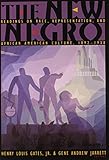
Henry Louis Gates, Gene Andrew Jarrett, eds. The New Negro: Readings on Race, Representation, and African American Culture, 1892-1938. Princeton: Princeton University Press, 2007. xii + 591 pp. $75.00 (cloth), ISBN 978-0-691-12651-7; $35.00 (paper), ISBN 978-0-691-12652-4.
Reviewed by Richard King
Published on H-Southern-Lit (December, 2008)
Commissioned by Lisa Hinrichsen (University of Arkansas)
Uplift and Beyond?
Although the Harlem Renaissance is firmly established in literary and cultural histories, its beginning and end points remain vague. If Alain Locke’s edited collection The New Negro is the canonical text, then 1925 is the starting point, with the Harlem Renaissance and the New Negro assumed to be a phenomena primarily of the 1920s. By extension, the Renaissance is usually considered to have faded pretty quickly once the Depression set in. But if the Renaissance was only five to seven years in length, it is hard to see what all the fuss was about. One of the interesting things about Henry Louis Gates, Jr. and Gene Andrew Jarrett’s The New Negro, a collection of writings from the period 1892 to 1938, is its focus on the New Negro rather than the Renaissance as the central organizing idea: “The tropes, politics and discourses of racial uplift that we intend to explain in the introduction outline the parameters of what could be thought of as ‘New Negro’ criticism” (p. 2). Thus the era of the New Negro encompasses something more inclusive than the Harlem Renaissance, yet, at the same time, it gives the latter a cultural-history setting that makes it something more than just a short episode of African American creativity. Within that framework, the editors set up a dialectic between “cultural politics” and the “political culture” as it bears on the “New Negro's philosophy of self-respect and racial uplift” (p. 12).
Gates and Jarrett offer a twenty-page introduction followed by some one hundred selections that cover a wide range of (often overlapping) topics: “The New Negro,” “How Should Art Portray the Negro?,” “The Renaissance,” “Art or Propaganda,” “Literature, History and Theory,” “Literature: The Literary Profession and the Marketplace,” “Literature: Poetry,” “Music: Spirituals,” “Music: Jazz,” “Theater,” and “The Fine Arts.” The pieces come from books, magazines, and journals of the period rather than academic scholarship and interpretive work from later in the century. Most of the usual suspects, including W. E. B. Du Bois, James Weldon Johnson, Alain Locke, Claude McKay, and Zora Neale Hurston are there, but surprisingly not Langston Hughes. Others figures are not as well known, including several women such as Charlotte Taussig, Anna Julia Cooper, and Katherine Tillman. The great majority of the contributors are African Americans but there are interesting, if brief, contemporary evaluations of the Harlem Renaissance and Locke’s original The New Negro from white intellectuals such as Carl Van Vechten, H. L. Mencken, and Carl Van Doren and even some obtuse reactions to jazz from contributors to Etude magazine from the 1920s. (I am assuming most of them are white, though there is plenty of evidence in Gates and Jarrett that not all Negroes at the time were “New Negroes.”)
One positive effect of this collection is to underline the rich diversity of the cultural traditions African Americans drew upon for their entrance onto the modern literary, intellectual, and cultural stage. Black American versions of the “genteel tradition” and uplift writing were followed by criticism of the modernist aesthetic kind, which was in turn succeeded by the social realism and naturalism of the 1930s. Through it all, two other traditions were brought into play: the newly resurgent attention to African art and sculpture and the exploration of the African American “Folk.”
As mentioned, Gates and Jarrett deploy the “trope” of the New Negro to tie all this material together so that a coherent narrative of racial uplift and creativity can be constructed. One implication of their reconfiguration of the Harlem Renaissance is the conclusion that the ostensibly quite different aesthetic preferences of Alain Locke and Richard Wright “did not operate through extreme philosophical disagreement.” Respectively emphasizing “cultural romanticism” and “political radicalism” (p. 9), both figures adopted a new stance toward African American history and culture that would give meaning to “the long New Negro movement” (p. 9) that underlay both the Harlem and the Chicago Renaissances. By 1936, Locke had come to see that African American art needed to engage more fully with social and institutional realities rather than concentrating on the aesthetic preferences of the black bohemia and avant-garde: “The task of this younger literary generation is not to ignore or eliminate the race problem, but to broaden its social dimensions and deepen its universal human implications” (p. 268). For both figures, thought and action, race and class, the particular and the universal, aesthetics and politics, were to be brought into fruitful interaction rather than kept rigidly segregated.
It is notoriously difficult to review anthologies. Still, there are several observations that might clarify how useful Gates and Jarrett's text of 556 double-columned pages is. Without doubt, Gates and Jarrett's The New Negro should prove a valuable reference work and teaching aid. There is some overlap with Locke’s original 1925 anthology but the volume under review here ranges far wider. Yet, I was surprised that the editors included no headnotes for the various sections or selections. The provenance of the individual pieces is located at the back of the text rather than accompanying the piece itself and nowhere are there thumbnail sketches of the contributors. Of course everyone knows Hurston and Du Bois, Locke and McKay, but Hubert Harrison and Benjamin Brawley may strain the memory of even knowledgeable readers and some of the early contributors from the 1890s are very obscure. Only the year of publication of the individual selections indicates what its message might be. The Locke of 1925, one assumes, will be quite different from the Locke of the mid-1930s.
I was also struck by the absence of Renaissance figures and publications that belonged to the aesthetic avant-garde. Jean Toomer’s Cane (1923) receives some mentions, positive and negative, in various articles analyzing the literary scene at the time. But there is no single essay devoted to Cane; in fact, there is little serious criticism of fiction, while poetry gets more than its fair share of attention. The editor of Fire! (1926), Wallace Thurman, has one piece on poetry included, but Fire! itself, which admittedly only lasted one issue, gets only two largely negative mentions. It is easy to criticize editors for their omissions, but most would find the absence of Langston Hughes, especially his “The Negro Artist and the Racial Mountain” (1926), distinctly strange. Along with Locke’s “The New Negro”(1925) and Wright’s “Blueprint for Negro Writing”(1937), Hughes’s essay is one of the most powerful expressions of the urge to find and define the African American voice. These essays do the African American cultural work that Ralph Waldo Emerson’s “The American Scholar” (1837) address did in the 1830s for American thought and culture.
On the other hand, Gates and Jarrett give much-deserved attention to the work and general importance of Sterling Brown. Alain Locke’s “Sterling Brown: Folk-Poet” (1934) pays handsome tribute to this writer-poet who “dared to give the Negro peasant credit for thinking" (p. 120). With his book of poetry, Southern Road (1952), Brown had, according to Locke, succeeded more than other Black writers such as Paul Laurence Dunbar, Toomer, and Hughes in resisting the lure both of “minstrelsy” and “race propaganda” (p. 122). Indeed, though Locke is often criticized for his alleged aestheticism (and there is often more than a hint of distaste for his “effete” manner), his contributions here show him to be much more flexible and subtle in his criticism than, say, Du Bois and far more versatile than most of the other intellectuals involved in the Renaissance.
The pride of place enjoyed by literature here, especially poetry, does jar with the widely accepted claim from figures as diverse as Du Bois and Amiri Baraka, that music represents the major contribution of African Americans to American and world culture. And, in fact, the selections on music seem limited in range and depth. It is not what they say so much as what they fail to cover. Hurston’s essay on “Spirituals and Neo-Spirituals” (1934) distinguishes the raw, unvarnished spiritual from what happens when they are domesticated, arranged, and performed in concert: “There never has been a presentation of genuine Negro spirituals to any audience anywhere"; rather, what people hear are “works of Negro composers or adaptors based on the spirituals” (p. 473). There are also essays on Black folk music. But there is nothing about the emergence of an African American symphonic tradition as represented by the work of William Grant Still and William Dawson. In fact, a claim was made in the 1920s that George Gershwin used one of Still’s phrases in his music. In his essay J. A. Rogers discusses the way that that several French composers, along with Igor Stravinsky, incorporated Black music into their work, giving it recognition analogous to the modern artists’ appropriation of African art and sculptural forms in their work. But though an essay by Louis Armstrong is included, the master of modern African American music, Duke Ellington, receives only one entry in the index.
Things are similarly unbalanced in the section on “The Fine Arts.” Three selections by Locke foreground the links between African art and African American art and Locke makes the point that African art in fact is highly formalized and restrained rather than exuberant and expressive. A young Romare Bearden makes a strong plea for the Black painter and sculpture to forge his or her own African American vision rather than copying European masters or trading on the exoticism of African art. Still, it is difficult to understand why there is little or nothing by or about Aaron Douglas, especially since a detail from one of his murals graces the cover of the Gates and Jarrett volume itself. The great photographer of the black bourgeoisie, James Van Der Zee, goes unmentioned or analyzed. But black artists and sculptors were very active in the interwar years and by no means were they simply aesthetically derivative, politically neutral, or, conversely, visual propagandists. They absorbed style and technique from all the current art movements, including the highly political Mexican mural movement, yet also explored the peculiar resources of their time, place, and race. Overall, as with the sections on music, the variety and richness of African American art are seriously underestimated here.
Finally, the trope of the New Negro that organizes this collection has, I think, occluded as much as it has illuminated African American political and cultural traditions from the early 1890s to the late 1930s. As was the case with the somewhat analogous (and contemporaneous) concept of the “New South,” the “New Negro” tended to lose its analytical distinctiveness over time and become synonymous with whatever it was that the person using it wanted it to signify. It could be contrasted with the servile slave or the subservient Black sharecropper and meant to refer to the proud middle-class striver, the self-respecting civic leader, or even the average educated African American. But it is still not clear to me that the rhetoric of the New Negro had much currency with the aesthetic avant-garde or among Black political radicals, whether communist or nationalist, in the interwar years.
The ideology of the New Negro assumes, as Gates and Jarrett indicate, a belief in a providential view of history in which racial uplift and progress are inevitable. Thus it assumes a deeply held optimism, a teleological commitment to change, along with a vindicationist impulse to refute the negative charges about African Americans and to proclaim their historical and cultural achievements. But because the reality of African America life began in slavery, there has been, almost by definition, no golden age in the past for the New Negro to yearn for. In contrast with their white Southern contemporaries, the Vanderbilt Agrarians, the spokespeople for the New Negro were stuck with a fundamentally one-dimensional ideal. The political implausibility of imagining a return to Africa, not to mention the undesirability of returning to the days of slavery or some simulacrum thereof, meant that the idea of progress became a shibboleth that none dared examine too closely.
This in turn helps explain why the essays in Gates and Jarrett’s anthology finally take on a certain monotonous quality. For instance, there is an implicit but important argument about the “Folk” vs. “The Talented Tenth” running throughout the anthology but surprisingly Gates and Jarrett do not include the Du Bois writings where he develops the concept of the Talented Tenth. Otherwise, we find that McKay disagrees fundamentally with Locke and Van Vechten but for not any very convincing reasons, while Du Bois seems to fade in importance. Some contributors object to the African theme as too exotic and as trafficking with the primitive. But, finally, the major issues among these intellectuals and critics are strategic rather than fundamental. The New Negro, however energetic and optimistic, smart and successful, political savvy or even radical he or she is, is just not artistically, morally, or philosophically very profound. Lacking cultural permission to think in terms of the tragic, the writers of the New Negro/ Harlem Renaissance tradition failed to produce works that matched the later literary achievement of Wright’s Native Son (1940) or Ralph Ellison’s Invisible Man (1952) or Toni Morrison’s Beloved (1987), all works which escape, strain mightily against, or even explore the stifling nature of the “uplift” paradigm.
Indeed, considering the crucial question which informs their anthology--to what extent can cultural work have strong and immediate political effects?--it is hard to tell whether Gates and Jarrett themselves have escaped the uplift tradition and the vindicationist framework for a deeper vision that satisfies not only the quest for improvement but recognizes that Martin Luther King Jr.'s well-known claim, taken from abolitionist Theodore Parker, that “though the moral arc of the universe is long, it bends toward justice” is a hope to be realized rather than a certainty to be assumed.
If there is additional discussion of this review, you may access it through the network, at: https://networks.h-net.org/h-southern-lit.
Citation:
Richard King. Review of Gates, Henry Louis; Jarrett, Gene Andrew, eds, The New Negro: Readings on Race, Representation, and African American Culture, 1892-1938.
H-Southern-Lit, H-Net Reviews.
December, 2008.
URL: http://www.h-net.org/reviews/showrev.php?id=23370
 | This work is licensed under a Creative Commons Attribution-Noncommercial-No Derivative Works 3.0 United States License. |

