



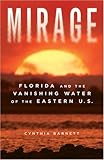
Cynthia Barnett. Mirage: Florida and the Vanishing Water of the Eastern U.S. Ann Arbor: University of Michigan Press, 2007. 240 pp. $24.95 (cloth), ISBN 978-0-472-11563-1; $18.95 (paper), ISBN 978-0-472-03303-4.
Reviewed by Christopher J. Manganiello (University of Georgia)
Published on H-Water (December, 2008)
Commissioned by Justin M. Scott-Coe (Monte Vista Water District; Claremont Graduate University)
The East Becomes the West: Water, Money, and Conflict
Anybody interested in water resource management or environmental history, particularly in the southern United States, will want to read this book. Cynthia Barnett covers a lot of ground to argue why the eastern United States faces a future defined by water scarcity and water wars. Florida's freshwater supply and those who speak for it--the politicians, environmentalists, water management districts, multinational water bottlers, and ever-present real estate developers--dominate this book. Additionally, Barnett's book is an extremely useful primer for more recent water scarcity issues in other eastern states. In all cases, the states have or are negotiating the same illusionary Mirage that couples rampant economic growth with a presumed inexhaustible water supply. With a journalist's eye, Barnett's political environmental history places Florida at the center of water management in the eastern United States as critically as Marc Reisner did for California and the American West in Cadillac Desert: The American West and Its Disappearing Water (1986).
Barnett, a Florida Trend magazine reporter, details the long history behind the creation of Florida's Mirage beginning with Ponce de Leon's fifteenth-century mythical search for a Fountain of Youth. But our more recent national water supply and management confusion, and Barnett's source for regional differentiation, can be traced to John Wesley Powell's 1876 decision to divide the arid American West from the humid East at the 100th meridian. Powell, and legions of his followers, assumed that the region west of this line would require irrigation to sustain human survival, but the eastern region would not. As a result, historians and casual observers have often told western water history as a story about water scarcity and irrigation delivery, while a southern story like Florida's has often focused on too much water, expedient drainage, and flood control. Barnett goes to great lengths throughout the succeeding chapters to illustrate why this stark distinction has broken down in the late twentieth century.
Twelve short chapters cover many interconnected topics from explosive population growth (Florida increased by one thousand people per day in 2006) to state sponsored marketing campaigns to spur in-migration. Barnett chronicles Florida's legislative attempts to mediate real estate development, environmental damage, and water supply to demonstrate why the state is a worthy case study of the eastern United States. Since statehood in 1845, Florida's leaders have given private developers the green light to drain or reclaim the state's extensive wetlands for agricultural and commercial development. These measures began as private endeavors, and, over the course of the twentieth century, became the shared responsibility of real estate developers, federal agencies like the United States Army Corps of Engineers, and state water management districts. Barnett links all these topics and others, including how drainage contributes to Florida's changing climate, to issue a stark warning about the state's precarious water supply. When humans drain wetlands and droughts intensify, consumption demands require sustained aquifer pumping. But all of this twentieth-century human and environmental activity limits an aquifer's ability to recharge and enables saltwater to seep into areas formerly occupied by fresh water, thus contaminating the source.
Other eastern regions and states enter the narrative, but Mirage is primarily about Florida and freshwater pumping from the region's extensive underground Floridian Aquifer. While many eastern states have experienced or are embroiled in water supply conflicts, most similarities end there. As Barnett demonstrates, the challenges and needs of watersheds--such as the internationally shared Great Lakes basin, or Maryland and Virginia's conflict over the Potomac River--will entail specific solutions. For example, Georgia, Alabama, and Florida gained national attention in 2007 for their collective dispute over water flows released from the Army Corps' Buford Dam and Lake Lanier into the Chattahoochee River--"the hardest-working river in America" (p. 114). Barnett points out that the distance between metro-Atlanta (about four million people in ten counties) and the Chattahoochee's headwaters that supply the city's water--less than seventy linear miles--is shorter than in any other place in the United States.
But another comparison worth mentioning, and one that Barnett does not entirely flesh out, is that the Great Lakes and Florida regions manage a natural water supply above and below ground. The Southeast, barring Okeechobee and a few coastal lakes, has no natural lakes, not even in the southern Appalachians. Many southeastern upstate cities like Atlanta rely on river flows and above ground storage in the region's numerous and massive artificial "lakes" built after 1945 primarily for power production, flood control, and navigation purposes. Like all of the regions Barnett discusses, other water supply stressors--recreation, municipal customers and the emergent urban-agriculture lobby, swimming pools, irrigation, downstream coal and nuclear power plants, and endangered species--place new demands on these structures for which they were not entirely designed. Southern reservoirs--like their more arid counterparts west of the 100th meridian--are entirely human creations. The Great Lakes and the Floridian Aquifer have contained a natural water supply for centuries, while the Chattahoochee River's massive federal dams, artificial water supply, and associated explosive regional growth has only occurred in the last fifty years. Mirage makes clear that no part of the water cycle is isolated. Yet, each state deals with different water supply issues, from overconsumption and pollution to flooding and drought. Accordingly, each region and watershed will require very different solutions since no single solution can fix all water supply problems.
Barnett does, however, offer many realistic solutions for Florida that are generally applicable to other regions grappling with water supply and demand. Certainly watershed restoration--such as the Comprehensive Everglades Restoration Plan and the Army Corps of Engineer's program to dismantle dams and canals--will enable water to move more freely across all waterscapes and naturally recharge ground water supplies. To control rampant real estate development and population growth, Barnett recommends tough development and planning laws with uniform and stringent enforcement by all involved agencies. For those living in areas affected by water scarcity, Barnett issues a call for personal conservation and evaluation: Do consumers really need green lawns, blue swimming pools, crystal-clear bottled water, and other highly consumptive water-related services? Lastly, Barnett cautions against a steadfast American reliance on new technologies--such as aquifer injections and desalinization--to rescue water-strapped cities.
Mirage is a much-needed addition to the history of water supply and management, not only for Florida and the eastern United States but also for the American South. The eastern United States as defined by this book has experienced multiple and major shifts in population and industry from the northern Rust Belt to the southern Sunbelt. As Barnett illustrates, the Southeast has consistently ranked among the nation's fastest growing regions since 1945, and the region's waterscape has without fail played a major role in these transformations.
If there is additional discussion of this review, you may access it through the network, at: https://networks.h-net.org/h-water.
Citation:
Christopher J. Manganiello. Review of Barnett, Cynthia, Mirage: Florida and the Vanishing Water of the Eastern U.S..
H-Water, H-Net Reviews.
December, 2008.
URL: http://www.h-net.org/reviews/showrev.php?id=23145
 | This work is licensed under a Creative Commons Attribution-Noncommercial-No Derivative Works 3.0 United States License. |

