



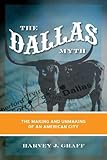
Harvey J. Graff. The Dallas Myth: The Making and Unmaking of an American City. Minneapolis: University of Minnesota Press, 2008. xxviii + 388 pp. $34.95 (cloth), ISBN 978-0-8166-5269-3; $34.95 (cloth), ISBN 978-0-8166-5270-9.
Reviewed by Emily E. Straus
Published on H-Urban (November, 2008)
Commissioned by Sharon L. Irish (University of Illinois Urbana-Champaign)
Deconstructing Dallas
Dallas is a city with no history--or at least that is what city boosters and leaders have asserted. In his thorough new examination of the ninth-largest American metropolis, Harvey J. Graff lays out how Dallas leaders have “obliterated and denied” (p. xxii) their own past and instead have created what Graff deems “the Dallas myth.” This myth arose from leaders’ portrayals of the city as a place with no past and, more importantly, with no limits. Graff argues that leading Dallasites embraced and perpetuated this view in order to free the city of the “constraints of place and the past” (pp. xxii-xxiii). As a place with no past (at least until that past became a marketable entity), Dallas had the remarkable ability to be sold continually as a “new city.”
Graff correctly asserts that while myths are often ahistorical, they are constructed, and reconstructed, in specific historical contexts. Therefore, to understand how, when, why, and by whom the myth was constructed helps to explain a moment in time. Exploring the process of myth-making is not futile for it sheds light on Dallas’s history.
The Dallas myth created problems for many of the city’s residents. Graff argues that the rejection of the past obfuscated the deep divisions between what he calls the two Dallases, one rich and predominantly white, and the other poor and populated by people of color. City leaders seized the power of the myth while shaping their local education and cultural institutions, workings of urban governance, and major physical development and redevelopment projects. As a result, they could justify ignoring a large segment of the population as well as a large spatial segment of the city.
Unmasking this myth is one of the two interconnected tasks that Graff sets forth in his work. The second challenge is an “experiment in historical thinking, interpretation, and writing” (p. xxii). The Dallas Myth is not meant to be picked up as a reference book about Dallas (though it has two extremely useful appendices which carefully outline Dallas’s historical development). Instead, the book is meant to challenge Dallas historians to examine the messiness of the city’s history. At the same time, his experiment reaches beyond Dallas historians to all scholars as he challenges the reader to reconsider how one approaches an historical topic.
These two interlocking goals shape the structure of the book, which is split into two parts: “Searching for Dallas” and “Understanding Dallas.” The first part examines and deconstructs the Dallas myth and lays out a series of ways to revise the historiography of the city. The second part, which reconstructs the city’s past, seeks to set the record straight on a variety of historical topics, such as the geographic, racial, and economic divisions in the city; the development of historical monuments in the city; and “the Dallas Way,” through which elites openly and unabashedly ruled Dallas. Graff explores how Dallas was established and how it grew. Dallas leaders built their city through big business’s “stealth and purchase,” “denial” of its past and present realities, “imitation” of other cities’ plans and models, and by creating a monumental skyline while ignoring essential infrastructure. Here Graff is at his finest as he carefully outlines the workings of the city’s political and social elite building and ruling their city in a manner akin to an urban political machine.
Graff employs an interdisciplinary approach to illuminate these wide-ranging topics. A professor of English and history, Graff’s disciplinary roots are on display as he tackles his subject. In order to understand the metropolis’s urban and social history, Graff looked to “read” the city itself as text. He examines the images and ideas that circulated in Dallas and connects those ideas to how city leaders made policy decisions. Graff argues that, in the minds of most Americans, three iconic images have come to define the Dallas metropolis: the television show titled after the city; the Dallas Cowboys football team; and the assassination of John F. Kennedy. Graff examines how leaders used or refuted these iconic images in planning for the future. But Graff is interested not only in the cultural production associated with the city; he also connects these images to the city’s socio-geographic landscape, which he carefully dissects. Through his analysis Graff demonstrates how Dallas was fragmented both on the ground and in the imagination.
Bridging different disciplines and covering such a wide range of information and variety of topics, Graff does not write a straight historical narrative, or follow a chronological line, but rather uses the chapters as semi-separate entities. As with any approach, there are gains and costs associated with the methodological and organizational decisions, however. Graff’s experiment challenges the reader to consider how we structure history books. While showing how myth-making frames how one thinks of a place, Graff also reveals how historical writing similarly shapes how we consider a subject. In doing so he offers an alternative mode of writing history. This approach causes some repetition throughout the book that could have been avoided with a more traditional narrative structure.
To build his argument about myth-making and its role in writing and masking history, Graff employs a wide variety of sources. He delves into traditional historical sources, such as newspaper articles, and he analyzes aspects of popular culture, such as the widely read and hugely controversial autobiography of former Dallas Cowboy player Peter Gent, North Dallas Forty (1973). While this examination of mostly local sources helps construct the picture of how Dallasites created their own history and their own image, an exploration of national sources may have further illuminated how the myth was perpetuated across the country.
Graff’s book will be of interest to urban historians, especially those who study how individuals shape their cities. He not only unmasks Dallas’s myth but also gives insight into the how historical memory is created. Graff shows the interconnectedness of popular culture, architecture, politics, business, and money, and he illustrates how together these created the Dallas of today. Only by understanding the myth and untangling the web of factors that created and upheld it, do we begin to understand Dallas’s past, present, and future.
If there is additional discussion of this review, you may access it through the network, at: https://networks.h-net.org/h-urban.
Citation:
Emily E. Straus. Review of Graff, Harvey J., The Dallas Myth: The Making and Unmaking of an American City.
H-Urban, H-Net Reviews.
November, 2008.
URL: http://www.h-net.org/reviews/showrev.php?id=23121
 | This work is licensed under a Creative Commons Attribution-Noncommercial-No Derivative Works 3.0 United States License. |

