

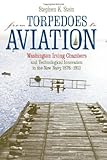
Stephen K. Stein. From Torpedoes To Aviation: Washington Irving Chambers and Technological Innovation in The New Navy, 1876-1913. Tuscalousa: University of Alabama Press, 2007. viii + 255 pp. ISBN 978-0-8173-1564-1.
Reviewed by Robert Moss
Published on H-War (December, 2008)
Commissioned by Janet G. Valentine (U.S. Army Command and General Staff College - Dept of Mil Hist)
Reform and Innovation in the US Navy, 1876-1913
Dr. Stephen K. Stein teaches history at the University of Memphis and is an adjunct professor at the U.S. Naval War College, College of Distance Education. His curriculum vitae touts his expertise in the fields of military, diplomatic, and twentieth-century history, with a strong list of published chapters, articles and papers to support the claim. His recent publications focus on late nineteenth- and early twentieth-century developments affecting the U.S. Navy, with particular emphasis on the activities of Captain Washington Irving Chambers. That trend culminates in this title, his first full-length book, and the only Chambers biography available. The book, Stein's resume, and his schedule of classes clearly show his interest in the U.S. Navy and the changes that occurred within it during that period. From Torpedoes to Aviation illustrates the growth of the U.S. Navy from a mediocre regional police force with little real capability to influence other nations, to a world power with rapidly growing capacity to implement foreign policy--all through the lens of an officer who helped to drive those changes. As a biography and as a glimpse of how bureaucracies change over time, it is a laudable work.
As a young lieutenant (junior grade), I was stationed at Chambers Field in Norfolk, Virginia. I knew that Captain Chambers had been the father of naval aviation. He spent the final years of his career championing the role of aircraft in naval service. That portion of his life is familiar to nearly every navy, Marine Corps or Coast Guard aviator who spent the formative years of their career in and around Naval Air Station, Pensacola. Yet, the remainder of this remarkable officer's career is equally impressive and remains largely unknown. Stein uses Chambers's papers in the Library of Congress to paint a vivid and remarkably accurate professional picture of this officer, and the time in which he served. This book is a welcome addition to the literature for any student of U.S. naval history, and serves to build a framework for the era in which naval power in the United States came of age. As a naval aviator, I also relish the fact that this work comes to me just as the navy begins plans to celebrate the centennial of naval aviation, a warfare community that has moved from an afterthought under the command of Washington Irving Chambers, to the backbone of the modern navy's ability to project power on behalf of the United States. Please forgive me if that bias shows in my review.
Stein's book is well laid out in a series of vignettes about Chambers’s time as a navy man. It opens with his application, acceptance and entry into the U.S. Naval Academy and follows the major blocks of his career, with a chapter devoted to each. The early chapters focus on Chambers's desire for adventure which led him to Latin America, the Arctic, and even Europe. Slowly, his focus shifted toward improving the navy as he worked his way through the Office of Naval Intelligence, the Naval War College, the Torpedo Station, and several ships, before finally achieving a command of his own. Ultimately, the author focuses on Chambers’s attempts to drag the navy into the future--tactically, technologically, and operationally. The book closes, as does Chambers’s career, with his efforts to build naval aviation into a meaningful community within the U.S. Navy with sound leaders willing to take on the charge after him. The progression is largely linear, but not entirely so, with overlaps in the timeline from one chapter to the next. Initially I found this distracting, but realized quickly that it allowed Stein to explore the effect each of these broader sets of events had on Captain Chambers, and how they served to shape his ideas and passions as he rose through the navy's ranks. This division also lets Stein better illustrate the conflict between navy leadership and the younger officers, Chambers among them, who were demanding change in an organization devoted to tradition.
Admiral Alfred Thayer Mahan recruited Lieutenant Chambers as a member of the Naval War College's first permanent faculty. His reputation as a seaman, an officer, a technophile, and an intellectual seems to have opened that door for him. Stein points to this period as one in which Chambers saw his chance to make a mark on the future of the navy. He held strong opinions on the application of technology and the importance of education in an officer's career. Chambers’s willingness to challenge established principles and the officials who espoused them came to a crescendo. He was even willing to disagree openly with his mentor Mahan, whose protective mantle saved him more than once from committing the career equivalent of suicide. The author also shows the development of Chambers’s capacity for reasoned diplomacy, and his recognition that it might serve his true desires better to temper his approach to changing the navy. At this point, Chambers also began to realize that there were two groups of change-oriented officers at work in the navy. Stein calls them the "institutional reformers and technological innovators" (p. 201). The two were on complementary paths, but their approaches were often as much at odds with each other as with the institution they hoped to modernize.
Chambers seems to have been both reformer and innovator. Throughout his time as a junior officer, which lasted considerably longer in that navy than it does in the U.S. Navy of today, Chambers took great pride in his seamanship on sailing vessels. He excelled at both deck and engineering duties, with the capacity to oversee either equally well. During his time at the New York Navy Yard, Lieutenant Chambers proposed, oversaw, and enacted significant changes in the way that organization did business on a day-to-day basis. His reforms improved the performance of that yard significantly and helped to shape reforms throughout the navy's shipyard system. Chambers, also a devotee of technology, designed torpedoes, coal-handling systems, guns, and even battleships. He developed tactics to exploit new technologies, and integrated them into the navy's doctrine and training. Although higher-ups dismissed many of his designs and innovations, he continued to pursue improvement through technology at every opportunity.
Stein offers excellent insight into Chambers’s capacity to persevere in the chapter entitled "Torpedoes and Dreadnoughts." Chambers designed an all big gun battleship with twelve large caliber guns in twin turrets, and arranged for that design to be tested in war games at the Naval War College. His design performed well in those tests, but building to his design specifications proved a very challenging endeavor. Many in power in the navy at that time did not agree with Chambers’s desire to eliminate smaller weapons and dedicate battleships to big guns alone. Nevertheless, Chambers pursued the idea doggedly, but diplomatically, eventually arriving at a compromise in the construction of a ship with eight twelve-inch guns and less displacement than Chambers’s original design. Ironically, the United Kingdom and Germany then built ships similar to what Chambers had proposed. In his accounts of such events, Stein plainly demonstrates the depth of his research.
I found only one shortfall in this biography. While it offers a wonderful idea of who Washington Irving Chambers, the naval officer, was, it gives very little insight into the person he was outside of the navy. Stein writes briefly about a romantic interest in his early career, but accounts of his subject’s personal life receive no more than a sentence or two. Chambers’s marriage earns a simple paragraph at the end of a section in his chapter on the Naval War College. That same paragraph also includes the only mention of his one child. Perhaps Chambers’s writings did not include sufficient information to build a personal picture, but it would have been a nice addition.
Stein obviously spent a great deal of time with, and gave considerable effort to, understanding the personal papers of Captain Chambers. The short period I spent at the Library of Congress with this collection rendered any doubts of that impossible. His references to specifics within Chambers’s writings always checked out, and having seen the writings that Stein waded through in producing this biography, I can only offer my thanks. Without his efforts, the specifics of an important contributor to U.S. naval history would still be unknown. I do not know of any other work that even begins to cover the life of Washington Irving Chambers, despite his contributions to modernizing the navy at the turn of the twentieth century. This short biography scratches the surface of an era and subject matter that would benefit from far more in-depth coverage. I sincerely hope Stein will continue to write on this period in the U.S. Navy.
From Torpedoes to Aviation is a well-written, solid biography of an otherwise little-known U.S. Navy officer. The prose is easy to follow and interesting, as is the format of the book. Reading this work was a pleasure. Stein's book is an excellent step toward better understanding of an important period in U.S. naval and military history. As his work is the first to tackle the ideas and accomplishments of Chambers, this area is wide open for further exploration. Each of Stein’s chapters offers an opportunity for students of the era to explore further. He deserves our thanks for opening the door.
If there is additional discussion of this review, you may access it through the network, at: https://networks.h-net.org/h-war.
Citation:
Robert Moss. Review of Stein, Stephen K., From Torpedoes To Aviation: Washington Irving Chambers and Technological Innovation in The New Navy, 1876-1913.
H-War, H-Net Reviews.
December, 2008.
URL: http://www.h-net.org/reviews/showrev.php?id=23103
 | This work is licensed under a Creative Commons Attribution-Noncommercial-No Derivative Works 3.0 United States License. |

