



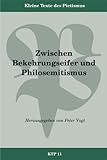
Peter Vogt. Zwischen Bekehrungseifer und Philosemitismus: Texte zur Stellung des Pietismus zum Judentum. Kleine Texte des Pietismus. Leipzig: Evangelische Verlagsanstalt, 2007. 128 pp. $23.00 (paper), ISBN 978-3-374-02456-8.
Reviewed by Lucinda Martin (Center of Excellence "Enlightenment-Religion-Knowledge," Martin-Luther-Universität Halle-Wittenberg)
Published on H-German (April, 2009)
Commissioned by Susan R. Boettcher
Pietism and Judaism: A Little-known Chapter in German-Jewish Relations
This small anthology highlights a little-known but fascinating aspect of the long and complex history of German-Jewish relations, namely the obsession of seventeenth- and eighteenth-century pietists with Judaism. The editor of this volume, Peter Vogt, has put together a wide sampling of pietist texts on Judaism, from radical pietist prophecies addressed to Jews, to Lutheran pietist schemes for the conversion of Jews, to a Moravian (Herrnhuter) cantata blending Jewish and Christian traditions, written for the wedding of a couple who had converted from Judaism.
Pietists accorded Jews a special place in God's plan, and especially in the final judgment. Believing that their world would soon be coming to an end, pietists interpreted the wars, plagues, and economic convulsions of their time as the first signs of an imminent apocalypse and final judgment. Pietist interpretations of biblical passages about the "Last Days" led them to conclude that Jews would convert en masse to Christianity before the return of the Messiah. As a consequence, pietists who wanted to hasten the establishment of God's kingdom on earth pursued the conversion of Jews.
The majority of texts in the volume thus treat the conversion of Jews in one way or another. Some texts address Jews directly, calling for them to "repent," but most reach out to a pietist audience of potential missionaries. One of the most interesting texts calls on nobles and regents to aid the conversion of Jews by improving conditions for Jewish communities. Philipp Jakob Spener, often seen as the "father" of Lutheran pietism, maintains that the low social status of Jews causes them to resent Christians and is therefore a barrier to conversion. He argues that many of the problems in Jewish communities arise from the fact that Jews were forbidden to carry out many of the professions, leading to poverty and boredom. Rather than calling for the lifting of such bans, however, Spener proposes that rulers allow Jews to settle remote, sparsely populated areas where they could work the land to earn an "honest" living.
The main thrust of Spener's essay is that the biggest hurdle for conversions is hatred and distrust between Jews and Christians. He urges that regular people build friendships with their Jewish neighbors, not with the purpose of converting them, but simply because this should be good Christian practice. Rulers could help, Spener writes, by forbidding preachers to stir up hatred against Jews from the pulpit and also by requiring Christians to keep the Sabbath and generally live more disciplined lives. Indeed, nearly every author in the volume bemoans the sorry state of contemporary Christianity and the "bad example" it sets for Jews and "heathens" who might otherwise be led to convert. Many of the authors in this edition make clear that they see a greater affinity between themselves and observant Jews than with so-called Schein-Christen, "false Christians," who do not live up to the pietists' strict standards.
Spener and other Pietists represented in this volume vehemently reject the use of violence against Jews, either to threaten them into conversion or even to force them to listen to sermons--both common practices in Europe at the time. Many of these pietist authors contend that Jews should be allowed to retain their own traditions, and they hatched various plans for how such a fused Christian-Judaism might look. Pietist insistence that Jews not be coerced to do anything against their consciences is surely an impulse toward enlightenment and modernity. Yet, other aspects of pietist thinking about Judaism are far from progressive. Nearly every text deplores the poverty and persecution of Jews, but explains it as God's "punishment" of a disobedient people. Several of the texts promise Jews that "repentance"--including embracing Christianity--would put them back in favor with God, who would then reward them with prestige and prosperity. In other words, according to these texts, Jews are themselves to blame for the persecution against them and only they can end it.
At the same time, pietists believed that they, together with Jews, were meant to play a key role in a divine universal plan. They alternately referred to themselves and to Jews as God's "chosen" people or "Zion," and many of their texts tried to explain the relationship between pietists and Jews. Nicolaus Zinzendorf, for example, saw both groups as different "herds" in the "barn" of the same "shepherd," and he tried to establish a group of converted Jewish-Christians within the Herrnhut tradition. A number of the texts in this volume also mention that Jesus and the Jews are "blood relatives," but not "spiritual kin." Some pietists even believed that the Messiah would return as a baby born of a Jewish woman. Awareness of these issues is certainly relevant to scholars of German-Jewish cultural relations.
Pietists were also fascinated with the Jewish cultural heritage--albeit always through the lens of chiliasm. They stressed the study of ancient biblical languages and some became great scholars of Hebrew. Several texts in the volume bristle with Hebrew citations, not only from the Hebrew scriptures, but also from contemporary rabbis and from the "Talmud,"--not usually the Talmud per se, but rather kabbalistic texts, which seemed to pietists to share many traits with pietist mystical texts. Halle pietists also directed a number of publications in Hebrew and in Yiddish to a Jewish audience.
The editor states that this collection is but a small selection and that he had to omit many interesting texts. The most obvious omission is the lack of texts by women authors. A number of influential and prolific female authors wrote pietist texts on Judaism, often bringing an added gender perspective by justifying women's writing through the words of Paul, that there is "neither Jew, nor Greek, slave nor free, male nor female, for you are all one in Christ Jesus" (Galatians 3:28). Instead of including two texts by Johann Wilhelm Petersen, the volume might have included at least one by his wife and partner in radical pietist causes, Johanna Eleonora Petersen, who also wrote extensively on the relationship between Jews and pietists. This objection notwithstanding, the volume provides a good starting point for anyone wishing to become familiar with the range of pietist thought on Judaism. The texts are rife with biblical references and obscure pietist language, which may bewilder those unaccustomed to such texts. Vogt's commentaryis extremely helpful in this regard and his afterword includes a concise overview of the scholarship on pietism and Judaism. Vogt's edition makes clear that much remains to be done on this intriguing aspect of German-Jewish history.
If there is additional discussion of this review, you may access it through the network, at: https://networks.h-net.org/h-german.
Citation:
Lucinda Martin. Review of Vogt, Peter, Zwischen Bekehrungseifer und Philosemitismus: Texte zur Stellung des Pietismus zum Judentum.
H-German, H-Net Reviews.
April, 2009.
URL: http://www.h-net.org/reviews/showrev.php?id=23094
 | This work is licensed under a Creative Commons Attribution-Noncommercial-No Derivative Works 3.0 United States License. |

