



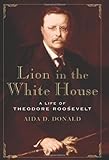
Aïda DiPace Donald. Lion in the White House: A Life of Theodore Roosevelt. Basic Books, 2007. xvi + 287 pp. $26.00 (cloth), ISBN 978-0-465-00213-9.
Reviewed by Douglas Craig
Published on H-SHGAPE (November, 2008)
Commissioned by James Ivy
Great White Wonder: Theodore Roosevelt and the General Audience
Aïda DiPace Donald's Lion in the White House is the latest addition to a long list of biographies of Theodore Roosevelt, which David Traxel has recently described as "a genre in itself."[1] Inevitable questions arise as to whether we need another biography of Roosevelt, and what Donald's addition adds to its predecessors and competitors. Donald is the former editor-in-chief of Harvard University Press and has worked at Hill and Wang. She, therefore, knows the publishing industry very well, and Lion in the White House shows that her knowledge of her subject is deep. Donald's answers to the inevitable questions are implied rather than explicit, and their plausibility depends in large part on an assessment of what her intended readership requires in a good "popular history."
Donald's book is a model of conciseness. In 265 pages, attractively presented in an open font and with many illustrations, Donald provides an effective narrative of Roosevelt's eventful life. Lion in the White House is directed squarely at general readers. It lacks even the basics of academic history's customary superstructure of bibliographies, historiography, and notes. Donald's brief discussion of her sources, hidden away in her acknowledgments, declares that the book is based "almost entirely" on "the abundant printed primary and secondary sources on Theodore Roosevelt and his era" (p. 267). These seem to be limited to published collections of Roosevelt's letters and writings, along with their editors' essays. Secondary works by Edmund Morris, Nathan Miller, H. W. Brands, and Kathleen Dalton are name checked, followed by a catchall reference to "dozens of books on numerous aspects of Roosevelt's life and times that provide insight" (p. 268). She does not identify these works further, and this is all the bibliographic assistance that Donald provides. Because there are no notes, there is no way for a reader, academic or general, to investigate further specific issues or ideas, to confirm Donald's interpretation of them, or even to check the accuracy of her quotations. She sometimes mentions authors in the text, and sometimes not. She quotes "one historian" about Roosevelt's first wife Alice Hathaway Lee, but offers no indication as to who that historian is and no way for a reader to find out (p. 32). All readers, inside and outside academe, deserve better than this.
Lion in the White House is not hagiography; many of Roosevelt's faults and mistakes are noted. Donald deals effectively with his intolerance and bitterness after 1912, as well as his periodic outbursts of rage, jealousy, and attention seeking behavior that punctuated his adult life. Yet, she notes rather than explore Roosevelt's faults. While emphasizing Roosevelt's adoration of Abraham Lincoln, Donald makes far less of his intellectual and political debts to eugenics, racism, nativism, and militarism. By brushing off the faults and playing up the virtues in her subject, Donald is all too ready to forgive Roosevelt's failings while rushing to celebrate his triumphs.
Donald structures her book to devote only three chapters and one hundred pages to Roosevelt's White House years. That leaves plenty of space for an account of Roosevelt's pre-presidential career from his youth in Manhattan and at Harvard until his election as vice president in 1900. Donald devotes a long final chapter--entitled "Too Much Fame"--to Roosevelt's post-White House life, but her coverage of those years is rushed and less surefooted than the rest of the book. There is too much material--Roosevelt's safaris to Africa and Brazil, his break with William Howard Taft, his tilt at the 1912 GOP nomination, his campaign at the head of the Progressive Party, his attempt to win the Republican nomination in 1916, his views on Woodrow Wilson and U.S. foreign policy after August 1914, the death in uniform of his son Quentin, and his final illnesses--to be covered adequately in thirty-four pages. Donald's determination to write a short biography of a life full of action and ideas forces her to make hard decisions about her material, and these lead her to rush through the last years of Roosevelt's life.
The earlier parts of Donald's book are more effective. She provides a careful and evocative treatment of Roosevelt's upbringing amid privilege and snobbery, and then provides a very useful treatment of his early political career in the New York State Assembly, as civil service commissioner, New York City police commissioner, and assistant secretary of the navy. These steps along an active political career path between 1881 and 1897 are adeptly, but largely uncritically, described in fluid and clear prose. Donald describes Roosevelt's deeds better than his motives; under her treatment, Roosevelt's ruthless ambition to succeed is too often subordinated to more elevated ideas of reformism and civic obligation.
Donald also provides a careful, but again unquestioning, account of Roosevelt's family life. As the adored eldest son of a dominant father who avoided Civil War military service and an unreconstructed Confederate mother, Roosevelt had a conflicted background. His tragically short first marriage brought forth an emotional crisis, but Donald understates its depth and significance. Although her account is mercifully free of the heavy-handed and amateur psychoanalytical approach that has marked and marred so many of Roosevelt's biographies, Donald's account tends to the other extreme. Her account of Roosevelt's emotional traumas and extreme reactions is bland and incapable of fully accounting for their significance. Roosevelt wore his emotions on his sleeve and used them to win popular fame and political capital, but Donald devotes neither much space nor deep analysis to them.
Lion in the White House offers a more thematic treatment of Roosevelt's political career after 1897. Under Donald's analysis, Roosevelt was Lincoln's successor and Franklin Delano Roosevelt's precursor. When he assumed the presidency in 1901, Donald maintains, his nation and his party had a golden opportunity for a new and better future. "In nothing less than a revolution, Roosevelt would make reform and character, which had been the polestars of his hero, Abraham Lincoln, acceptable once more to the Republican Party. The new president never doubted that progressive Republicans were Lincoln's heirs, and he would use the martyr's heritage to exhort, challenge and change the nation. He would be midwife to a new birth of Republicanism" (p. 130). The key theme of Donald's treatment of Roosevelt is that he attempted, but ultimately failed, to create a new Republican Party that was less beholden to plutocratic economic forces and more attuned to the broader demands of a rapidly industrializing and diversifying society. In this, Donald implicitly criticizes the GOP and its past and current conservatism, and portrays Roosevelt as its great lost opportunity to transform itself into something less selfish, less class bound, and more liberal. "Roosevelt's legacy was enormous," she argues, but it was deeply ironic. "It found a home, a generation later, in his cousin Franklin Roosevelt's Democratic Party" (p. xv).
Donald's attempt to transform Roosevelt into a proto-New Dealer provides a clear structure for her treatment of his presidency, but will cut little ice with academic historians. Because she does not engage with any secondary literature, Donald's judgments are neither contextualized nor problematized. She baldly notes that Roosevelt, like Lincoln, "would always be color-blind and guided by the tenet of equality," and then cites Roosevelt's famous dinner with Booker T. Washington in the White House (p. 72). "'I shall have him to dine as often as I please,'" Roosevelt declared, but never did so again (p. 139). In 1906, Roosevelt handed out summary and collective punishment to 106 African American soldiers at Brownsville, Texas, and in 1912, his Progressive Party platform and candidacy were so unhelpful to African Americans that many supported Wilson's Democrats instead. Just how all these events can be fitted into a coherent analysis of Roosevelt's racial views and policies is left unexplored. The same criticism can be leveled against Donald's treatment of Roosevelt's foreign policy, which she also leaves unproblematized, because of her avoidance of the huge body of secondary literature that explores the meanings, ambiguities, and implications of Roosevelt's interventionism. In these and other issues, Donald's readers are informed about the bare narrative but left almost completely ignorant of their place within historical analysis and competing notions of historical meaning and significance.
Academic historians, in short, will find little that is new and much that is irritating about Lion in the White House. That is not surprising, because this book is not written for them. Instead, it aims for those who are described as general readers. The great fault of Donald's book is that it sells that intended readership short. Writing for a general audience should not mean writing down to it. Convoluted historiographical discussions, endless bibliographies, and intricate notes are easily dispensable for a nonacademic readership. Subtle and inclusive analysis, however, is essential for any work of scholarship with a story to tell.
Note
[1]. David Traxel, "Writing Progressive Era History for Trade Publication," The Journal of the Gilded Age and Progressive Era 7, no. 2 (April 2008): 253-258, quotation on 255.
If there is additional discussion of this review, you may access it through the network, at: https://networks.h-net.org/h-shgape.
Citation:
Douglas Craig. Review of Donald, Aïda DiPace, Lion in the White House: A Life of Theodore Roosevelt.
H-SHGAPE, H-Net Reviews.
November, 2008.
URL: http://www.h-net.org/reviews/showrev.php?id=23057
 | This work is licensed under a Creative Commons Attribution-Noncommercial-No Derivative Works 3.0 United States License. |

