



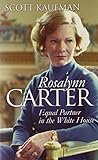
Scott Kaufman. Rosalynn Carter: Equal Partner in the White House. Lawrence: University Press of Kansas, 2007. xi + 206 pp. $29.95 (cloth), ISBN 978-0-7006-1544-5.
Reviewed by Jeannette Cockroft
Published on H-SAWH (November, 2008)
Commissioned by Antoinette G. van Zelm (TN Civil War Nat. Heritage Area Center for Historic Preservation)
A Southern First Lady Redefines the Role
Based on newly released documents from the Jimmy Carter Library, as well as interviews with Jimmy and Rosalynn Carter and a number of White House aides, Scott Kaufman’s narrative biography argues that Rosalynn Carter played an unusually active policy role in her husband’s administration. This expanded role of First Lady was emblematic of the personal and professional partnership the Carters have developed over the course of their marriage. However, these enhanced responsibilities of the First Lady were also quite controversial. Rosalynn Carter was not the first woman to redefine the role; Edith Bolling Wilson, Eleanor Roosevelt, and Betty Ford all transformed the role of First Lady. But Rosalynn Carter expanded the role in new ways within the context of a larger social dialogue on the place of women in American life. She was controversial for those who wanted a traditional personification of women as helpmates, and she was also controversial for feminists who thought her redefinition of the role of First Lady did not go far enough.
Eleanor Rosalynn Smith was the eldest of four children born to William Edgar Smith and Frances Allethea (“Allie”) Murray. Born in 1927 and raised in Plains, Georgia, in a middle-class family, Rosalynn was a bright, conscientious, albeit shy, student interested in both the world around her and the cultural opportunities beyond her hometown. In 1940, Rosalynn’s father died of leukemia; in the next year, her maternal grandmother died, and her maternal grandfather moved in with the family. Although the family was not impoverished, Rosalynn’s mother needed to work and Rosalynn became in many ways a surrogate parent for her three younger siblings and a source of advice and support for her mother.
Once in high school, Rosalynn began to work. Having her own income nurtured her sense of strength and independence. After graduation, she attended a nearby community college, Georgia Southwestern, in Americus, Georgia, and returned home on weekends. While a student, she fell in love with the brother of her high-school friend Ruth Carter. On July 7, 1946, Rosalynn Smith married James Earl “Jimmy” Carter Jr., who had recently graduated from the U.S. Naval Academy, and embarked on a career as a navy wife.
Rosalynn cherished the opportunities to become a strong, independent wife and mother. In 1953, the Carters had one of the two serious quarrels of their marriage when Jimmy decided to return to Plains to run the family’s peanut warehouse in the wake of his father’s death. Rosalynn was uneasy about being subjected to the meddling of both her own mother and her mother-in-law, "Miss Lillian" Carter, who had always believed Rosalynn was not a suitable mate for her son. However, those concerns quickly abated as the Carters struggled to save the family business. Rosalynn borrowed accounting texts to learn how to handle the finances of the business but was soon working in the warehouse itself as well, weighing peanuts alongside her husband and three sons. As Rosalynn Carter told Kaufman, she and Jimmy became partners in all aspects of life, and his confidence in her made her own confidence grow (p. 33).
They also became political partners. Both supported integration in the aftermath of the unpopular 1954 Brown v. Board of Education decision and both understood the social and financial risks they took in making that choice. Their political partnership was strengthened as Jimmy began to hold political office, first on the local school board and later as a member of the state legislature. As Jimmy spent more time away from home, Rosalynn continued to run the business and tend to the family; in her free time, she also contacted voters. She was an integral part of both the strategizing and the campaigning during her husband’s successful 1970 gubernatorial race.
By the time of the presidential campaign in 1976, the shy country girl uncomfortable with public speaking had been transformed into a competent and confident campaigner who had become one of her husband’s most valued political confidantes. Although awed by the possibility of being married to the most powerful man on earth, Rosalynn believed that Jimmy could win the presidency and that the two of them could create a more “caring society” (p. 35). Rosalynn was the one who urged Jimmy to run in every presidential primary. She also encouraged him to stay in the homes of as many supporters as possible, not only to stay close to the voters but also to save money. On a campaign trip to Florida, Rosalynn was the first to report flagging support for George Wallace; she was correct, and Jimmy Carter won that presidential primary. Because she was an equal partner, she was also willing to challenge her husband. She admonished him on the campaign trail not to flash the “V for Victory” sign because of its association with former president Richard Nixon; she also chided him for his use of the phrase “ethnic purity” in speaking to an African American audience (p. 28).
Once in the White House, Rosalynn was determined to pursue the agenda that she had focused on in Georgia and that she would continue to focus on during the post-presidential years. She believed her successes not only reflected well on her husband but also complemented his political agenda and enhanced his political support. Those issues included increased services for the mentally handicapped, aid to the elderly, volunteerism, childhood immunization, and passage of the Equal Rights Amendment (ERA). Despite the fiscal austerity of the mid-seventies, she was the first First Lady to have an office and staff in the East Wing. Although legally prohibited from chairing the President’s Commission on Mental Health, she served as the de facto chair of that commission. In order to garner government funding for the recommendations of the commission, Rosalynn Carter testified before Congress, only the second First Lady to do so. When she believed that Joseph Califano, secretary of health, education, and welfare, was obstructing the implementation of the commission’s recommendations, she successfully urged the president to replace him.
Rosalynn Carter had much less success in her advocacy of the ERA. By the time she became First Lady, thirty-four of the required thirty-eight states had ratified the amendment, and she campaigned tirelessly for its passage. In November 1977, she spoke at the National Women’s Conference. In 1978, she lobbied for the amendment’s passage in Illinois and issued a public statement in support of the amendment on Women’s Equality Day. Despite her efforts for equality, her anti-abortion stance alienated many feminists, who saw her work as simply an extension of her husband’s agenda. Moreover, the media encouraged the perception of Rosalynn Carter as a political dilettante without true commitment to any one issue. This, coupled with criticism in Washington DC of the Carters’ refusal to serve alcohol in the White House, resulted in an image of Rosalynn Carter as a conservative, traditional wife simply attempting to burnish the reputation of a failing president.
According to Kaufman, nothing could have been further from the truth. In addition to pursuing a domestic agenda fueled by her own wide-ranging interests, Rosalynn Carter played a significant foreign policy role in the Carter administration. One of the goals of the administration was to move beyond paternalistic relations with Latin America. To underscore the seriousness with which this goal would be pursued, President Carter sent his wife to seven Latin American countries in the early months of his administration. Although cautioned to avoid complicated, contentious issues, such as tariff negotiations, Rosalynn did deal with substantive policy concerns. She urged the Colombian government to cooperate with American efforts to eradicate the drug trade. The president did subsequently consult with his wife before authorizing financial assistance to the Colombians. In contrast, her efforts to dissuade the Brazilian government from accepting nuclear technology from the West Germans were unsuccessful.
Although Rosalynn never again traveled as the president’s envoy, she continued to influence his thinking on foreign affairs. She supported his efforts to relinquish American control of the Panama Canal by hosting a White House luncheon of influential Americans in hopes the guests would in turn lobby their senators in support of the Panama Canal Treaty. She later encouraged her husband to explore the possibility that his brother Billy’s contacts in Libya might be helpful in freeing the American hostages in Iran.
Kaufman has done a fine job of putting Rosalynn Carter’s work in historical context. The book includes both a bibliographic essay detailing available scholarship on the politics of the 1970s, including the Carter administration, as well as an essay exploring the public ambivalence about the role of First Lady. Accessible to a general audience, this book is a well-written and timely addition to the ongoing American conversation about the place of women in political life.
If there is additional discussion of this review, you may access it through the network, at: https://networks.h-net.org/h-sawh.
Citation:
Jeannette Cockroft. Review of Kaufman, Scott, Rosalynn Carter: Equal Partner in the White House.
H-SAWH, H-Net Reviews.
November, 2008.
URL: http://www.h-net.org/reviews/showrev.php?id=22924
 | This work is licensed under a Creative Commons Attribution-Noncommercial-No Derivative Works 3.0 United States License. |

