

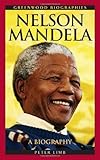
Peter Limb. Nelson Mandela: A Biography. Westport: Greenwood Press, 2008. xvi + 144 pp. ISBN 978-0-313-34035-2.
Reviewed by Steven Gish
Published on H-SAfrica (November, 2008)
Commissioned by Peter Midgley (University of Alberta)
A Concise Life of Mandela
Given the number of books published on Nelson Mandela in recent years, it is quite a challenge to write a new biography of the world’s most famous African and make a unique contribution at the same time. But Peter Limb has risen to the task. Limb, African studies bibliographer and associate professor (adjunct) of history at Michigan State University, has written a book on Mandela for the Greenwood biographical series, which was launched in 2003. Greenwood biographies are tailored for high school students and public libraries and cover a wide range of well-known personalities, including world leaders, writers, entertainers, and athletes. Limb's biography of Mandela is an excellent contribution to the series and deserves a wide readership.
In his introduction, Limb promises to present “a well-rounded, balanced view of Mandela set squarely in his time and place” (p. xii). He has more than fulfilled his promise. His account offers a good blend of biographical detail and historical background, personal and political coverage, and praise and criticism. It captures Mandela's significance in South Africa’s march to freedom without downplaying the contributions of others. While focusing on Mandela's role as a political leader, the book also discusses Mandela's family life. Limb describes the ups and downs of Mandela's relationship with Winnie and reveals the psychological toll that politics took on the Mandela family and on Mandela personally. The portrait of Mandela's tenure as South Africa’s first black president is particularly balanced. Limb praises Mandela's role in building a new nation and promoting democracy, but suggests that his pro-business bias prevented him from effectively addressing poverty and unemployment.
By interweaving Mandela's story with South Africa's, Limb helps readers understand the wider history of apartheid. He notes how Mandela's education and youth coincided with the growth of the black South African educated elite. Mandela's living conditions in Orlando (now part of Soweto) in the 1940s are described alongside the larger changes affecting black South Africans at the same time, such as urbanization and rising industrial employment. In chapter 5, “No Easy Walk to Freedom,” Limb links Mandela's rise to national leadership in the 1950s with the increasing severity of government policies and in so doing, offers a vivid portrait of apartheid. Chapter 8, “Free at Last,” discusses the factors behind Mandela's release from prison, such as international pressure (including sanctions), the end of the Cold War, the rise of F. W. de Klerk, and Mandela's own diplomatic initiatives.
In preparing this short biography, a less conscientious author could have relied on Anthony Sampson's work and Mandela's own autobiography [1], but Limb draws upon a wide array of primary and secondary sources, including interviews. In preparing chapter 7, “The Long Prison Years,” he consulted the latest research on Robben Island and incorporated the perspectives of other prisoners to put Mandela's experiences in context. Far from being a period of stagnation, Mandela's twenty-seven years in prison proved to be critically important in his struggle against racial discrimination, his contact with the outside world, and his efforts to end South Africa's political stalemate.
Limb's writing style is ideal for a general audience. His concise, digestible chapters present a vivid and compelling narrative. Quotations from Mandela and his contemporaries further enliven the account. By including some of Mandela's most stirring public statements, Limb captures the drama of Mandela's Rivonia trial and his inauguration as South Africa's first black president. Although Limb's writing is always clear, it is never oversimplified or shallow. His passages on Mandela's attitude toward communism, African nationalism, and nonracialism are nuanced, as is his discussion of nonviolence, which Mandela supported as a tactic, not an overriding philosophy. Limb shows that Mandela's positions could change over time as conditions in South Africa changed. At the end of each chapter, Limb highlights the main significance of particular periods in Mandela's life and foreshadows future developments, making the reader want to keep reading. He concludes by reflecting on Mandela's legacy and overall significance. As Limb notes, Mandela helped transform a bitterly divided land and led South Africa to freedom and democracy. In so doing, he became a worldwide symbol of “the endurance of the human spirit, of victory over evil” (p. 127).
Because Greenwood biographies have strict page limits, they inevitably move quickly over time and place. Readers of this biography might want to learn more about a number of issues--the circumstances surrounding Mandela's 1962 arrest; black consciousness and the 1976 Soweto unrest; and the controversies surrounding the Truth and Reconciliation Commission. However, the book's notes and bibliography direct readers to other sources should they wish to dig deeper. A timeline, a glossary of key terms, photographs, and an index are also provided.
Peter Limb's Nelson Mandela: A Biography is authoritative, balanced, up-to-date, and highly readable. It is now the most recent and concise biography of Nelson Mandela written by a specialist. The book will be useful not just for high school students, but for college and university students of world history, African history, and South African history. It would also be an excellent choice for general readers wanting an introduction to this worldwide icon of freedom. Greenwood is fortunate to have recruited such a fine author--and so are readers.
Note
[1]. Anthony Sampson, Mandela: The Authorized Biography (New York: Vintage Books, 1999), and Nelson Mandela, Long Walk to Freedom (Boston: Little, Brown and Company, 1994).
If there is additional discussion of this review, you may access it through the network, at: https://networks.h-net.org/h-safrica.
Citation:
Steven Gish. Review of Limb, Peter, Nelson Mandela: A Biography.
H-SAfrica, H-Net Reviews.
November, 2008.
URL: http://www.h-net.org/reviews/showrev.php?id=22904
 | This work is licensed under a Creative Commons Attribution-Noncommercial-No Derivative Works 3.0 United States License. |

