



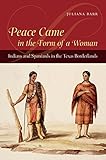
Juliana Barr. Peace Came in the Form of a Woman: Indians and Spaniards in the Texas Borderlands. Chapel Hill: University of North Carolina Press, 2007. 416 pp. $19.95 (paper), ISBN 978-0-8078-5790-8; $59.95 (cloth), ISBN 978-0-8078-3082-6.

Steven W. Hackel. Children of Coyote, Missionaries of Saint Francis: Indian-Spanish Relations in Colonial California, 1769-1850. Chapel Hill: University of North Carolina Press, 2005. xx + 476 pp. $59.95 (cloth), ISBN 978-0-8078-2988-2; $25.00 (paper), ISBN 978-0-8078-5654-3.

David J. Weber. Bárbaros: Spaniards and Their Savages in the Age of Enlightenment. New Haven and London: Yale University Press, 2005. xviii + 466 pp. $35.00 (cloth), ISBN 978-0-300-10501-8; $22.00 (paper), ISBN 978-0-300-11991-6.
Reviewed by Carla Gerona
Published on H-Atlantic (December, 2008)
Commissioned by Natalie A. Zacek (University of Manchester)
Is Borderlands History Ethnocentric?
The father of borderlands history, Herbert Bolton, called himself one of Turner's "boys" in homage to his professor Frederick Jackson Turner. But for the most part, neither he nor the first two generations of Boltonians (now fourth-generation removed) followed in Turner's American exceptionalist tracks. Like Bolton, many translated the works of Spanish explorers, missionaries, and bureaucrats, and wrote about them from a Eurocentric perspective in the context of European imperial contestation. This first generation of Boltonians did not feature Native American perspectives in their "Spanish" borderlands, although they knew a great deal about Native America. Bolton even wrote a Caddo ethnography, "Red Men of the Piney Woods," in 1907, but the monograph remained unpublished until 1987, when it appeared as The Hasinais, about the same time that new models highlighting Native American agency became central to Western history.[1]
Whereas these earlier borderlands scholars focused on Spaniards, "middle grounds" and even "Indian grounds" have become central concepts in more recent borderlands history. The three following must-reads of recent borderlands history, David J. Weber's Bárbaros, Juliana Barr's Peace Came in the Form of a Woman, and Steven W. Hackel's Children of Coyote, Missionaries of Saint Francis, strongly reflect this paradigm shift in the historiography. They also suggest that there is still more to learn about Spaniards on the borderlands. All three books are about regions where Indians were powerful--zones that the Iberian crown claimed, but did not always secure. Weber takes a comparative look at Spain's southern and northern frontier during the Bourbon Era, especially the 1790s; Barr analyzes Indian and Spanish relations in Texas from the 1680s to the 1780s; and Hackel measures the colonial impact on California Indians around Monterey from 1769 to 1850.
While all of the authors are interested in European-indigenous dynamics, all approach their analysis in unique ways, partly because they study discrete (though sometimes overlapping) places, but mainly because of distinct methodological and theoretical groundings. Weaving together recent findings in intellectual and social history, Weber suggests that Spaniards put Enlightenment ideas to work on their frontiers. Drawing on insights from gender studies, Barr uncovers the significant role that kinship and gender played in early encounters. Inspired by demographic reconstructions in European historiography, Hackel analyzes church records to reconstitute the community around mission San Carlos Borromeo (Carmel Mission). Each of these unique approaches yields fresh insights into the Spanish and Indian borderlands, places closely connected to, if sometimes seen as on the margins of, the Atlantic world.
Like so many of the subjects that inhabited these borderlands, historians of the borderlands usually mediate between more than two groups of people and more than two historiographies. A 1999 exchange in the American Historical Review points to the difficulty of this task. In their article "From Borderlands to Borders," Jeremy Adelman and Stephen Aron proposed a return to Bolton's understanding of the borderlands as a place of "contested boundaries between colonial domains." Primarily sites of imperial rivalries, borderlands were also places where "Indians exploited these differences ... partly to resist submission but mainly to negotiate intercultural relations on terms more to their liking."[2] Critiques flew from all sides. According to John R. Wunder and Pekka Hämäläinen, the proposed model represented a "return to a Turnerian tradition in which native populations are objects rather than subjects, mere pawns in the great colonial board game."[3] Christopher Ebert Schmidt-Nowara's "reservation" was that the intellectual foundations of Adelman and Aron's project lay "too squarely in the English-speaking world, from Turner and Bolton to the current western historians," thus creating a "barricade of ideas" that obscured other borderlands perspectives, such as those developed by Cuban nationalist José Martí.[4] In his 2007 review essay, "The Decline and Fall of the Spanish Empire?" Matthew Restall states this Anglocentric problem even more boldly: recent scholarship "resurrects" old views of Spanish Empire, especially "the twin notions of protracted imperial decline and the Black Legend."[5] Is it possible to write a borderlands history attentive to imperial designs, indigenous history, and Hispanic culture? Or, are the borderlands always doomed to some ethnocentric perspective or other? These books offer an opportunity to ruminate on this borderlands conundrum.
Leading borderlands scholar, master synthesizer, and self-identified third-generation Boltonian, Weber cleaves closest to Adelman and Aron's perspective, that Spain operated in an expansive and competitive European world. Instead of opening his book on Spain's frontiers, Weber begins his introduction in the United States with Thomas Jefferson's Secretary of State Henry Knox, who hoped to "fashion an Indian policy based on conciliation rather than confrontation" (p. 1). Like Knox, Spain's "most progressive Bourbon officials hoped to bring peace to the ragged edges of empire by replacing war with commerce, colonists, and diplomacy" (p. 6). If Anglo and Spanish officials recommended similar strategies in the 1790s, Knox and other Americans actually knew relatively little about the workings of their southern neighbors. According to one enlightened eighteenth-century Bourbon official, Félix de Azara, people in other countries continued to misperceive and vilify Spaniards as the cruel conquistadores of a "backward time," when, in fact, the Spanish Empire embraced an "infinity" of Indians and adopted "a voluminous code of laws in which every sentence and every word breathe an admirable humanity and grant Indians full protection" (p. 5).
To a degree, Weber agrees with Azara, and suggests that historians continue to misunderstand the Spanish Empire and its relations with Indians. In line with Jorge Cañizares-Esguerra, Weber points to the crucial role the Enlightenment played in colonial capitals--and on its frontiers--where new ideas about science and society offered distinctive ways to conduct relations with Indian "Bárbaros" or "savages" who resisted conversion. Of course, not all Spaniards agreed, and Weber untangles these many intellectual and practical crosscurrents on all of Spain's American frontiers. Like North American republicans, such as Knox, Spain's enlightened despots "could not control the actions of local officials or individual frontiersmen" (p. 9).
The bulk of the book develops the idea that Spain's northern and southern frontiers were more alike than different. These similarities stemmed from several common factors. First, other Western nations, including England, France, Holland, Portugal, Russia, and the United States, competed to control these frontier zones. Second, indigenous people sought to maintain their independence, often succeeding due to their increased knowledge of European culture and greater access to European goods. Third, as already noted, Enlightenment thinking reshaped intellectual, religious, bureaucratic, and military traditions. University students absorbed the latest scientific and humanistic thought in their studies, and educated military officers, bureaucrats, priests, and illustrados (the Spanish equivalent of French philosophes) read French, English, and American books, even those banned by the Inquisition.
When naval officer Alejandro Malaspina proposed a scientific "Voyage around the World," the Spanish crown readily supported his plan. From 1789 to 1791, Malaspina circumnavigated the globe on a fact-finding mission in a ship filled with scientists, artists, books, and technological equipment. In line with the "new Spanish sensibility," Malaspina and his men viewed Indians differently--as both "specimens" and "symbols." As specimens, "savages offered Europeans an opportunity to deepen their understanding of the origins of human society and the impact of culture and environment on social arrangements." As symbols, "savages offered European social critics ready foils they could use to draw sharp comparisons with European societies" (p. 31). Malaspina drew on Rousseau's critique of social inequality to account for the bellicosity among the Patagonians in Spain's southern frontier and hierarchy among the Tlingits in Spain's northern frontier. Above all, Enlightenment thinking allowed Spaniards to imagine Indians as humans that could be shaped and transformed through reason rather than faith.
Bourbon Spain's Enlightenment was both secularizing and practical. During this period, authorities evicted the powerful Jesuits from Spanish territories and demanded that other missionaries change the way they did business. Hoping to limit missionaries to the "purely spiritual realm," reformers adopted a "new method" that sought to reduce missions and relieve missionaries "of their control over Indian labor and property" (p. 104). This "new method" worked effectively where Indians could be incorporated into Spanish markets. In places with few colonists and little commerce, such as Alta California, Bourbon officials compromised and allowed the religious orders to found new missions. Still, whenever possible, Bourbon officials sought to incorporate Indians into Spanish economy and society, rather than isolating them in missions, hoping to bring independent Indians under Spanish influence through trade and as allies.
A few war hawks advocated exterminating Indians who would not submit to Spanish rule, but more officials concluded that a "bad peace" was better than a "good war." Even so, pragmatic officials adjusted their views depending on the situation. Fearing foreign influence, the Crown rejected an offensive war against the Mapuche in South America's Auracanía. Spaniards had no such concerns with the Apache in North America, and thus engaged them in an offensive war that took Apache slaves to Cuba. But even here the cash-strapped Bourbon pragmatists vacillated between defensive wars, offensive wars, and attempts to bring Apaches into the Spanish fold through missions and trade. Bourbon thinkers elaborated theoretical rationales to grant Indian autonomy "based on the law of nations" that might be viewed "as a victory of humane ideas in the Age of Reason," but those ideas, Weber notes, "often went down in defeat when confronted by opportunism and avarice" (p. 217). Spanish officials, then, promoted Enlightenment ideas only when it served their purpose.
Although Bárbaros is about Indians, some might accuse Weber of being ethnocentric--or in Wunder and Hämäläinen's words, treating Indians as "pawns" in a "game of imperial chess."[6] Weber himself notes that the "one-sided record" prevents him from writing Indian history, and he offers no apologies for his inability to "illuminate Indian societies from within" and from the "manifold cultural and material perspectives of a great variety of Native peoples, some of whom comprehended reality in ways quite foreign to the Western rationalism" that shaped Weber's own thinking (p. 17). But Weber also hopes that this book about European and Indian relations is not "entirely Eurocentric" (p. 7). And, indeed, Bárbaros's stunning synthesis of primary and historiographic sources offers a wealth of information about Native American societies, especially in terms of how they developed European technologies to increase their power in contested places.
Weber does, however, focus primarily on Europeans, as the following example regarding a Mapuche and a Franciscan priest suggests. In the encounter, the Mapuche tells the father that priests need not "tire themselves in traveling to Indian lands every year to baptize the little ones." Instead, they should simply baptize Mapuche penises, so that "all of their future children would be baptized" (p. 129). Although this moment is saturated with meaning that could increase our understanding of Mapuche religiosity, diplomacy, politics, kinship, sexuality, and gender, in Bárbaros, the incident is important because it gave the Franciscan ammunition to criticize the Jesuits for their earlier failure to properly educate Mapuches. To be sure, Weber can be critical of colonialism and the selective use of Enlightenment thinking by the Spanish (and, in the concluding chapter, Latin American) regimes. Thus Weber writes, "In the Age of Reason ... the integration of independent Indians that the crown favored did not always prevail", because "where Spaniards coveted Indian land ... enlightened policies gave way to avarice, opportunism, and collective violence" (p. 220). But I suspect such censures may not fully satisfy indigenous critics, such as Linda Tuhiwai-Smith, who claim that Enlightenment ideas were in and of themselves avaricious, opportunistic, and violent. Indigenous critics may have a point, and I do wonder what unique insights Weber might formulate should he ever tackle the challenge of doing borderlands history from a Native American point of view. Nonetheless, this outstanding book shows that scholars have only begun to tap into the vast Spanish materials in the archives that can better reveal Spanish perspectives on the borderlands.
Drawing on some of the same cast of characters as Weber, Barr's Peace Came in the Form of a Woman makes an "Indian perspective" her central mission. Barr belongs to the school of recent historians, including Wunder and Hämäläinen, who challenge European master narratives by, in her words, "visiting a world in which Indians dictated the rules and Europeans were the ones who had to accommodate, resist, and persevere." She flatly rejects the idea of a "middle ground," at least for Texas; even a focus on Indian "agency" fails to counter the "foundational" colonial history model that "always puts Indians on the defensive and Europeans on the offensive." Barr instead posits a "story of Indian dominance" (p. 7).
This Indian world was above all organized around families, and "Native American constructions of social order and of political and economic relationships--defined by gendered terms of kinship--were at the crux of Spanish Indian politics in eighteenth-century Texas" (p. 2). Gender even trumped race, as Indians took little notice of European social categories. To get along in Texas, Europeans had to follow indigenous rules, which meant forming kinship ties, whether actual, fictive, or symbolic. But the Spanish were not very good at this, which weakened their already precarious presence on the frontiers. Such scholars as David La Vere have also pointed to the centrality of kinship on the borderlands; however, Barr's book makes this the pivotal point of her thorough analysis of the ensuing "diplomacy of gender." When Spaniards or Indians sought peaceful relations, both groups invariably turned to women who "stepped (or were pushed) forward as the chosen emissaries of truce" (p. 1).
Virtually absent in Weber's book, gender analysis is the principal component of Barr's text. Part 1 of Peace Came in the Form of a Woman covers early encounters between Europeans and Caddos in east Texas, beginning in the 1680s when Robert de La Salle set up Fort St. Louis on the Texas Gulf Coast and the Spanish responded with over ten land and sea expeditions. These Spaniards quickly encountered the stronger and more numerous Caddo, who initially viewed European "aspirants" as "insignificant" (p. 21). But, as the foreigners increased, Caddo leaders saw an opportunity to extend political economies and create new trade routes. Early groups of Europeans and Caddos initially "communicated and miscommunicated" through performances and pageants that featured male displays of power, in which both groups "bound their concepts of political authority to military identity and ability" (p. 43).
While Europeans thought the rituals symbolized Caddo political submission, Caddos believed Europeans were paying them tribute. This misunderstanding allowed the initiation of friendly relations, despite the fact that Europeans arrived with no women, a traditional sign of war for Caddos. Spaniards did, however, share iconic images of the Virgin Mary and stories of the Spanish nun Sor Agreda in symbolic gestures of friendship. But Spaniards failed to go beyond this formal diplomacy because permanent relations required incorporation as Caddo kin, and to the Spaniards becoming a Caddo convert was unthinkable. Spanish men could not see beyond European notions of sexual virtue, for example by identifying tattooed breasts as indicators of lewdness. In the 1690s, Spaniards wore out their welcome after several incidents of violent rape that, according to Barr, largely determined the Spanish retreat from east Texas. Spaniards did no better when they returned in 1717--with their own women. Still refusing to incorporate themselves as Caddo kin, Spanish governors rejected invitations to join Caddo villages, and missionaries appeared weak without brides.
By contrast, the French took a different road. From La Salle's party to later official and unofficial traders, the French married into Caddo households and understood that family underpinned Caddo political, economic, and religious worlds. Barr does note that some Spaniards eventually caught on and became a part of the French-Caddo symbiosis, especially as brothers-in-law and when they reoriented their economy to fit Caddo practices.
Parts 2 and 3 show that Indians persisted in setting the terms in Texas, as they contended with each other, perhaps even more than with Spaniards. These shifting Indian grounds led to new diplomacies of gender, centered on male martial worlds and around captive taking. The central Texas Indian groups that congregated at the San Antonio missions beginning in the 1720s did so to better defend themselves against their Apache foe. Hardly "European-directed spaces" in which Indians could only "resist," according to Barr, Indians controlled the terms by which they lived together with Spaniards (p.118). They voted for their own governors and leaders, and fought Apaches alongside the Spaniards. In fact, this alliance with the central Texas Indians caused Spaniards to become the "enemies of the Apaches without even meeting them" (p. 160). Indians even had their say over the most contentious issue--gender roles. Missionaries expected men to farm and women to work at home to "shelter" their "honor." But Indian men left to hunt bison and women to gather prickly pear, leaving missionaries to blame the Indians' "sexually charged world" for such desertions (p. 158).
A few decades later, in the 1750s and 60s, the Spanish and Apache formed uneasy alliances to counter Comanche threats. But by the 1770s and 80s, Spaniards sought peace treaties with the powerful Comanche and Wichita Indians. While at war with Apaches, Spaniards captured women to sell as slaves. With the Comanche and Wichita, Spaniards negotiated ransoms in their attempts to bring peace to the region. Weber might have attributed such shifts to the effect of Enlightenment thinking; Barr, however, situates the changes in the events on the ground--Comanches could overpower Spaniards.
While Barr's portrayal of the many Indians in Texas is incredibly rich, her treatment of Spaniards as distinctive might raise questions for scholars concerned about Anglocentricism. Overly stark contrasts of French and Spanish actions and the lack of attention to Spanish internal divisions seem out of place in this otherwise nuanced book. For example, Barr's evidence for Spanish rapes as the defining moment that caused Spanish retreat relies on the reports of Fray Damian Massanet--a missionary who denounced military officials and competed with them for Indian bodies and souls. Like the French, Spanish soldiers also deserted and took Indian wives--information that Barr includes in a footnote. Moreover, Franciscans also critiqued French practices. Barr notes that French trader Alexis de Grappe formed extensive ties with the Caddo, but she does not mention that Father Miguel Santa María y Silva accused him of holding five captive prostitutes. My point here is not that Spanish men did not sexually abuse Indian women. Quite the contrary, the evidence suggests that many men--Spanish, French, Indians, secular leaders, religious leaders, husbands, and partners--abused Indian (and other) women. And together, all of these people altered kinship patterns on Indian ground--especially through their participation in the hemispheric and transatlantic slave trade.
In Peace Came in the Form of a Woman, Barr masterfully uncovers the ways in which Spaniards and Indians engaged in hostage exchanges, but she is less attentive to larger regional and global markets that changed Indian grounds for women. Even more attention to this larger world of captivity might help us move beyond Spanish "Black Legend" history--though other dark histories would surely surface.
Some of the Franciscan fathers in Hackel's Children of Coyote, Missionaries of Saint Francis had connections to the Texas missions that Barr discusses; these California missionaries also belonged to the enlightened generation of Weber's Bárbaros. The fact that Hackel's book connects so readily to those of Barr and Weber supports one of Hackel's larger points: Alta California (usually treated as a distinctive field) was part of a larger colonizing process that can connect the disparate fields of Latin American, U.S. colonial, and borderlands history.
Hackel's study quantifies and uses a vast array of sources, including colonial records and indigenous history, as it moves away from narrowly focused polarizing debates in California history, such as Father Junipero Serra's canonization. Rejecting any one model of cultural interaction, Hackel attempts "to understand how California Indians contrived to weather and at times even manage the great upheavals that began with European colonization as their numbers dwindled" (p. 2). Like Barr, Hackel challenges models of Spanish hegemony, even at the missions. The 2,500 to 3,000 Costanoan Rumsen and Esselen Rumsen Indians who moved to San Carlos chose to do so. Most Indians ultimately found Spanish colonization "oppressive, disruptive, and at times cruel," but they "oscillated between acceptance and rejection of the missions" (pp. 8-9). Yet in the end--and unlike Barr--Hackel does not paint a picture of Rumsen-controlled "Indian grounds." Environmental and demographic factors, more than Indian diplomacy or mission fathers, are the primary agents of historical change.
Hackel fleshes out a "dual revolution"--a Crosby-like Columbian Exchange that pushed California Indians to choose mission life as the most viable way to survive and maintain their culture. First, ecological imperialism, that is, European horses, cattle, sheep, wheat, and weeds, thrived in California, accelerating the "collapse of villages and subsistence economies" (p. 74). Second, microbes caused death rates four times higher than in England. In an exceptional discussion of venereal disease, Hackel shows how syphilis and gonorrhea contributed not only to high mortality, but also to low fertility rates that exacerbated low population levels beyond epidemic years. Missionaries blamed Indian promiscuity for the depopulation, and at least some of the fathers did not allow the Rumsen to mourn: after his wife and daughter died, Tiburcio Obmusa left the mission, because when he cried on five separate occasions, "Father Dantí ordered him whipped" (p. 123). Despite such violence, Indians joined missions to find "sustenance, community life, and support for their imperiled way of life." The Franciscans, of course, intended just the opposite: to convert California Indians to Catholicism and "what they considered a 'civilized life,'" and this could only lead to a clash of cultures (p. 127).
Hackel explores the tensions and accommodations around religion, marriage, politics, labor, and justice at the missions and in the surrounding communities. As elsewhere on Spain's frontier, the missionaries came with an extensive and highly scripted religious program. Each mission required at least fifty different objects to perform Catholic rites: when Indians burned San Diego Mission in 1775, the Spanish recovered seventeen pounds of melted silver. Hackel does not purport to gage the genuineness of Indian Catholicism, but his analysis of Baptisms and conversions suggest that they did not eagerly convert. Still, San Carlos Indians responded to and adapted some elements of Catholicism and continued to practice Catholic rituals after the missions closed.
Missionaries, for their part, tolerated and even supported some precolonial behaviors, but "in matters of marriage and sexuality, Franciscans demanded complete and immediate compliance with Catholicism" (p. 182). As early as 1772, San Carlos priests locked unmarried women in dormitories, and confessions involved intrusive questions about sexuality. According to Hackel, this strict enforcement of marriage rules led to stifling surveillance and increased violence and murder. Some of the evidence Hackel produces includes the story of Eulalia, who pulled on her husband Juan's testicles as her lover and his brother strangled him. In another incident, a man named Silverio threatened to kill his wife Rebecca, since she had no relatives to defend her. Given such examples, and the fact that so many other aspects of indigenous culture survived, Hackel may be understating the persistence of violence in precolonial practices. But whether the violence came from European subjugation, indigenous culture, or both, bureaucrats, officers, and missionaries familiar with Enlightenment ideas offered little protection for Indian men or women.
In 1786, Jean-Francois de La Pérouse, the French navigator, scientist, and proponent of individual liberty and equal rights, stopped at Monterey and compared the missions to a slave plantation--though one governed with more "gentleness and humanity" (p. 272). But Hackel suggests that the missions were hardly beneficent. Despite changing sensibilities in Mexico City, missionary fathers did not apply many "new methods," and instead insisted on their right to use corporal punishment in their charge to "civilize" and "convert" a "primitive people" (p. 324). Bourbon officials managed to limit punishments to twenty-five lashes a day, yet a 1798 investigation revealed that fathers resorted to meting out novenas--or twenty-five lashes on nine separate days--to discipline Indians. Governors and military officers objected to such harsh measures, but not because they believed in Indian rights, rather they sought greater control of Indian punishment--and labor.
La Pérouse erred in other ways as well. Hackel suggests that, had the Frenchman stayed longer, "he might have discerned a far more complicated and fluid economy in which Indians took on, or even initiated, multiple and overlapping forms of labor" (p. 272). Rumsen worked as craftspeople, in settlers' and soldiers' homes, and as convict laborers in the presidio. Hackel's analysis shows that Indians could sue and testify in courts, but they did not receive equal justice, and were especially likely to experience corporal punishment, which, in turn, reinforced asymmetrical Spanish hierarchies.
The last part of Children of Coyote, Missionaries of Saint Francis follows Monterey's Indians through the collapse of colonialism and into the twentieth century. When Mexico declared its independence from Spain in 1821, Mexican-born liberals initiated "an era of reorganization that surpassed anything the architects of the Bourbon reforms had implemented" (p. 369). They closed down the missions, replaced missionaries with parish priests, and debated whether Indians could be citizens and own property. In a "great land grab," a select minority of twenty individuals received ninety thousand acres of land around San Carlos. Few Indians secured "surplus" mission lands; nonetheless, emancipated Mexican Indians "enjoyed new rights and opportunities" (p. 369). But the United States dashed Rumsen hopes after taking Monterey in 1846 and further dispossessed Indians of their rights and lands. Unable to maintain communities near the missions, the descendents of the Rumsen dispersed. But Rumsen continued--and continue--to live in California, and their memories are crucial to Hackel's book, even giving it its title. In the early twentieth century, María Viviena Soto, Jacinta Gonzalez, and Tom Torres told how their ancestors, that is, Eagle, Hummingbird, and Coyote, had escaped to the mountains during a flood. When the waters receded Coyote, with guidance from the others, married five women, and gave them instructions for the well being of his children. The Rumsen, Hackel observes, must have drawn on such powerful narratives of rebirth and regeneration "as one deluge after another overwhelmed them, thinned their ranks, transformed their world, and forced them repeatedly to relocate and begin anew" (p. 17). By the 1930s, another Rumsen descendent described a chained Coyote displayed at an exposition in 1915: "his cheeks all stained with streaks for the tears running down" (p. 437). Like the coyote, Hackel's "Children of Coyote" survived, but they could not "put their rancherias like before" (p. 437). There may be even more to this sad story. For the most part, Hackel depicts the "Children of Coyote" as one group, especially after they joined the missions, but internal divisions occasionally surface in Hackel's account as when Indians blamed both missionaries and other Indians for calamitous diseases. These brief moments of contention, especially those between Costanoan and Esselen, make me want to know more about how Coyote's five villages became one.
Taken together, these three books often support each others' central findings: Indians had a lot of agency and Enlightenment officials did not always act in enlightened ways. But the books' distinctive findings raise important questions. Were there more "Indian grounds" (conflicted or otherwise) in California? How did diseases impact Texas's Indian communities, both inside and outside the missions? Can a focus on Indian kinship add to our understanding of how the Enlightenment operated on America's frontiers? Perhaps most obviously, who exerted the most control in these contact zones: imperial bureaucracies, Indian groups, or foreign microbes? Looking at these three books--or even any one alone--suggests that there is no simple answer to these questions. Standing in one place gives you an imperial perspective; standing in another gives you an indigenous perspective. But the fact that the historian can stand in either is precisely what made this place a borderland--and what makes borderland history so relevant today. To my mind, the AHR debate on the borderlands is useful, not because any one perspective is right, but because they all are. Some scholars have criticized borderlands history--like Atlantic history--for being too capacious and thus not saying enough. But it is precisely this capaciousness that can help us make sense of these contested places. In borderlands, as much as in (the also not so homogenous) New England towns, we can find one origin of our multicultural society.
Another critique of borderlands history is that it is Eurocentric by nature--even the term borderlands comes from the assumption that these places lay on European peripheries. This would be a valid point if we tried to fix definitions of the borderlands in European movements, or in the European desire to establish borders. It becomes less valid if our model of the borderlands is based on the simple acknowledgment of a contested and heterogeneous place, one that had borders--and disputed borders--even before Europeans arrived. Even so, accusations of Eurocentrism might still hold water. Bolton once stated that the Caddo belief in animal ancestry was "childish," but his deep knowledge of the borderlands also had him admitting that "no white man ever understood the psychology of an Indian, and the most difficult task in studying institutions is to correctly interpret their social and religious customs, for one may see the externals of a ceremonial without understanding its meaning."[7] That historians today rely on the same sources as Bolton did over one hundred years ago should give us pause. Perhaps Bolton--and Weber--are correct in suggesting that Western academics simply cannot think outside of this framework and recover truly Indian perspectives.
But we do have some new sources and, equally important, new ways of thinking about history. At the risk of making mistakes, historians working in Western institutions should at least try to transcend their Eurocentrisms--and, in their own ways, each of these authors finds ways to recover Indian lives and perspectives on the borderlands. These three excellent books, along with other important books, such as Ned Blackhawk's Violence over the Land: Indians and Empires in the Early American West (2006), Kathleen DuVal's The Native Ground: Indians and Colonists in the Heart of the Continent (2006), and Pekka Hämäläinen's The Comanche Empire (2008), suggest that, as a larger field, borderlands history is restoring First Peoples as important actors in American history and reuniting with post-Turner Western history. In the process, borderlands scholars have moved away from nationalistic models that failed to integrate U.S., Latin American, and Indian histories and historiographies. Whether scholars of the United States will incorporate the post-Bolton borderlands--especially its Hispanic component--remains to be seen.
Notes
[1]. David J. Weber, "Turner, the Boltonians, and the Borderlands," American Historical Review 91, no. 1. (February 1986): 66-81; and Herbert E. Bolton, The Hasinais: Southern Caddoans as Seen by the Earliest Europeans, ed. Russell M. Magnaghi (Norman: University of Oklahoma Press, 1987).
[2]. Jeremy Adelman and Stephen Aron, "From Borderlands to Borders: Empires, Nation-States, and the Peoples in Between in North American History," American Historical Review 104, no. 3 (June 1999): 816.
[3]. John R. Wunder and Pekka Hämäläinen, "Of Lethal Places and Lethal Essays," American Historical Review 104, no. 4 (October 1999): 1232.
[4]. Christopher Ebert Schmidt-Nowara, "Borders and Borderlands of Interpretation," American Historical Review 104. no. 4 (October 1999): 1226-1228.
[5]. Matthew Restall, "The Decline of the Spanish Empire?" William and Mary Quarterly 64, no. 1, (January 2007): 183.
[6]. Wunder and Hämäläinen, "Of Lethal Places and Lethal Essays," 1232.
[7]. Bolton, The Hasinais, 138.
If there is additional discussion of this review, you may access it through the network, at: https://networks.h-net.org/h-atlantic.
Citation:
Carla Gerona. Review of Barr, Juliana, Peace Came in the Form of a Woman: Indians and Spaniards in the Texas Borderlands and
Hackel, Steven W., Children of Coyote, Missionaries of Saint Francis: Indian-Spanish Relations in Colonial California, 1769-1850 and
Weber, David J., Bárbaros: Spaniards and Their Savages in the Age of Enlightenment.
H-Atlantic, H-Net Reviews.
December, 2008.
URL: http://www.h-net.org/reviews/showrev.php?id=22897
 | This work is licensed under a Creative Commons Attribution-Noncommercial-No Derivative Works 3.0 United States License. |

