



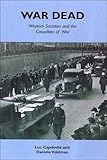
Luc Capdevila, Danièle Voldman, eds. War Dead: Western Societies and the Casualties of War. Edinburgh: Edinburgh University Press, 2006. xix + 200 pp. $130.00 (cloth), ISBN 978-0-7486-2297-9; $40.00 (paper), ISBN 978-0-7486-2298-6.
Reviewed by Monica Black (Furman University)
Published on H-German (January, 2009)
Commissioned by Susan R. Boettcher
A "Western" Way of War Death?
War death, both among soldiers and civilians, and its social impact, have recently been topics of interest to historians across a variety of fields, writing on subjects as disparate as Civil War America, the Soviet Union, twentieth-century Germany, and post-1945 Europe.[1] The history of death--including the procedures of burial; how the living interact with the dead and imagine death and afterlife; and the evolving material culture surrounding the commemoration of the departed--is perhaps as old as humanity. As Luc Capdevila and Danièle Voldman suggest, however, certain historical developments of the nineteenth and twentieth centuries--including the rise of nationalism; racially inspired war and genocide; industrial methods of warfare; aerial bombing; the obscuring of demarcations between home and fighting fronts; mass civilian death in war; and the use and threat of nuclear weapons--have dramatically altered how war death is perceived and memorialized, and have produced new practices for handling the dead.
Rather than examining shifts in the perceptions and practices surrounding war death arising from any one national context or particular conflict, the authors focus instead on trends they see arising in the West, which they define as including western Europe, South America's Southern Cone, and North America. Within this "shared culture" (p. xv), it is the authors' central contention, experiences of war have "interrupt[ed], temporarily though persistently, the slow process which began during the century of the Enlightenment whereby the dead have been removed from the world of the living" (p. 182). The claim that the living want little to do with the dead in the modern West has its roots in the work of such scholars as Geoffrey Gorer and Philippe Ariès.[2] Both argued in the 1960s and 1970s that western society had become alienated from death and tended to suppress grief. Gorer, in particular, famously claimed that, among Britons in the 1960s, death had become so taboo as to be practically a new form of pornography.
With this conceptual framework in mind, Capdevila and Voldman set out to demonstrate how, in point of fact, violent conflict in the twentieth century has continually and inescapably forced the living and the dead together in a variety of ways. The blurring of distinctions between civilian and soldier, coupled with industrial methods of warfare, has produced unprecedented numbers of deaths; yet, the sensibilities of the twentieth century have tended to militate against the use of communal graves (commonplace until the American Civil War in the United States and the Franco-Prussian War in Europe). The living must thus seek carefully to locate and identify the remains of the dead and then to inter them individually, a massive undertaking under the best circumstances. New tools (such as dog tags) have been adopted to facilitate these processes. International legal norms have been developed for the treatment of "enemy" dead, although these norms have not infrequently been honored more in the breach than in the observance, as soldiers and civilians alike engaged in desecrating corpses or hiding the bodies of the dead to prolong the suffering of their enemies. While the vicissitudes of war have sometimes made preserving traditional ritual practices surrounding death impossible, societies have attempted nonetheless to maintain them, even in the heat of battle and as bombs rained down. Lastly, private and governmental associations to foster the remembrance of the war dead of individual nations have emerged; they bring communities together on key holidays to commune with the dead in national cemeteries and other sites of collective memorialization.
The authors' observations and the topics they choose to explore are fascinating and certainly raise many interesting points for discussion. Yet the framework imposed on their study by the assumption that there is an identifiably "western" way of death, that can be generally applied over a great span of time and to many, rather distinctive, cultures, presents some analytical problems. The authors contend, for example, that "the glorification of war has been undermined by the horror of death" (p. 18). One is not sure what to make of this statement in the context of the contemporary United States. Whether or not horror is necessarily associated with war death (itself an arguable point), it would be difficult to maintain that war has lost its glorifying aspects for contemporary U.S. Americans.
The study's generalizing tendencies also result in a lack of differentiation between types of violence, the ideologies that have inspired it, and the ensuing social impact of the deaths associated with that violence. War Dead includes in its analysis the world wars, colonialist warfare, state-sponsored violence against domestic political enemies (as in Argentina and Chile in the 1970s and 1980s), the Holocaust, the American Civil War, and other instances of violence. Yet, the vastly different motivations and justification behind each of these events, in the many societies affected by them, certainly have a role to play in how the deaths associated with them have been and are today viewed. To offer but one example: the notion of sacrificial death and of soldiers' blood "consecrating" the ground where the dead fell--ideas with real currency in Nazi Germany--might in some ways be fruitfully linked across cultures; after all, they are identifiably Christian in motif and origin. But in Nazi Germany, those ideas were used not only to justify but to sanctify mass murder, and that sets them apart from similar ideas that emerged in other places and times. Attending to such differences is important if the history of death has a larger story to tell about the evolving symbolic life of various groups of people; about the construction of their moral, cultural, and social norms; and if it can be used to show us how ideology informs and reshapes the practices of everyday life. In a similar vein, it is difficult to see how can we usefully compare responses to death among the French, Germans, British, and Americans in World War II (which the parameters of the authors' analysis would seem to suggest that we can), given the strikingly different conflicts each of those societies saw themselves involved in, to say nothing of their dramatically different experiences during the war and the widely divergent outcomes each faced after May 1945.
Notes
[1]. Drew Gilpin Faust, This Republic of Suffering: Death and the American Civil War (New York: Knopf, 2008); Catherine Merridale, Ivan's War: Life and Death in the Red Army, 1939-1945 (New York: Metropolitan Books, 2006); Catherine Merridale, Night of Stone: Death and Memory in Twentieth-Century Russia (New York: Viking, 2001); Alon Confino, Paul Betts, and Dirk Schumann, eds., Between Mass Death and Individual Loss: The Place of the Dead in Twentieth-Century Germany (New York: Berghahn, 2008); Monica Black, "The Meaning of Death and the Making of Three Berlins: A History, 1933-1961" (Ph.D. diss., University of Virginia, 2006); and Richard Bessel and Dirk Schumann, eds., Life after Death: Approaches to a Cultural and Social History of Europe during the 1940s and 1950s (Cambridge: Cambridge University Press, 2003).
[2]. Geoffrey Gorer, Death, Grief, and Mourning (Garden City:
Doubleday and Co., 1965); and Philippe Ariès, The Hour of Our Death (New York: Vintage, 1981).
If there is additional discussion of this review, you may access it through the network, at: https://networks.h-net.org/h-german.
Citation:
Monica Black. Review of Capdevila, Luc; Voldman, Danièle; eds., War Dead: Western Societies and the Casualties of War.
H-German, H-Net Reviews.
January, 2009.
URL: http://www.h-net.org/reviews/showrev.php?id=22875
 | This work is licensed under a Creative Commons Attribution-Noncommercial-No Derivative Works 3.0 United States License. |

