



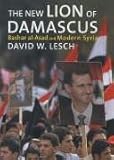
David W. Lesch. New Lion of Damascus, The: Bashar Al-Asad and Modern Syria. New Haven: Yale University Press, 2005. 320 pp. Photographs, map. $35.00 (cloth), ISBN 978-0-300-10991-7.
Reviewed by Curtis Ryan
Published on H-Levant (October, 2008)
Commissioned by Kevin W. Martin (Indiana University - Bloomington)
Same as the Old Boss? Bashar al-Asad and Modern Syria
In The New Lion of Damascus David Lesch, a longtime scholar of Syrian politics, attempts to understand the man at the pinnacle of power in Syria: Bashar al-Asad, the son of the even more enigmatic Hafiz al-Asad. In 2000 Bashar succeeded his father as president of the Syrian Arab Republic, the first such succession in 30 years. The succession from father to son, in an otherwise anti-monarchical and ostensibly socialist republic, was in itself fascinating enough. But the succession was also apparently Plan B for the elder Asad. He had previously groomed his eldest son, Basil, as his successor. Yet Basil’s death in 1994 in a car accident prompted a significant change of plans and opened the way for a very unlikely candidate’s accession to the presidency of Syria.
In this book, Lesch provides a detailed analysis of this succession, and a revealing look at the man who became president. It is an unusual story. Bashar had largely avoided politics and even Ba’th Party membership prior to 1994, opting instead for a career as an ophthalmologist. Previously, his most active public role had been as president of the Syrian Computer Society. In fact, when news of his brother’s death arrived, Bashar was in London studying for his ophthalmology exams. What followed changed his life, to say the least, and has deep implications for the present and future of Syria and the entire Middle East.
In exploring the politics of this succession process and its outcome, Lesch’s book is in many ways the successor to Patrick Seale’s Asad: The Struggle for the Middle East (1989), a study of the presidency of Hafiz al-Asad. And in that light, The New Lion of Damascus features many of the same strengths and weaknesses as Seale’s work. In some circles, both of these books have been judged overly sympathetic to their subjects. But both offer something that no other works can: direct and extensive personal contact with the Syrian president. Lesch acknowledges the problem at the outset of his study. He correctly notes that any scholarly work that is in any way positive regarding Syria or its president is certain to be regarded with suspicion in a field that is highly politicized. However, Lesch states his determination to remain fair and objective as he takes his readers through the corridors of power and into the family home of Syria’s relatively young leader.
Lesch conducted a number of lengthy interviews with Bashar al-Asad, and quotes the president extensively throughout the book. He also interviewed key players in Syrian politics, such as former vice president Abd al-Halim Khaddam, foreign minister Farouk al-Sharaa, government spokesperson Bouthaina Shaaban, and Syria’s ambassador to the United States, Imad Moustapha. In addition to such luminaries, Lesch also interviews other government officials, Bashar’s friends, his ophthalmological teachers and classmates in London, his grade school and secondary school teachers, and his wife, Asma. In the process, Lesch provides a detailed picture of the president’s upbringing, his family life, and a rich sense of his personality and his views on politics, family, exercise (Bashar is a devotee of the latter), and pop music. Indeed, where else would one discover that the Syrian president still lives in the third-floor apartment of the building in which he was raised or that he is a huge fan of the Electric Light Orchestra and other British and American pop and rock bands from the '70s and '80s?
Still, the book is more than a personal biography alone. Rather, Lesch weaves the biographical narrative in and out of the story of modern Syrian politics. The biographical account is therefore supplemented with additional chapters that examine a series of key issues facing the country and the region, including the challenges of domestic reform, as well as Syria’s external relations with the United States, Israel, Lebanon, and pre- and post-invasion Iraq.
The author describes Bashar as extremely humble, unfailingly polite, and self-effacing. Lesch is emphatic that this president is in no way comparable to regional leaders such as the late Saddam Hussein. Instead, Lesch sees in Bashar al-Asad a “combination computer nerd, ophthalmologist, devoted family man, westernized pop-culturist, outgoing and caring friend, humble and reluctant leader, avid photographer, health and fitness advocate, and lurking reformer (who) had all of a sudden become a Middle Eastern dictator” (p. 4).
Yet as early as page 2, Lesch also compares Bashar to Michael Corleone of the Godfather movies, although he does not see Bashar ultimately following the brutal and ruthless lead of the Al Pacino character. Instead, he portrays Bashar as genuine in his desire for reform, but severely constrained not only by an old guard elite (that Bashar is nonetheless gradually pushing aside), but also by weak or useless institutions, endemic corruption, and a managerial class that is not educated to function--much less compete--in the contemporary world economy. Lesch also argues that the seemingly nonstop crises in the region continue to impact Syrian domestic politics, impeding efforts to achieve greater domestic social, economic, and political change.
Lesch sees the current Syrian regime as distinctly different from that of the old “Lion of Damascus,” Hafiz al-Asad. He argues that Bashar does not fit the Corleone, or Machiavellian, or even Hafiz al-Asad model, and instead sees a constrained reformer who needs much more time to change an economic, social, and political system in dire need of overhaul. In his concluding chapter, Lesch compares Bashar to Iran’s ill-fated reformist prime minister Mohammad Mossadegh, who, tellingly, was overthrown in 1953 via a CIA-backed coup. The author’s desire for a different outcome in the contemporary Syrian case is quite evident.
For all its positive interpretation of Bashar’s motivations (if not the effectiveness of his policies thus far), Lesch’s book does not shy away from the many controversial issues surrounding Syrian politics, including such fiascos as the notorious 2005 assassination of Lebanese prime minister Rafiq Hariri. Lesch concludes, however, that it is unlikely that Bashar was involved, but notes that Syrian agents probably were, thereby underscoring the president’s lack of control over parts of the Syrian state.
In explaining Syrian policy, Lesch attempts to balance the record, neither accepting Ba’thist propaganda nor engaging in Syria-bashing. Lesch makes the case for seeing Syrian policy as essentially a kind of hard-nosed realism, but is emphatic that Syria is not comparable to Iran, North Korea, or Iraq. Indeed, “Syria Is Not Iraq” is even the title of one of the book’s chapters.
Despite his book’s title, Lesch ultimately concludes that Bashar is not the “New Lion of Damascus” after all. For those hoping for the kinds of change first envisioned in the so-called Damascus Spring of 2000, that is a good thing. The bad news, on the other hand, is how long all this is sure to take. Lesch often invokes the image of a broken-down automobile to describe the system Bashar inherited, arguing that the “solution may ultimately be not to tune up the engine of the old, broken-down car or replace some parts here and there that will keep the wreck running. Bashar may well have to get a new car” (p. 228). In that same vein, however, Lesch fears that an alternative regime, or a violent, Washington-backed attempt at “regime change,” would be disastrous. For that reason, he insists that “Bashar al-Asad ... is someone with whom we should be engaged, someone whom we should be helping to make sure Syria does not implode” (p. 242). Lesch also notes that Asad and members of his regime feel that they have taken great risks, with no real rewards. This is not just an analytical point, but also a warning. In Lesch’s view, if the United States does not respond positively to signs of moderation from the Bashar al-Asad regime, then Bashar’s “position domestically will be that much more weakened, compelling him to tack in the direction of confrontation in order to shore up the base of his regime” (p. 175).
Since the publication of The New Lion of Damascus, a number of dramatic events have occurred: Bashar’s reelection by plebiscite to a second seven-year term, the ouster of longtime vice president Khaddam (who then joined the exile opposition movement), and Israel’s 2006 war with Hizbullah in Lebanon. If anything, these dramatic regional changes only make the book, and especially its close inside look at an influential Middle East leader, that much more important and compelling. Even for those that find Lesch too sympathetic to his subject, the book remains a vital source of--in effect--insider analysis, but from a distinctly careful and scholarly perspective.
Overall this is a very well-written book, and flows easily for the reader, making it useful not just for scholars and policymakers interested in a key leader and important country in Middle East politics, but also for advanced undergraduates and graduate students in courses on the comparative politics or international relations of the region. In each of these contexts, the book is sure to generate lively debate.
If there is additional discussion of this review, you may access it through the network, at: https://networks.h-net.org/h-levant.
Citation:
Curtis Ryan. Review of Lesch, David W., New Lion of Damascus, The: Bashar Al-Asad and Modern Syria.
H-Levant, H-Net Reviews.
October, 2008.
URL: http://www.h-net.org/reviews/showrev.php?id=22840
 | This work is licensed under a Creative Commons Attribution-Noncommercial-No Derivative Works 3.0 United States License. |

