



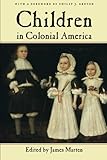
James Alan Marten. Children in Colonial America. New York: New York University Press, 2007. xiii + 253 pp. $71.00 (cloth), ISBN 978-0-8147-5715-4; $22.00 (paper), ISBN 978-0-8147-5716-1.
Reviewed by Gail Murray
Published on H-Childhood (October, 2008)
Commissioned by Patrick J. Ryan (University of Western Ontario)
Not Just Little Adults
Understanding colonial America’s children as something other than the “little adults” of eighteenth-century portraiture has come a long way since Karen Calvert first taught scholars about the material culture of childhood in Children in the House (1992). James Alan Marten is one of the scholars most responsible for the heightened interest in the history of childhood. Not only has he published widely in the area (see, for example, The Children’s Civil War [1998]; an edited anthology, Children and War [2002]; Childhood and Child Welfare in the Progressive Era [2004]; and Children for the Union [2004]), but he has also served as secretary and treasurer for the Society for the History of Children and Youth. Most recently, he has recruited editors and authors for a new series, Children and Youth in America, that highlights the most recent and imaginative scholarship in this fast-growing, international field. In the collection under review, Marten has compiled a highly readable set of short, original essays about child life and child rearing in a variety of North American locales and cultures. Short primary documents accompany each section. Clearly designed for the advanced high school or college classroom, instructors in colonial American history will find many essays to supplement discussions of family life, ethnic diversity, and early education. Those who teach the history of childhood will rejoice that they can move beyond the handful of aging classics on childhood in early America to explore new terrain, such as sibling rivalries, youth in the American Revolution, and the attempts to assimilate New England’s Indian children.
The collection begins with a graceful introduction by Philip Greven, whose The Protestant Temperament ( 1977) was one of the first to use child rearing to explore personality formation and to launch serious inquiry into children’s experiences as a valid subject for historical inquiry. Marten’s own introduction provides a mini-historiographical lesson and also acquaints the reader with scholarly debate between those who focus on the construction of childhood as an idealized category and those who study children as historical actors. The contributor essays that follow are grouped into four sections, each of which has a chronological and thematic coherence.
Like many collections, the quality of the essays is uneven: some contain all the detail and notes of a dissertation, while others summarize secondary literature. The strength of the collection, however, is the way it expands one’s thinking about colonial America, a society dominated numerically by those under the age of twenty. Particularly strong in this regard is John Navins’s study of the English “pilgrim” children who moved with their families first to Holland and then to Plymouth Plantation. “Sickness, deprivation, and staggering mortality affected every child who sailed on the Mayflower,” writes Navin, and the gender imbalance in Plymouth meant that female children had almost no adolescence before being married off (p. 131).
Marten took care to include studies of the mix of peoples populating colonial America. The section on “Race and Colonization” includes essays on the lives of Indian children in Spanish colonial Mexico, Indian children as objects of proselytizing and assimilation in New England, and enslaved children in British Jamaica. Mariah Adin’s essay explores how court records in New Amsterdam reveal the Dutch colonial struggle to construct the meaning of childhood in a new and threatening environment. Primary documents that reinforce the ethnic variety of voices include Edward Winslow on Indian parenting and Venture Smith on his capture in Guinea and the middle passage.
More familiar British-American childhoods also receive creative and provocative analysis, as in J. L. Bells’s “From Saucy Boys to Sons of Liberty” and Darcy R. Fryer’s exploration of “Growing Up Rich in 18th Century South Carolina." The latter argues that even well-off parents insisted that children contribute to the financial success of the household by making copies of business letters, supervising the dairy or kitchen garden, tutoring younger siblings, and acting as couriers to the nearest town or plantation. Keith Pacholl’s essay on advice literature in eighteenth-century newspapers and periodicals covers well-trod ground in the history of childhood, yet it reminds the reader of how each generation seeks to inculcate its understanding of “virtue” and practical learning through literature written for children. Supporting documents on British American childhood include letters from Eliza Lucas, who inherited plantation management at age fifteen, Philip Fithian’s description of the Carter children whom he tutored, and autobiographical writings of both Benjamin Franklin and John Barnard.
The collection could have profited from including the rich work being done in the history of Canadian children and some of the essays (only ten-fourteen pages) are too brief to convey much information. However, as a whole, these twelve brief essays and seven documents provide a student-friendly introduction to the history of childhood in much of colonial America. Specialists as well will find intriguing new ways of thinking about the colonial experience and the ways it shaped the adults of the revolutionary and postrevolutionary America. The essays might evoke from the reader a greater appreciation of the constructed nature of childhood and its persistent and/or malleable characteristics. Marten is to be commended for conceptualizing the series and spearheading the appearance of this first title in that series.
If there is additional discussion of this review, you may access it through the network, at: https://networks.h-net.org/h-childhood.
Citation:
Gail Murray. Review of Marten, James Alan, Children in Colonial America.
H-Childhood, H-Net Reviews.
October, 2008.
URL: http://www.h-net.org/reviews/showrev.php?id=22828
 | This work is licensed under a Creative Commons Attribution-Noncommercial-No Derivative Works 3.0 United States License. |

